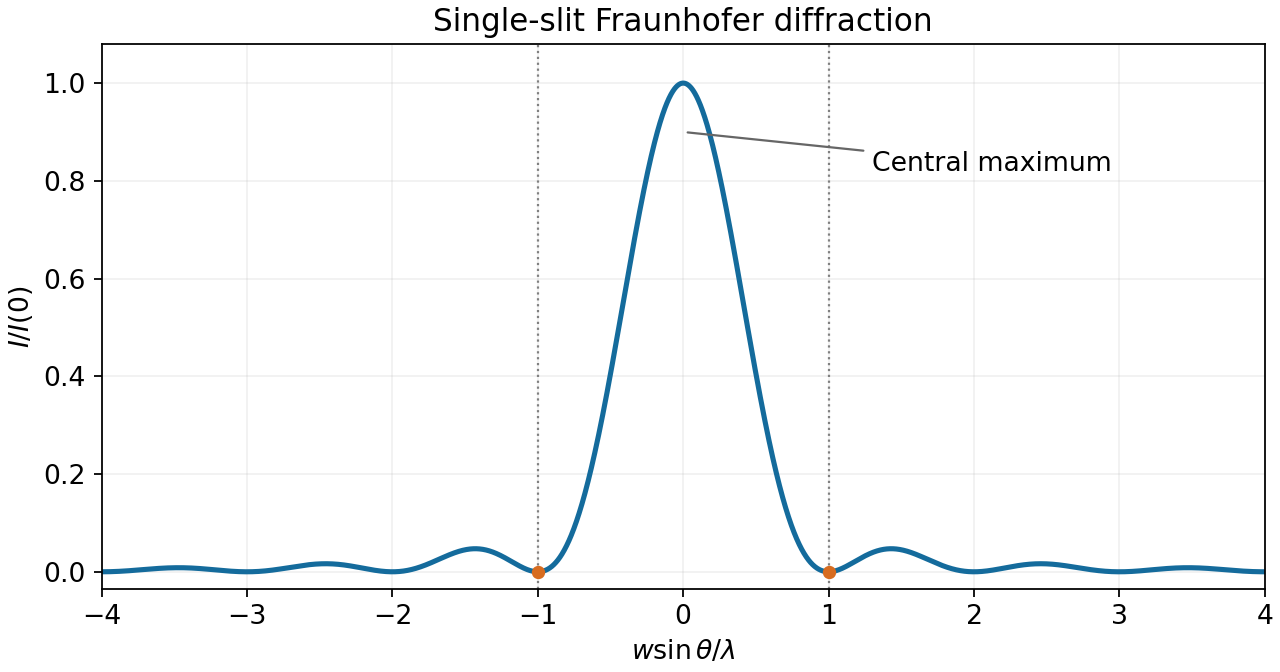
In the Fraunhofer approximation, contributions from positions across the slit have relative phase . With uniform illumination, the field relative to its axial value isThus the single-slit diffraction intensity isOn the detector ; near the axis, . The central maximum takes the continuous limit , and the minima satisfy for nonzero integers . The stated far-field condition justifies adding the aperture contributions with a linear phase.
The first single-slit minimum is at , so the characteristic angular resolution of an aperture of width is of order . With m, nm, and distance m, this slit-based estimate isFor the actual circular lens, the Rayleigh criterion uses the first zero of the Airy disk, . It gives rad and a resolved separation of about m. The factor belongs to the circular aperture, not to the one-dimensional slit derivation.

For normal incidence, adjacent grating lines have optical path difference . Constructive interference at order requires . Differentiating at fixed yields the angular dispersionIt is zero in the zero order and increases in magnitude toward grazing diffraction. An order exists only if . The number of illuminated lines controls peak width and resolving power, but does not alter this angle-versus-wavelength relation.
Articles by others on the same topic
There are currently no matching articles.