Source paper: Oxford source archive, member
2013/CP2_Sept_2013c.pdf. The cover prints “Tuesday 11 September 2013”; its weekday and calendar date disagree, and that source wording is retained here. All ten questions and all printed Roman subparts are treated.The magnetic Lorentz force isSince the given velocity is perpendicular to the magnetic flux density, its magnitude is . Its direction follows the vector product for positive charge and reverses for negative charge.
The instantaneous power delivered by the magnetic field isTherefore over any part of the orbit. The magnetic force changes direction of motion but leaves the speed and kinetic energy constant.
Let be the initial position, , and , including the sign of . Solving givesThusThe locus is a circle in the plane perpendicular to , centred at , withThis also follows by equating the magnetic force to the centripetal force. The nonrelativistic angular frequency is .
Place charges and on the inner and outer conductors. In the vacuum gap, Gauss's law gives . Their electric potential difference isConsequently the spherical capacitor hasFor a narrow gap , this approaches , the local parallel-plate approximation. For , it becomes the capacitance of an isolated sphere.
In the linear inverting amplifier, the non-inverting terminal is grounded and negative feedback connects the output to the inverting terminal. For large open-loop gain , ; a finite unsaturated output therefore requires . ThusThis is a virtual ground: it has approximately ground potential, but it is not a conducting connection to ground. The ideal operational amplifier draws no input current, so input current flows through the feedback resistor. Saturation, loss of feedback, or insufficient bandwidth invalidates the approximation.
An external source sees the input resistor between its terminal and the virtual ground. The input current is , soThe infinite input resistance of the ideal operational amplifier itself is distinct from the finite input resistance of the complete inverting amplifier. Negative feedback makes the output approach an ideal voltage source; a real amplifier retains a small nonzero output resistance.
Assume a converging thin lens with , a real object, and a real image on the detector. For positive object and image distances , the thin lens equation gives . Put . ThenSince , , with equality at . ThereforeBelow this separation no real conjugate pair exists for one ideal thin lens; a diverging lens alone cannot form a real image of a real object on the detector.
Faraday's law statesfor a stationary loop, with and consistent contour and area orientations. The minus sign expresses Lenz's law: the induced response opposes the change of magnetic flux. An emf can exist across an open loop even when no conduction current flows.
Choose the loop normal along . Rotation about gives , so the linked magnetic flux is . ThereforeThe sign uses the contour orientation associated with . For the small open gap, this is the corresponding open-circuit terminal emf, with the stated terminal ordering. The tangential induced electric field is nonconservative, so its circulation is not the integral of a single-valued electrostatic potential gradient.
If closes the break, a conduction current flows and electrical energy is dissipated. When loop self-inductance is negligible,The externally imposed flux-change emf remains the same. If self-inductance matters, the current instead satisfies ; its steady amplitude is and it lags the emf by . If the break remains open after inserting a resistor elsewhere in series, the loop is still open and the conduction current remains zero.
Use positive current in the charging direction and passive voltage drops across . The five ideal elements obeyThe battery maintains its emf independently of current. An ideal open switch has with its voltage unconstrained; an ideal closed switch has with its current unconstrained. These statements are the switch's piecewise current-voltage relation. Inductor current continuity and capacitor-voltage continuity hold when no impulse voltage or current is imposed.
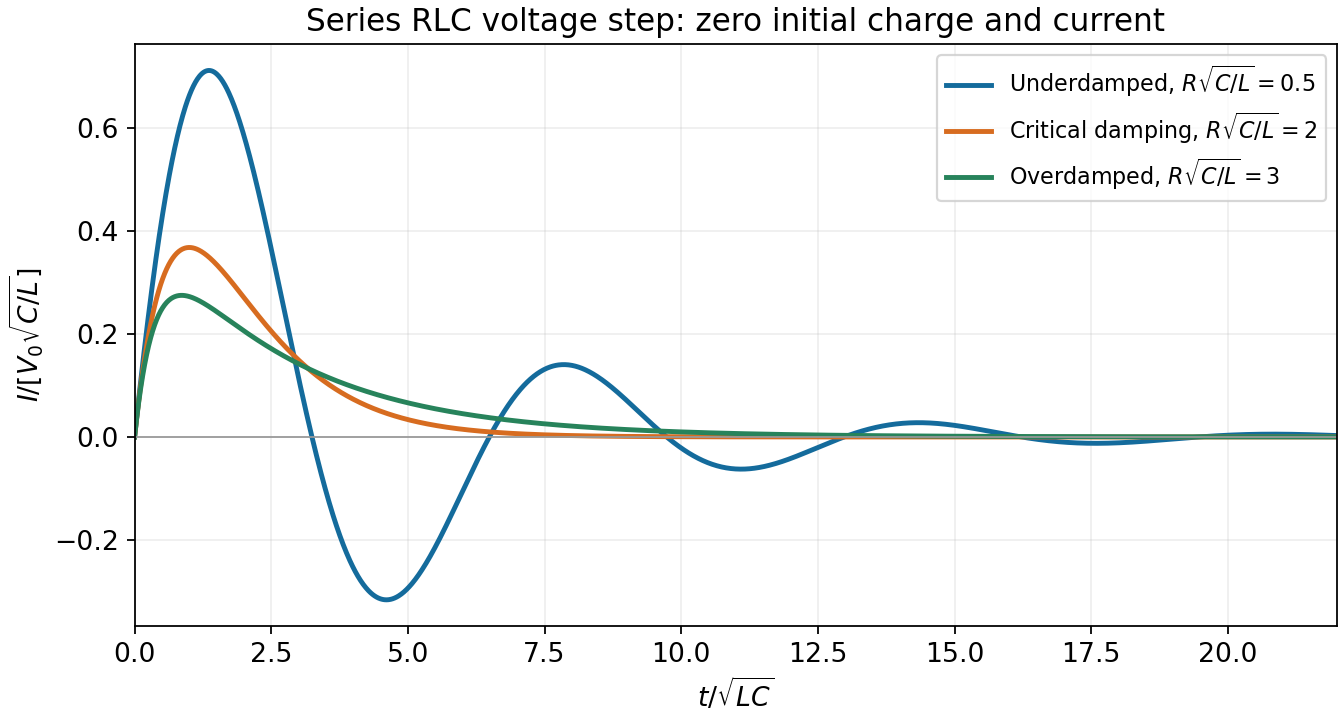
For an initially uncharged capacitor and zero initial current, Kirchhoff's voltage law is , with . LetDifferentiating the circuit equation at gives , while the original equation fixes and . The underdamped response isFor critical damping, , its limit is . For overdamping, put and obtain . These forms cover every positive .
The source does not explicitly specify the capacitor's initial charge. If its initial voltage is , replace in the numerators by ; an open switch alone does not discharge a capacitor. The boxed expression uses the usual uncharged initial condition.

Put at , at , and at , with . For a nonzero test charge, the force vanishes when the electric field vanishes:For equal-sign nonzero , take the positive square root . The distances are positive, so andFor the zero moves toward the weaker charge ; equal charges give .
With , both field contributions between the charges point the same way. Their signed force on isSince is dimensionless, the small-displacement expansion is , givingThe force at the midpoint is nonzero and the first variation is quadratic, not linear. In particular, the midpoint is not an equilibrium supporting a linear restoring-force approximation. The printed comparison of with is dimensionally inconsistent; the expansion above keeps their distinct roles.
Here and . The part of the electrostatic potential energy that changes isAt the two endpoints, and . The fixed-source interaction energy is unchanged, and conservation of energy givesThe force points toward increasing throughout this interval: the left charge repels and the right charge attracts it, so release from rest reaches the stated endpoint without a turning point.
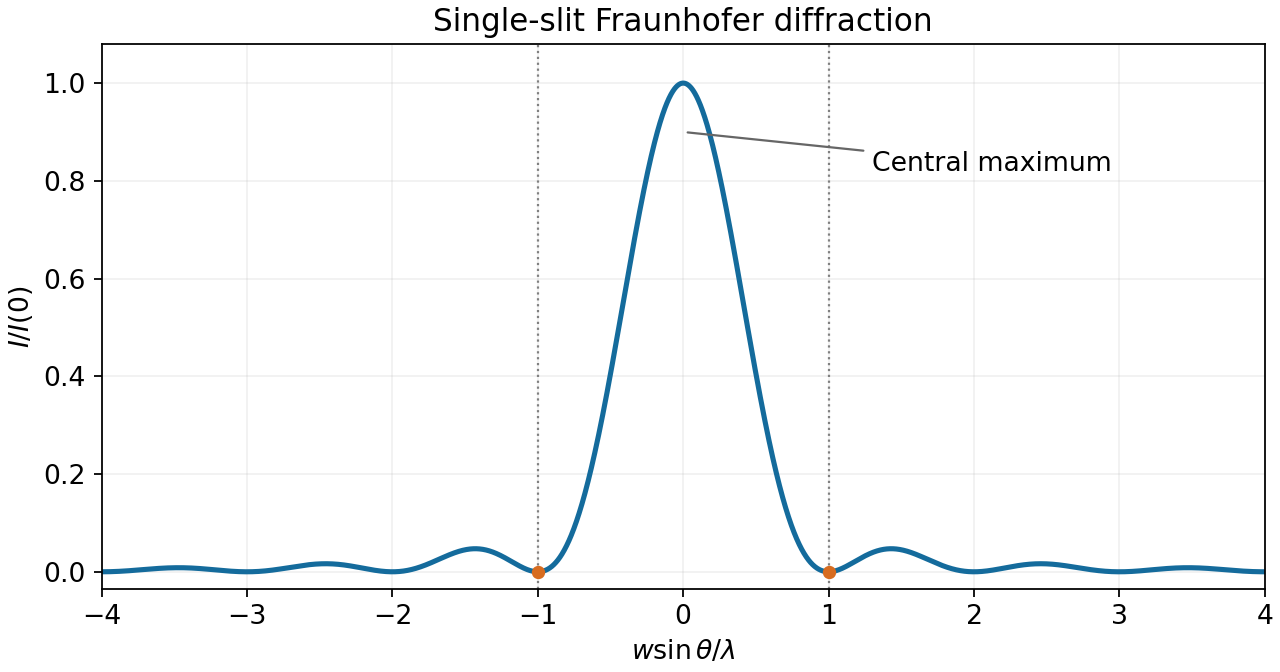
In the Fraunhofer approximation, contributions from positions across the slit have relative phase . With uniform illumination, the field relative to its axial value isThus the single-slit diffraction intensity isOn the detector ; near the axis, . The central maximum takes the continuous limit , and the minima satisfy for nonzero integers . The stated far-field condition justifies adding the aperture contributions with a linear phase.
The first single-slit minimum is at , so the characteristic angular resolution of an aperture of width is of order . With m, nm, and distance m, this slit-based estimate isFor the actual circular lens, the Rayleigh criterion uses the first zero of the Airy disk, . It gives rad and a resolved separation of about m. The factor belongs to the circular aperture, not to the one-dimensional slit derivation.

For normal incidence, adjacent grating lines have optical path difference . Constructive interference at order requires . Differentiating at fixed yields the angular dispersionIt is zero in the zero order and increases in magnitude toward grazing diffraction. An order exists only if . The number of illuminated lines controls peak width and resolving power, but does not alter this angle-versus-wavelength relation.
Let be the tube cross-section. A long uniformly wound solenoid with total turns has field , approximately uniform inside and negligible outside. Therefore the flux through one cross-section, or one turn of either coil, isThe linked flux of coil A is ; that of coil B is . Distinguishing flux from flux linkage prevents an extra factor of the turn count.
For chosen positive terminal currents, define self-inductance by the coil's own flux linkage and mutual inductance by when only coil A carries current. With matching winding directions and terminal references,The reciprocal flux-linkage relation gives the same from B to A, and in this ideal fully coupled long-solenoid limit. The induced emf is ; passive terminal voltage drops use the opposite sign, and similarly for B.
Reversing one winding reverses its signed coupling to the other, while its self-inductance is unchanged. With the same north-to-south current references,Equal currents then produce opposing magnetic fields: the signed axial field is proportional to , rather than . Which direction is positive must be fixed by the right-hand rule and the actual winding orientation.
Let be the northward component of the ambient magnetic field. Define if positive north-to-south current in A produces a northward field, and otherwise. With opposite windings and the same signed current in both,A compass reverses only when this northward component becomes negative. For current chosen to make the coil field southward,At equality the ideal axial field is zero and the needle has no preferred axial direction. If , the opposing coil fields cancel and no finite current reverses it in this model. A numerical threshold cannot be given without and the coil parameters.
Use north-minus-south terminal voltages for both oppositely wound coils, with coil A measured at high input impedance so its AC current is zero. Then and , with . HenceThe magnitude is the turns ratio times the drive, and these terminal references give a phase reversal. Reversing one voltmeter lead reverses the displayed sign. A fixed DC bias in A does not change this incremental result, while short-circuiting A would require solving both coupled current equations.
Use sinusoidal phasors, . Differentiation becomes multiplication by , so the time-dependent element laws reduce to algebraic complex impedances:Then encodes both amplitude ratio and voltage-current phase difference . Series impedances add, while parallel admittances add. This applies to linear sinusoidal steady state; switching transients are separate homogeneous solutions.
The source figure has a series capacitor followed by in parallel with . Its complex impedance isThe imaginary part vanishes at a finite positive frequency only if , in which caseAt that frequency, substituting into the real part givesIf , no finite positive-frequency cancellation exists; the impedance merely tends toward its high-frequency limit.
The parameters satisfy , andThus the source current is A RMS. The ideal reactive elements dissipate no average power, so all mean input power is lost in :The source's instantaneous input power also has maximum W because its total current is in phase with its voltage, although its power maximum need not occur at the resistor's power maximum: the reactive elements exchange stored energy.
Articles by others on the same topic
There are currently no matching articles.