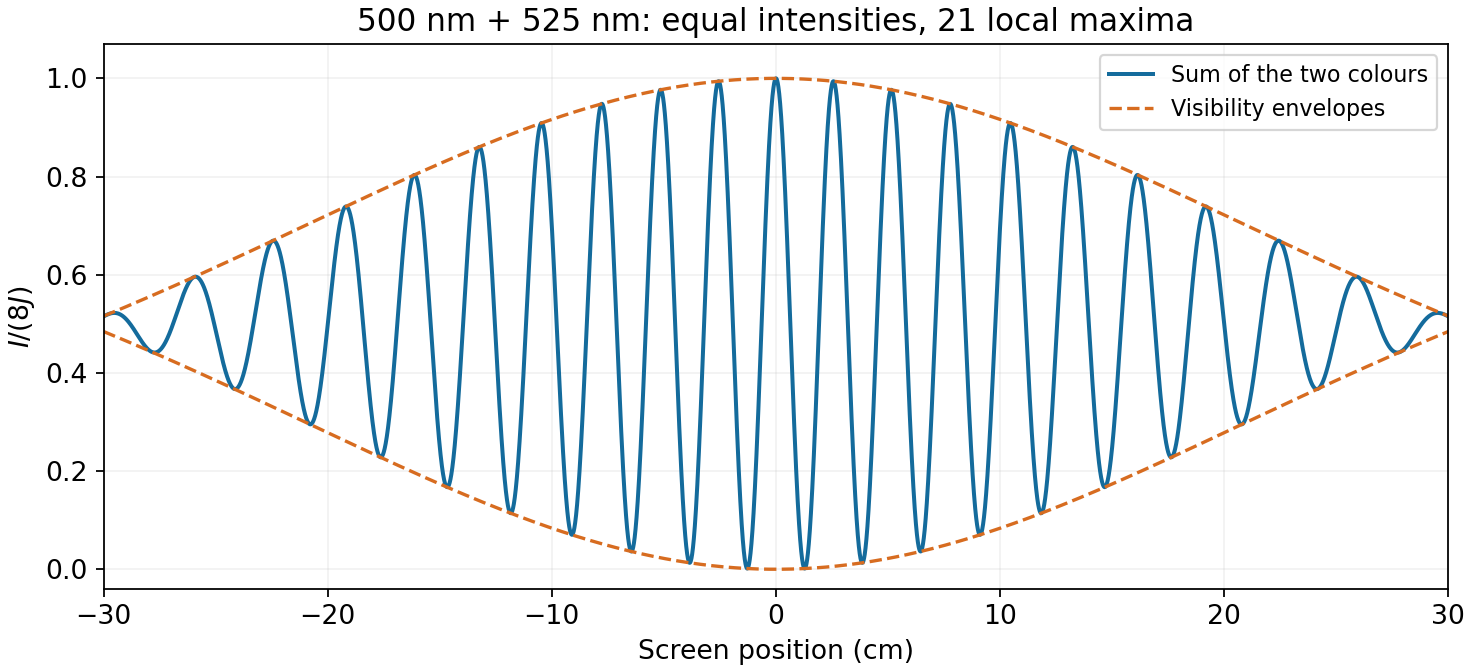
Let be the single-slit intensities at the two wavelengths. At a screen position , the path difference is approximately , with . Fields from the two slits interfere at each wavelength, while a detector averaging over the optical beat period adds the intensities of the two distinct wavelengths:For equal single-slit intensities , define and . ThenThe first cosine gives the interference visibility envelope. Near the centre one may further replace by . The formula neglects unspecified single-slit envelopes and the slow change of single-slit intensity across the screen.
For the centred screen, m. Retaining the screen-angle geometry givesThere are about carrier orders on each side. With equal spectral intensities, direct extrema of the intensity formula giveTheir contrast declines toward the edges: the first equal-intensity visibility zero occurs at , just beyond the screen's limit. Edge visibility is only about , so fewer fringes may be discernible at a practical contrast threshold.
The screen reaches , where a paraxial conversion of its full width is inaccurate. Also, wavelength-independent detector sensitivity does not itself establish equal source intensities. The boxed count specifies the usual equal-intensity idealization; without spectral weights and a visibility threshold, a unique experimental count is not fixed.

Articles by others on the same topic
There are currently no matching articles.