Source paper: Oxford source archive, member
2013/cp2_june_2013_final.pdf. The cover dates this ordinary sitting to Tuesday 4 June 2013. All eleven questions are treated. Unlettered marked blocks use ordinal subparts; printed Roman subparts are retained.Newton's second law applies separately to each body's total force: zero force on means zero acceleration of , while a nonzero force on a free gives nonzero acceleration of . It does not assert that those two forces must be equal and opposite.
The conducting shell is a third interacting body. Its induced surface charges shield the cavity from the external charge, while charges on its outer surface can still exert a force on . Reaction forces act on the shell and, if it is held fixed, on its supports. In the electrostatic limit the force balance of the complete isolated charge–shell system is . Thus the given situation is consistent with both Newton's second law and Newton's third law once the shell is included.
Shielding removes the cavity field due to external charges; it does not generally remove the force of the inner surface charges induced by an off-centre . Zero total force on is an additional condition, satisfied for example when it is at the centre of a spherical cavity.
The electric field is force per unit positive stationary test charge, in the limit that the test charge does not disturb the source:The magnetic flux density is defined by the velocity-dependent part of the Lorentz force, . Equivalently, a straight current element in a uniform field experienceswhich fixes its magnitude and right-hand-rule direction by force measurements with different current orientations.
For a point charge , Coulomb's law gives . The flux through an oriented surface element isHere is its signed solid angle seen from the charge. A closed surface subtends total oriented solid angle for a point inside and zero for a point outside. Thus the flux of each inside charge is and each outside charge has zero net flux. By superposition,This is Gauss's law; a surface passing through a point-charge singularity is excluded.
In classical Maxwell's equations, electric charge is a source or sink of the electric field, so in vacuum can be nonzero. There is no magnetic-charge source in the same theory: Gauss's law for magnetism is . Magnetic flux entering a closed surface equals the flux leaving it. A magnetic dipole has both polarities; it is not an isolated magnetic monopole.
Let be the single-slit intensities at the two wavelengths. At a screen position , the path difference is approximately , with . Fields from the two slits interfere at each wavelength, while a detector averaging over the optical beat period adds the intensities of the two distinct wavelengths:For equal single-slit intensities , define and . ThenThe first cosine gives the interference visibility envelope. Near the centre one may further replace by . The formula neglects unspecified single-slit envelopes and the slow change of single-slit intensity across the screen.
For the centred screen, m. Retaining the screen-angle geometry givesThere are about carrier orders on each side. With equal spectral intensities, direct extrema of the intensity formula giveTheir contrast declines toward the edges: the first equal-intensity visibility zero occurs at , just beyond the screen's limit. Edge visibility is only about , so fewer fringes may be discernible at a practical contrast threshold.
The screen reaches , where a paraxial conversion of its full width is inaccurate. Also, wavelength-independent detector sensitivity does not itself establish equal source intensities. The boxed count specifies the usual equal-intensity idealization; without spectral weights and a visibility threshold, a unique experimental count is not fixed.
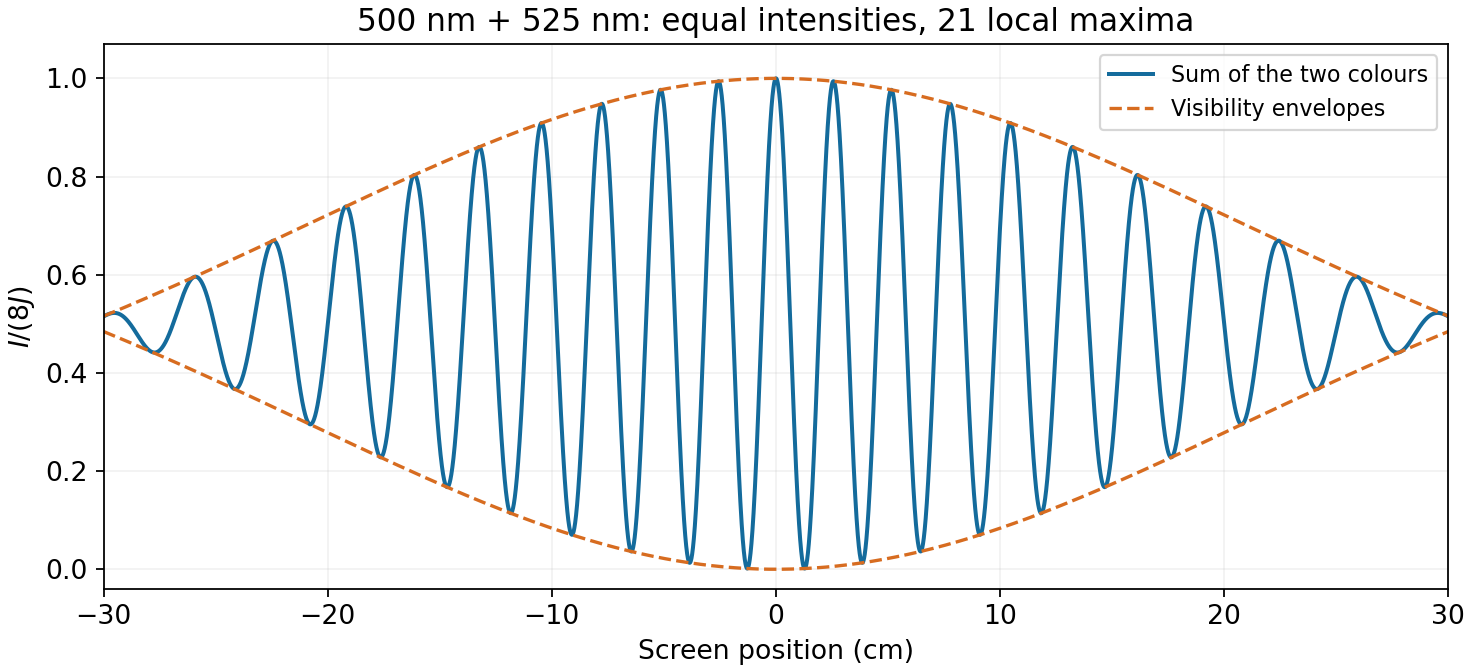
Two-colour double-slit fringes across the stated 60 cm screen
. Equal intensities at 500 and 525 nm are added incoherently between colours. The actual screen-angle geometry gives 21 local maxima, with low contrast near the edges. Details.
Take B as reference and define positive source current upward into the upper internal node; the source symbol does not specify an arrow, so this definition fixes its sign. With A open, no current flows through the upper series resistor. The shunt resistor therefore has voltage , and the battery's longer plate is on the right, adding toward A. ThusDeactivate the independent sources: open the ideal current source and short the ideal voltage source. The two resistors then lie in series between A and B, givingThe Thévenin equivalent is a source in series with , positive toward A. If is instead defined downward, replace by ; the resistance is unchanged.
The ideal voltage source drives a series –– branch and a separate resistor in parallel. At , the series branch is purely resistive, so its peak current is . Its stored energies areTheir sum is constant in sinusoidal steady state, with value . Each resistor dissipates average power , including the resistor directly across the source. Over one cycle,Omitting the parallel resistor would double this ratio. The expression concerns the driven steady state, not a switch-on transient.
The upper positive plate gives a downward field , while points into the page. For a rightward electron, the electric force is upward and the magnetic force downward. Its initial speed isThese are equal to the precision intended by the rounded plate spacing: the arrangement is a velocity selector. Accordingly,It is not appropriate to calculate a large electric deflection and ignore magnetic bending. For completeness, if all printed values are treated literally, let , , and . The exact nonrelativistic crossed-field motion iswith and . At the exit solve m, then use . The small rounding mismatch produces nanometre-scale oscillations, with rad. Its precise oscillatory exit angle is not robust to the supplied rounding.
In uniform fields, a rigid neutral electric dipole with both charges moving at the selected common velocity has zero net translational force. To leading nonrelativistic order its torque is , which also vanishes at the velocity-selector condition. Thus it continues undeflected and, initially nonrotating, does not start rotating in the ideal balanced fields. An unbalanced effective field could exert a torque; the dipole orientation is not otherwise specified.
Ground the non-inverting input and take the ideal operational amplifier in stable, unsaturated negative feedback. Its inverting input is a virtual ground and draws no current. Kirchhoff's current law there givesThe minus sign is the phase inversion of the inverting amplifier.
The input source supplies into the virtual ground, so the complete circuit's input resistance is . The ideal output is a zero-resistance controlled voltage source:These are properties of the closed-loop circuit, distinct from the infinite input resistance of the amplifier terminals themselves.
With , the output and input voltage magnitudes are equal. The signal power supplied at the input is , while the load receives . HenceThis is dB of power gain into the specified load. Output energy comes from the amplifier's supply rails; unity voltage-gain magnitude does not imply unity power gain. Dissipation in the feedback resistor is additional to the specified load power.
Replace the feedback resistor by a capacitor , retaining the input resistor . The virtual ground makes the input charge flow onto the feedback capacitor rather than into the ideal amplifier. Integrating its current givesIf the calorimeter delivers for deposited energy , then . A reset establishes the initial output; a practical large resistor across limits long-time drift, but is omitted from the ideal integration interval.
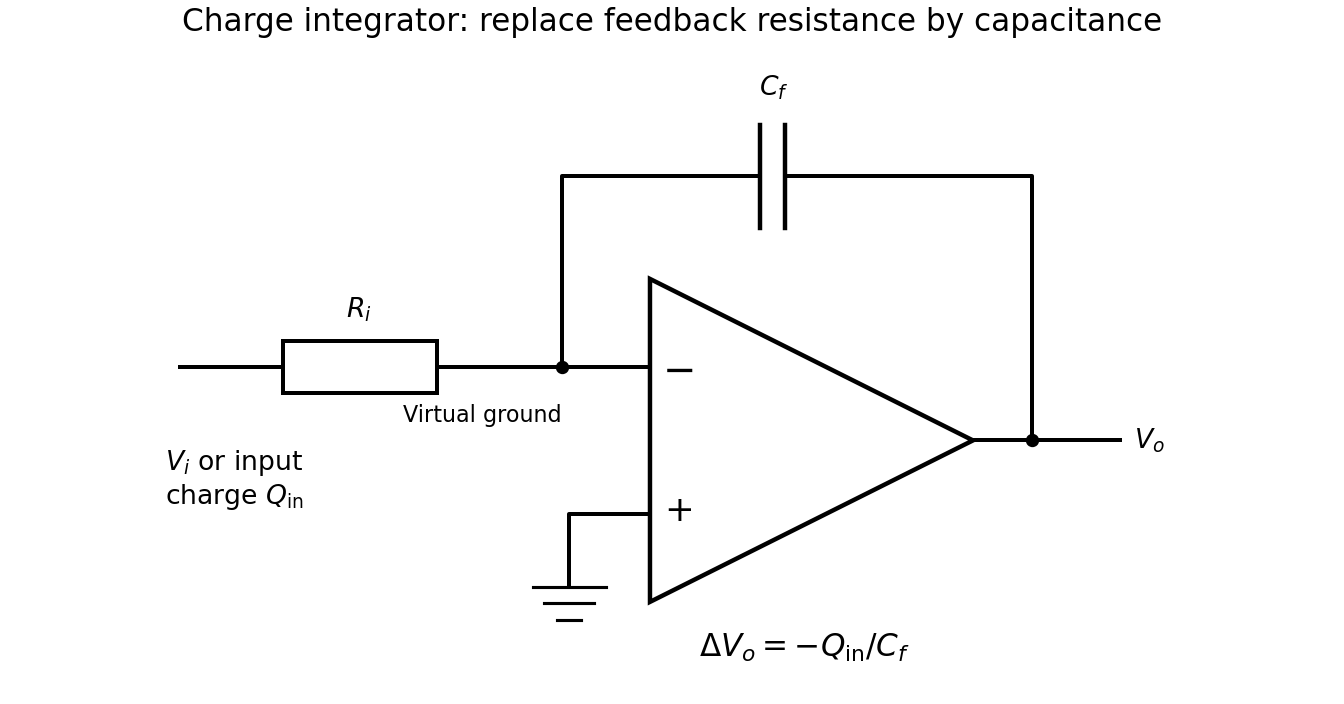

For the modified circuit, and . With ,The sinusoidal component has amplitude and leads the cosine input by ; the constant is set by the initial capacitor charge. This assumes the output remains within the amplifier's linear range.
Fermat's principle says that the travel time, or equivalently the optical path length, is stationary under small path variations at fixed endpoints. For a flat interface, let the ray cross at horizontal coordinate , with source and detector at heights and horizontal separation . Apart from , its travel time isSetting givesThe angles are measured to the normal. This is Snell's law; “least time” is more generally a stationarity condition.
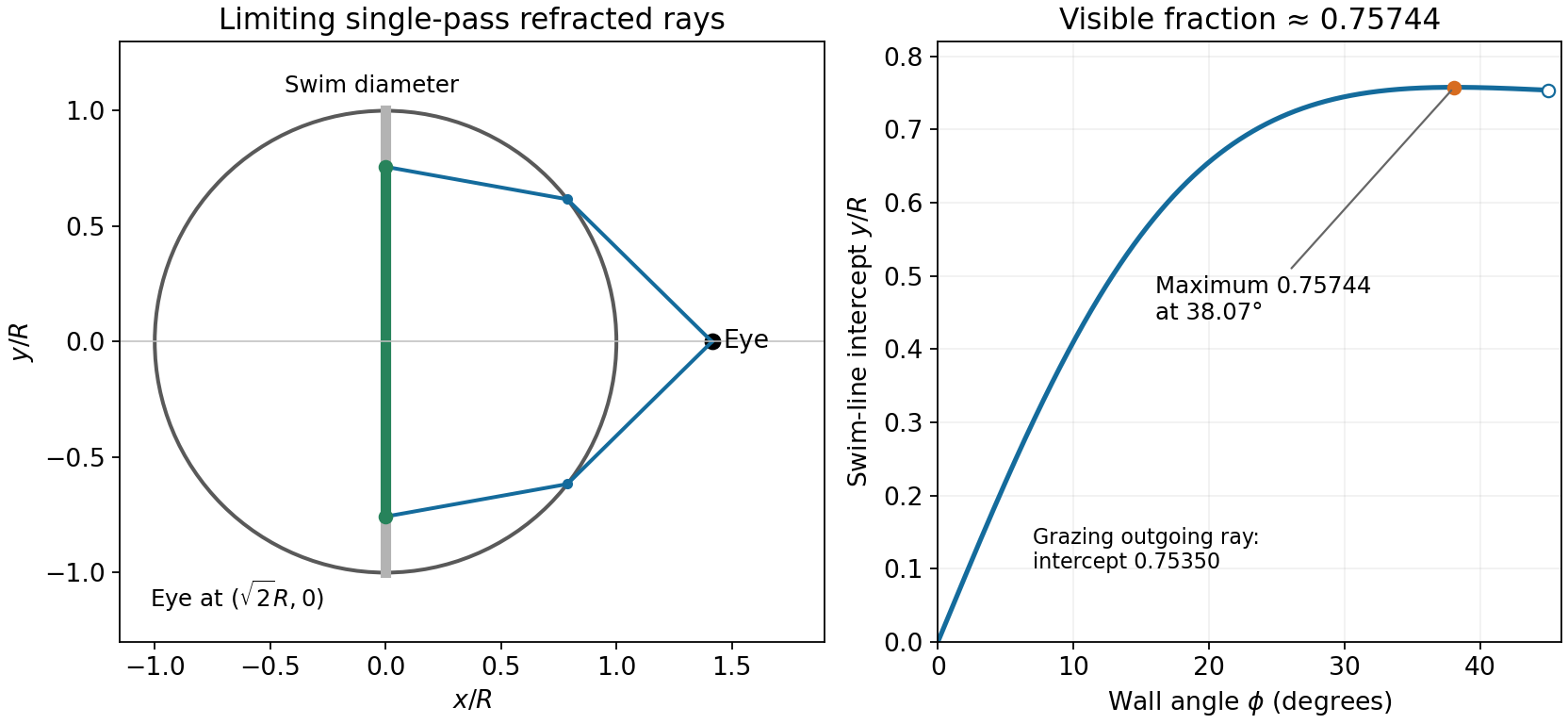
Take a horizontal cross-section in units of . The eye is at , and the tadpole swims along the perpendicular diameter shown in the source. Since glass and water have the same red-light index, their internal interface causes no red-light refraction. Write an exit point on the circular wall as . An unobstructed outward ray to the eye has .
For , let be the magnitude of the emerging ray's angle to the outward normal and its internal angle. Geometry and Snell's law giveThe outgoing internal ray makes angle to . Its backward continuation intersects the swim diameter atThe directly visible positive endpoint is the largest such intercept, including all single-pass refracted rays. Maximizing this one-variable expression gives and . By symmetry the visible length is , soChecking only the grazing exit at gives , a close estimate but a slightly smaller fraction. The exact limiting ray occurs before that grazing ray, where two refracted paths merge at a caustic. This is a geometrical, single-pass visibility boundary; finite pupil size and detection thresholds would smooth the transition.

The result need not be the same. Optical dispersion changes the refractive index with wavelength. Under normal dispersion, the blue-light index is larger, changing the refracted rays and generally reducing the visible fraction in the one-interface model. The blue indices of both water and glass are not specified; they may also differ from each other, introducing refraction at their interface. Thus no unique numerical blue-light fraction follows from the red-light value alone.
For near-normal viewing through the flat top surface, the refracted ray appears to originate at an apparent depth . A ray at horizontal offset has , and Snell's law gives . In the paraxial limit,At an oblique viewing angle the exact ray-based apparent depth is ; the simple ratio presumes the usual near-normal top view.
Let the wire lie along , and observe at perpendicular distance . In the Biot-Savart law, the azimuthal contributions from line elements add with magnitudeIndependently, cylindrical symmetry makes the field constant and azimuthal on a circular Amperian loop, so Ampère's law gives . Both yieldwith direction fixed by the right-hand rule.
For a thin current-carrying cylindrical shell, a coaxial Amperian loop encloses zero current inside and the entire current outside. HenceMore generally for and for . The tangential field discontinuity is supported by the surface current.
Let the column radius be , and be its uniform axial current density. Treating it as concentric shells, only the current at radii below contributes to : a surrounding shell has zero interior field. ThusThe magnetic force density is radially inward, . Radial mechanical equilibrium at a fixed height requiresConsequentlyThe pressure is higher at the centre: its outward force balances the inward magnetic pinch. Vertical hydrostatic variation is separate from this radial pressure difference.
Ignoring edge fields, Gauss's law gives between the parallel plates. Their voltage is , and their charge magnitude is . Therefore
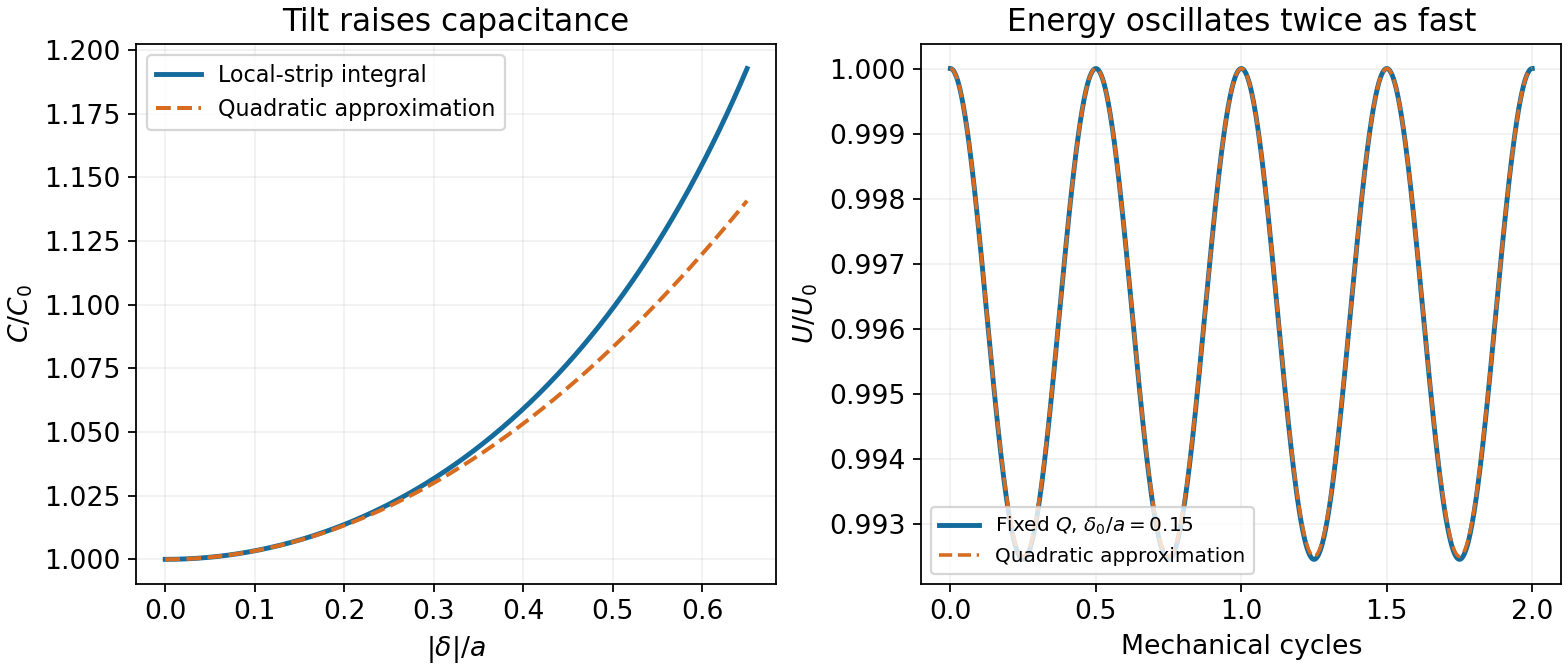
Take along the tilt, with local separation . Since and the tilt is small, each narrow strip is a local parallel-plate capacitor at the same voltage . Its surface charge densities are approximatelyParallel strip capacitances add, so for ,Using givesThe denser charge at the smaller gap explains why tilting increases the capacitance. The local-strip approximation neglects fringing and slope corrections of order , smaller than the retained term.
Isolation fixes charge, not voltage: . The electrostatic energy is therefore . Inverting the small-tilt capacitance givesThe leading variation has frequency , since tilts of opposite sign give the same capacitance. With , the result is to this order. Energy decreases as the gap becomes less uniform at fixed charge; the difference is exchanged mechanically with the oscillator.

Articles by others on the same topic
There are currently no matching articles.