The adjacent-corner resistance of a resistor cube follows from Kirchhoff's current law and cube symmetries. Hold adjacent corners and at potentials and zero. The two corners have a common potential ; their neighbours have . Write the remaining two potentials as .
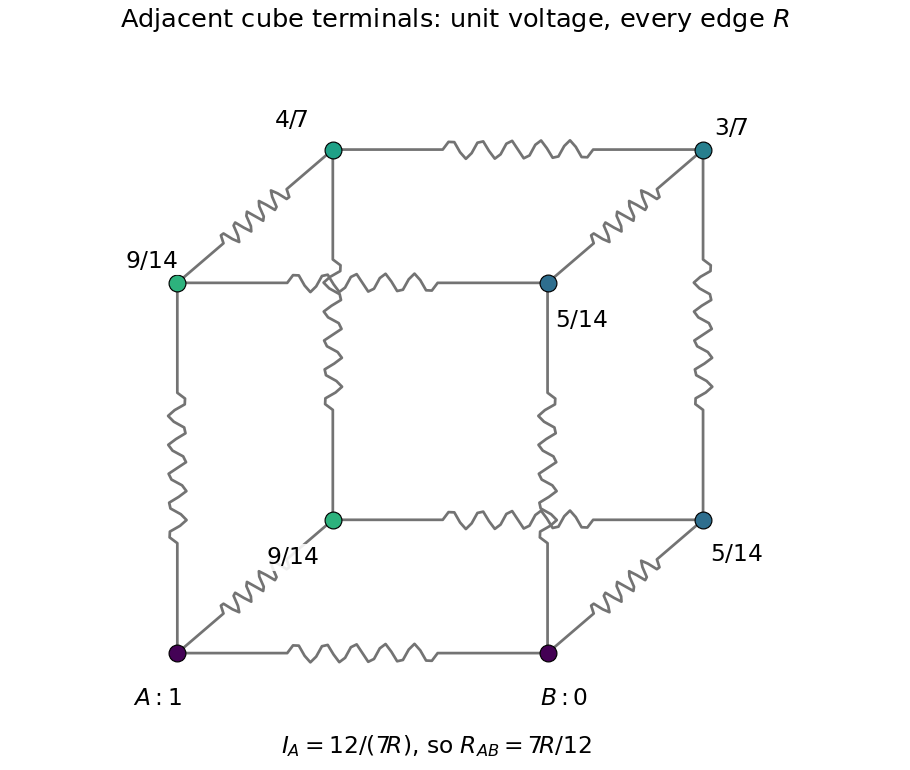
At a corner of the first pair and at , Kirchhoff's current law gives
Thus and , yielding , . The supplied current at is
The direct edge between the terminals is one of three current paths leaving ; treating the other eleven resistors as a single obvious series chain would miss the branching.
Figure 1.
Cube network potentials for unit applied voltage between adjacent corners; each edge has the same resistance
. Details.

Articles by others on the same topic (0)

There are currently no matching articles.