The method of images replaces a conducting boundary by fictitious point charges placed outside the physical region being solved. Choose their positions and strengths so that the resulting electric potential has the required constant value on each conductor. The uniqueness theorem for the electrostatic potential then guarantees that this solution equals the physical solution in the allowed region, provided the other boundary conditions are also satisfied.
For a plane held at zero electric potential, a real charge a height above the plane has an image the same distance below it. The pair's electric potential vanishes everywhere on the plane. Its tangential electric field consequently vanishes there, as required in electrostatic equilibrium. The image is a mathematical representation of the induced surface charge, not a physical charge placed inside the conductor. Forces on the real charge can be computed from the image field, but total physical electrostatic energy must account for the conductor's induced response rather than simply counting a full real-plus-image pair energy.
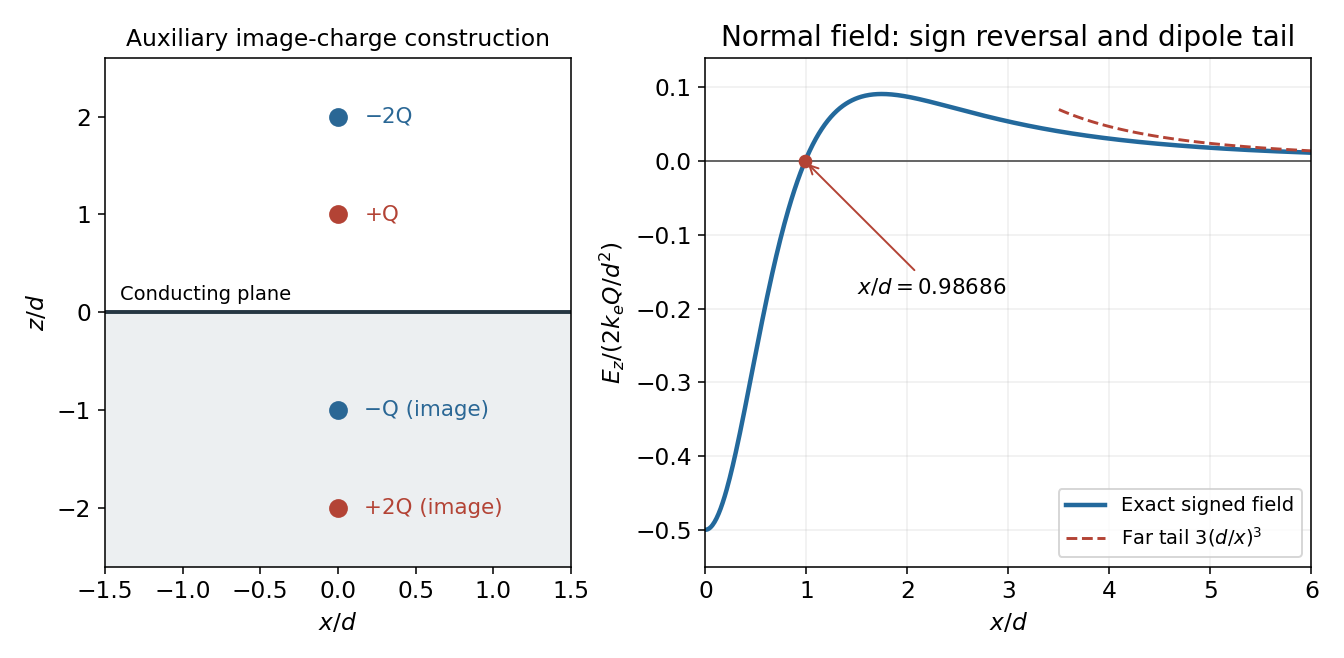
Use the standard infinite-plane boundary condition: the sheet is an equipotential, with no imposed uniform background electric field and the electric potential tending to zero far from the localized charges. The images of at and at are at and at .
At the point directly below the real charges, horizontal components vanish. The first real-image pair contributes along , while the second contributes . ThereforeFor , the electric field points downwards into the sheet. The expression is the one-sided vacuum limit; the electric field inside the conducting material is zero. A prescribed uniform background field would be an additional boundary condition and would change this result.
Let denote the radial distance from the axis in the plane, and write . A charge at height and its image give a combined normal electric field at ; the tangential components cancel. Superposing the two pairs yieldsThe conductor boundary condition gives , soTo integrate the induced surface charge, use concentric annuli of area . Since ,The local surface charge density is negative near the origin but positive farther out; integrating only the negative patch would miss the total. The total real charge is , so the induced also agrees with the sum of the two image charges. An isolated finite plate constrained to zero net charge would require a different global boundary-value problem; the formula is the infinite-plane solution just specified.
Set the normal electric field to zero and cancel its nonzero overall factor:Taking the power gives , henceThe numerical value is independent of the nonzero magnitude of . Beyond this radius the signed normal electric field is positive. Thus its magnitude first falls to zero, rises again and eventually decays; it is not globally monotone.
For , expanding each denominator givesThis is a dipole rather than a monopole tail. The real-plus-image charge distribution has zero total charge and dipole moment ; in its equatorial plane a dipole produces , confirming the coefficient and sign.

Articles by others on the same topic
There are currently no matching articles.