The integral and differential forms of Gauss's law in vacuum areFor an isolated spherical conductor, symmetry gives outside and zero inside. Taking electric potential zero at infinity, . Thus the capacitance of an isolated conducting sphere isCharging from zero gives the electrostatic potential energyThis is also the integral of electric field energy density outside the sphere. The later insertion into a coaxial cylindrical capacitor conserves its electric charge, not its original isolated electric potential.
Initially the isolated sphere has . After insertion without contact, its charge remains . In the long-cylinder approximation, with the sphere far from the openings, neglect electric flux escaping through the ends. A Gauss surface running through the shielding metal and closed by end sections of negligible flux then encloses zero net charge. Its cavity wall therefore carries . Since that cylinder is isolated and initially neutral, its outside wall carries . The grounded outer cylinder supplies charge on its inside wall, terminating the annular electric field lines.
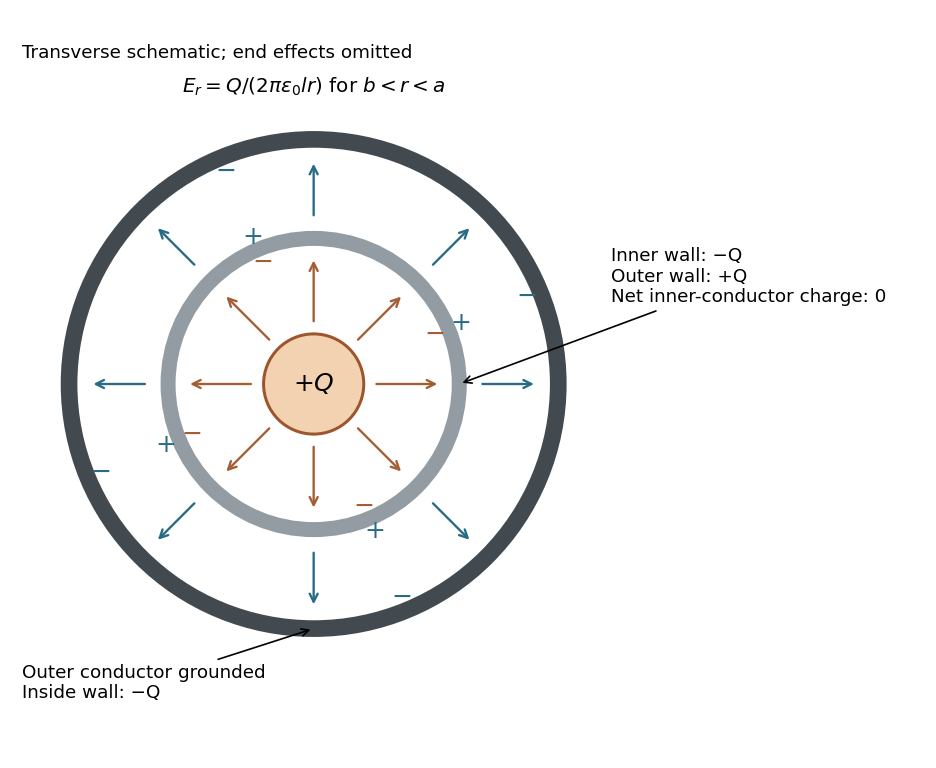
Transverse schematic of a charged sphere inside a neutral coaxial capacitor: induced charges and electric field lines, with no field inside the conducting walls
. Details. 
For positive , the cavity electric field lines run from the sphere to the inner wall, while annular electric field lines run from the outside of the inner conductor to the grounded outer conductor. Negative reverses their directions. The transverse picture is schematic: exact cavity fields depend on the sphere's position and the ends. The following annular formulas neglect end effects and place the sphere well inside the long cylindrical assembly.
For , a coaxial Gauss surface of length encloses net charge : the sphere and the cavity-wall charge cancel, leaving on the outside of the inner conductor. In the long-cylinder approximation,The electric field points radially outward for . End effects and axial nonuniformity near the openings are excluded by the ideal coaxial cylindrical capacitor approximation.
The grounded outer cylinder fixes . Integrating the annular electric field inward givesEquivalently, the coaxial cylindrical capacitor has and carries charge , so . The original sphere potential is used to infer its conserved charge; it is not the final potential of the sphere or of the inner cylinder.
Articles by others on the same topic
There are currently no matching articles.