For propagation along , a transverse wave has two perpendicular displacement components. With , write , . Their trajectory at a fixed point obeysThe general nondegenerate trajectory is an ellipse: elliptical polarization. For or , the components remain in phase or antiphase and the trajectory collapses to a line. A single nonzero component is also linearly polarized. Equal amplitudes with give circular polarization. Unequal quadrature amplitudes give an ellipse aligned with the chosen axes, while general phase differences rotate its axes.
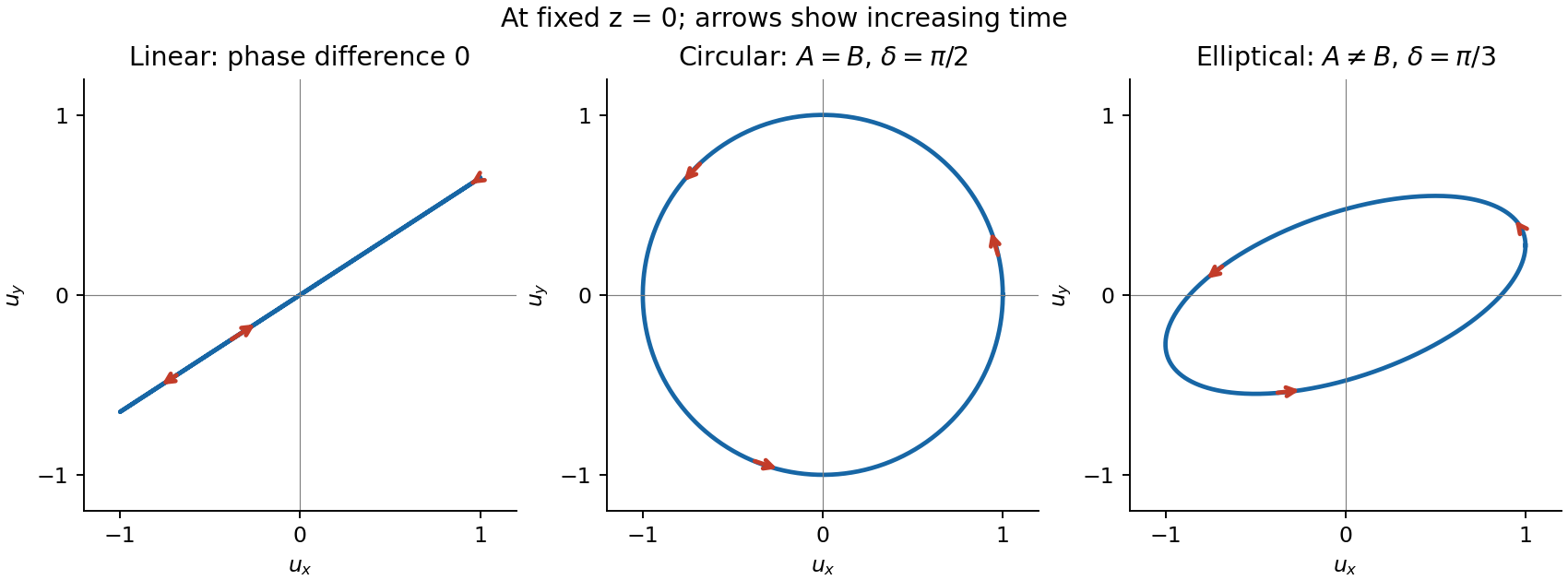

For the displayed convention and , at the vector starts at and moves towards as time increases. Reversing reverses its rotation. Right- and left-handed labels require a stated viewing and phase convention, so rotation is defined explicitly here. A fixed ellipse is a coherent relationship between transverse components; unpolarized light instead has fluctuating orientation and phase relationships on the measurement timescale.
A linear polarizer transmits a linearly polarized beam with intensity proportional to , allowing its direction to be measured by an analyser. circular polarization transmits equal intensity through any linear analyser, but that test alone does not distinguish it from unpolarized light. A quarter-wave plate converts a suitable coherent circular state to linear polarization, allowing the combination to discriminate them. For light the electric field defines the usual polarization; the magnetic field remains perpendicular to it and to propagation. Longitudinal sound in a homogeneous gas lacks the two transverse degrees of freedom needed for these polarization states.
Articles by others on the same topic
There are currently no matching articles.