A completely filled valence band carries no net current: its occupied crystal-momentum states have velocities that cancel. Near a valence-band maximum, an almost full band is conveniently described by the few missing electrons, or electron holes. Removing an electron of charge , with , changes the charge relative to the filled band by . This is a quasiparticle description of electronic motion, not a mobile positive ion or a Positron.
For an isotropic parabolic maximum, . Assign the missing-electron state momentum and hole energyIt has positive effective mass . Its velocity equals the velocity of the missing electron state, and its positive-charge current replaces the negative of that state's electronic current. Semiclassical motion is thus . With momentum relaxation time , the low-field mobility is andIf electrons also contribute, : the two species' longitudinal conductivities add.
A Hall bar separates carrier concentration from mobility. Apply current density , magnetic field , and measure transverse electric field . For one isotropic hole population, transverse force balance gives , soFor thickness , the Hall-voltage magnitude is . A longitudinal four-terminal resistance measurement supplies independently. Use ohmic contacts, known conducting thickness, controlled temperature and low enough current to avoid self-heating. Reversing magnetic field removes even-in-field longitudinal offsets from contact misalignment; reversing current also helps reject thermoelectric offsets. These are central controls, rather than merely taking one transverse voltage reading.[ref]
Resistivity and Hall Measurements by National Institute of Standards and Technology. Sample Geometry; Resistivity Measurements; Definitions for Hall Measurements; Hall Measurements and Hall Calculations
The simple inference assumes one carrier type and a known Hall scattering factor. More generally , so measures Hall mobility rather than automatically the drift mobility. With two carrier populations at weak field,Its sign alone need not identify the more numerous carrier. A Hall experiment also cannot determine and separately: their ratio sets mobility. cyclotron resonance supplies an independent mass measurement by sweeping frequency or magnetic field through and detecting resonant absorption. The measured cyclotron effective mass can depend on band anisotropy and need not equal every curvature mass; the isotropic parabolic model identifies them. Its linewidth provides a scattering-time estimate only with a specified damping model.
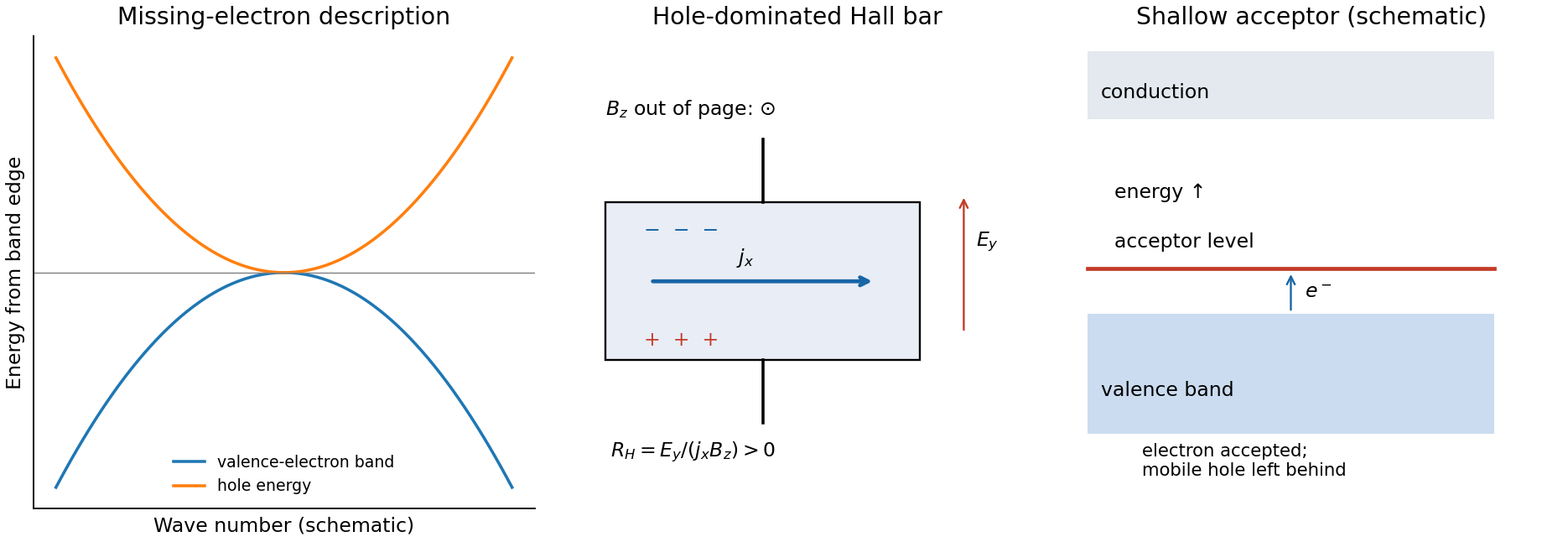
semiconductor doping generates holes by adding acceptor impurities. In silicon, a substitutional group-III atom such as boron provides one fewer valence electron than silicon. A shallow acceptor level lies slightly above the valence-band edge: accepting a valence electron makes the dopant negatively ionized and leaves a mobile hole in the valence band. The impurity stays fixed in the lattice. charge neutrality and the nondegenerate equilibrium mass-action law giveFor fully ionized, uncompensated acceptors in the extrinsic regime, and ; with fully ionized donor compensation, while holes remain dominant. The Fermi level moves towards the valence band. At low temperature, semiconductor carrier freeze-out suppresses mobile electron holes; at high temperature intrinsic electron-hole generation can dominate. Increasing dopant density also changes scattering, so a conductivity increase alone cannot distinguish increased carrier density from changed mobility. Temperature-dependent Hall and conductivity measurements separate these effects, subject to the carrier and scattering qualifications above.
For a small longitudinal disturbance, let the equilibrium pressure and mass density be , their perturbations be , and the fluid velocity be . Linearizing conservation of mass and the inviscid momentum equation in one dimension givesWhen compression is adiabatic, the equation of state gives with . Differentiating and eliminating yieldsfor an ideal gas with heat-capacity ratio and molar mass . Compression raises temperature as well as density, explaining the factor compared with the isothermal value .
A rightgoing plane sound wave has pressure and particle velocity in phase, , and mean intensity for peak amplitudes. Particle displacement is a quarter-cycle out of phase with particle velocity: particles oscillate locally while the compression pattern transports energy. This continuum linear description requires wavelength much larger than the mean free path, small pressure perturbations and negligible viscous attenuation. Adiabatic propagation requires heat exchange across the compressed region to be slow on the oscillation time; strong thermal coupling would instead favour an isothermal response.
The Q factor measures stored energy relative to loss: , or in the weak-loss limit. For viscous damping , write , and . The conventional oscillator parameter isIn free ringdown, fit the amplitude envelope . Its decay time is , whereas the cycle-averaged energy envelope decays on ; thus . Equivalently the logarithmic decrement between same-sign peaks is . It gives for weak damping, or the exact parameter relation . Fit multiple peaks above the noise floor, measure the damped period, and verify an exponential envelope rather than assuming all amplitude loss is viscous.
For a driven measurement, allow transients to settle and scan frequency at fixed force amplitude. Near resonance and at high , the response is Lorentzian in displacement power, with half-power points at displacement amplitudes of the maximum. Their angular-frequency separation gives . Halving the amplitude is not a half-power criterion.
The absorbed-power bandwidth of a viscously damped oscillator can be found exactly. Sinceits maximum is at , and the half-power frequencies satisfy . HenceFor broad resonances, displacement and absorbed-power peaks differ, so the measured observable must be specified. Frequency-dependent drive, backgrounds or several overlapping modes can otherwise masquerade as a changed Q factor.
For propagation along , a transverse wave has two perpendicular displacement components. With , write , . Their trajectory at a fixed point obeysThe general nondegenerate trajectory is an ellipse: elliptical polarization. For or , the components remain in phase or antiphase and the trajectory collapses to a line. A single nonzero component is also linearly polarized. Equal amplitudes with give circular polarization. Unequal quadrature amplitudes give an ellipse aligned with the chosen axes, while general phase differences rotate its axes.
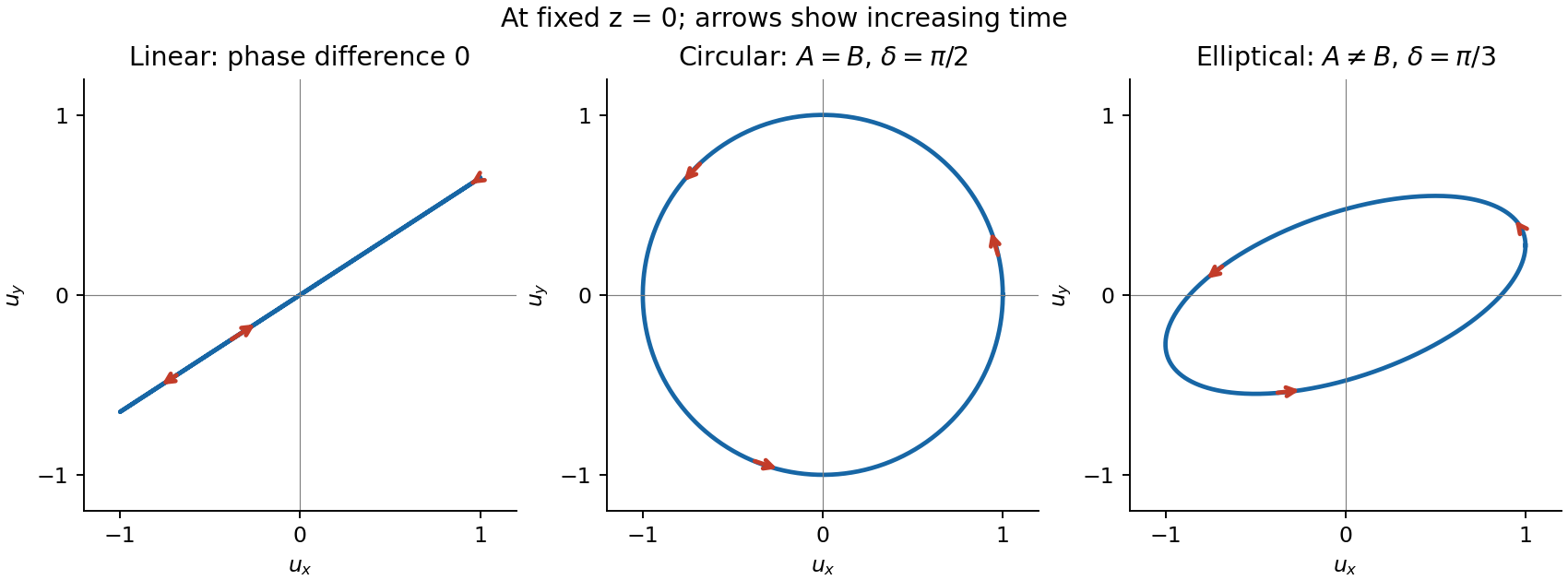


For the displayed convention and , at the vector starts at and moves towards as time increases. Reversing reverses its rotation. Right- and left-handed labels require a stated viewing and phase convention, so rotation is defined explicitly here. A fixed ellipse is a coherent relationship between transverse components; unpolarized light instead has fluctuating orientation and phase relationships on the measurement timescale.
A linear polarizer transmits a linearly polarized beam with intensity proportional to , allowing its direction to be measured by an analyser. circular polarization transmits equal intensity through any linear analyser, but that test alone does not distinguish it from unpolarized light. A quarter-wave plate converts a suitable coherent circular state to linear polarization, allowing the combination to discriminate them. For light the electric field defines the usual polarization; the magnetic field remains perpendicular to it and to propagation. Longitudinal sound in a homogeneous gas lacks the two transverse degrees of freedom needed for these polarization states.
Articles by others on the same topic
There are currently no matching articles.