Use the unitary position-to-momentum Fourier transform . Integration giveswhere with its continuous value one at zero. The amplitude is real and even, with central maximum , zeros at for nonzero integer , and alternating-sign sidelobes decaying as .
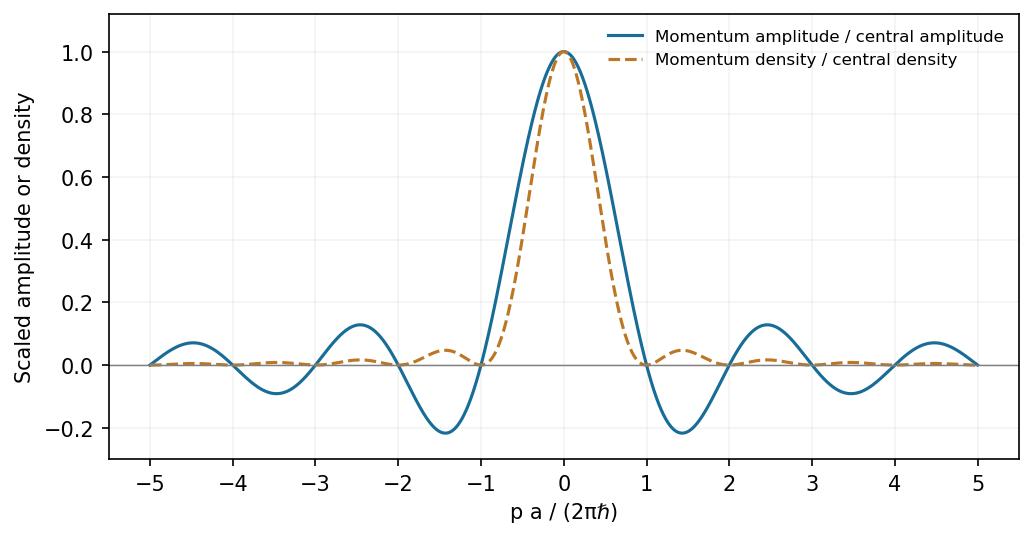
A finite rectangular position amplitude gives a sinc momentum amplitude and a sinc-squared momentum density
. Source. Details. 
The probability density is , not the signed Sinc function amplitude. Its integral is one by the unitarity of the Fourier transform.
Articles by others on the same topic
There are currently no matching articles.