Uniform signal sampling at rate multiplies a continuous signal by a time-domain Dirac comb, giving frequency-domain replicas spaced by :If a baseband signal is restricted to and , these replicas can be separated by an ideal reconstruction filter. Frequencies differing by integer multiples of have the same sampled phase progression; for real signals they fold into the interval from zero to . This ambiguity is aliasing.
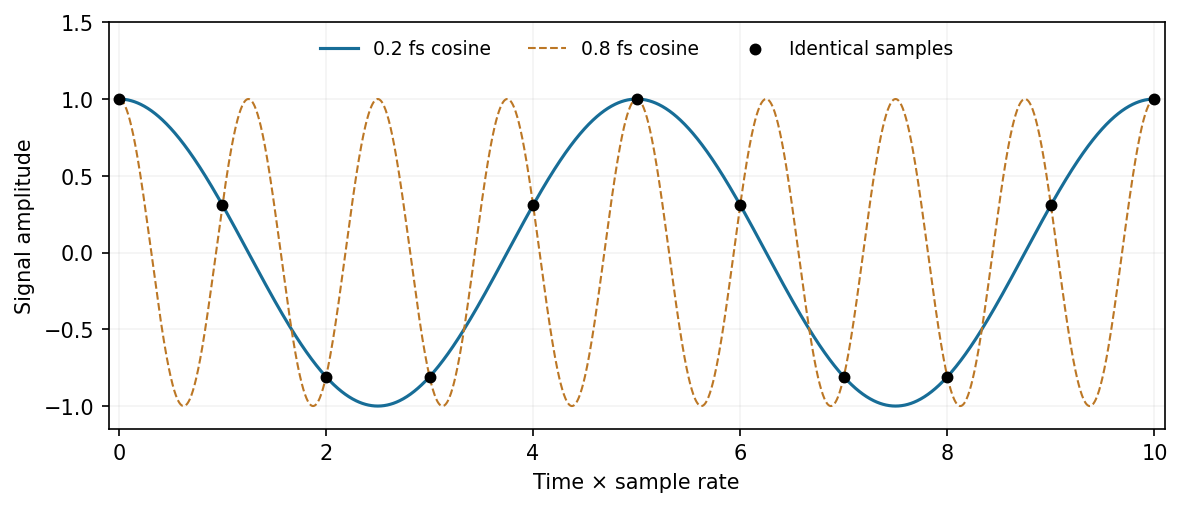
Two different continuous cosine frequencies produce the same samples when one lies above Nyquist
. Source. Details. 
For example, and cosines produce identical sample values. Apply an analogue Anti-aliasing filter before digitization and choose enough sample-rate margin for its finite transition band. A digital filter applied afterward cannot distinguish components already folded onto one another. Out-of-band noise also aliases unless filtered. The sample rate sets temporal/spectral coverage; quantization resolution sets amplitude precision and is a separate limitation. Bandpass Signal sampling has additional conditions beyond the simple baseband rule.[ref]
What the Nyquist Criterion Means to Your Sampled Data System Design by Walt Kester. MT-002: spectral replicas, aliases and practical filtering
Articles by others on the same topic
There are currently no matching articles.