The ideal voltage-feedback Operational amplifier has zero input currents and, while stable negative feedback holds it in its linear operating range, equal input voltages: and . The first rule follows from infinite input impedance; the second is the large-open-loop-gain limit of . Equal input electric potential is a virtual short, not an electrically conducting connection.
For an inverting amplifier with the noninverting input grounded, and node-current balance gives , hence . For a noninverting amplifier, the feedback divider gives , hence .
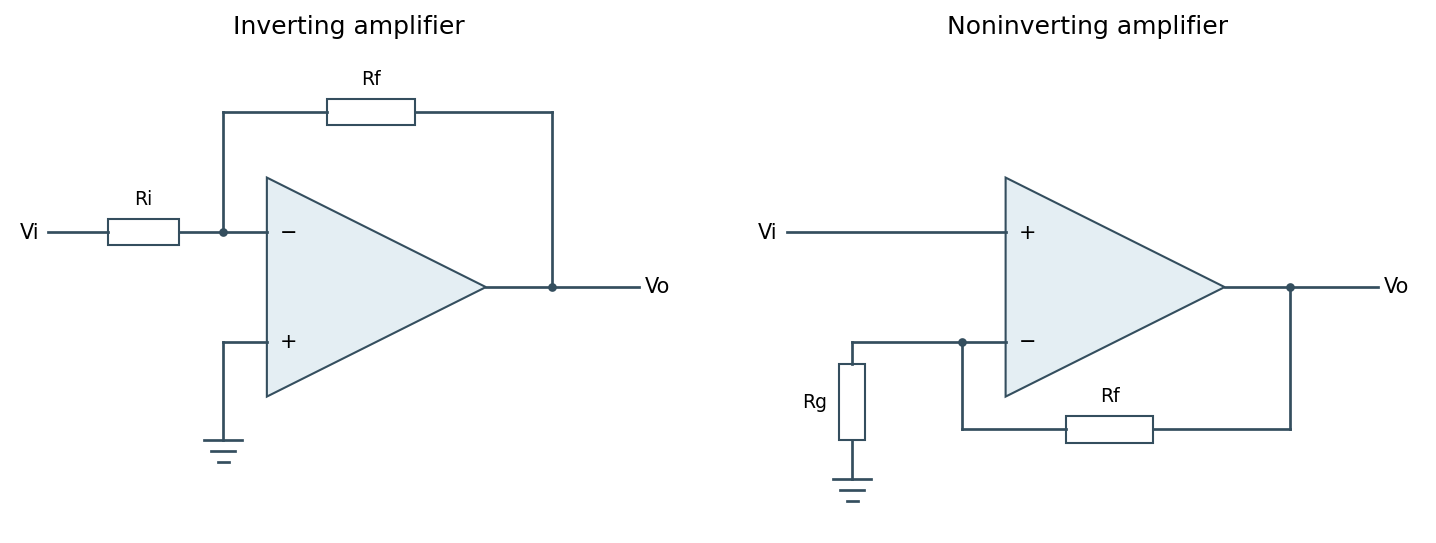
Ideal inverting and noninverting negative-feedback configurations
. Source. Details. 
One should check output swing, input common-mode range, slew rate, Gain-bandwidth product and stability before using these limits in a real circuit. Saturation, positive feedback or operation beyond bandwidth invalidates the equal-voltage rule; finite input bias currents and offset voltage can also matter.[ref]
Operational-amplifier negative feedback by Analog Devices. University electronics course, Chapter 3: high-gain feedback assumptions and practical limits
Thermal agitation in a resistor produces Johnson-Nyquist noise, even without an applied mean current. In the classical low-frequency regime, its one-sided open-circuit voltage spectrum is and its equivalent short-circuit current spectrum is . In an Effective noise bandwidth ,For a matched load, available thermal noise power is . A resistor and load at the same temperature exchange noise power without a net heat flow.
Cooling reduces the rms amplitude as if Electrical resistance and bandwidth remain fixed. A cryogenic bath or refrigerator, thermal anchoring and controlled heat input can maintain a steady low temperature. Radiation shields, an insulating vacuum, thermally anchored leads and limited measurement dissipation reduce heat leaks and self-heating. Temperature sensing and stable feedback control reduce slow temperature-induced drift; keeping temperature constant does not remove microscopic thermal fluctuations.
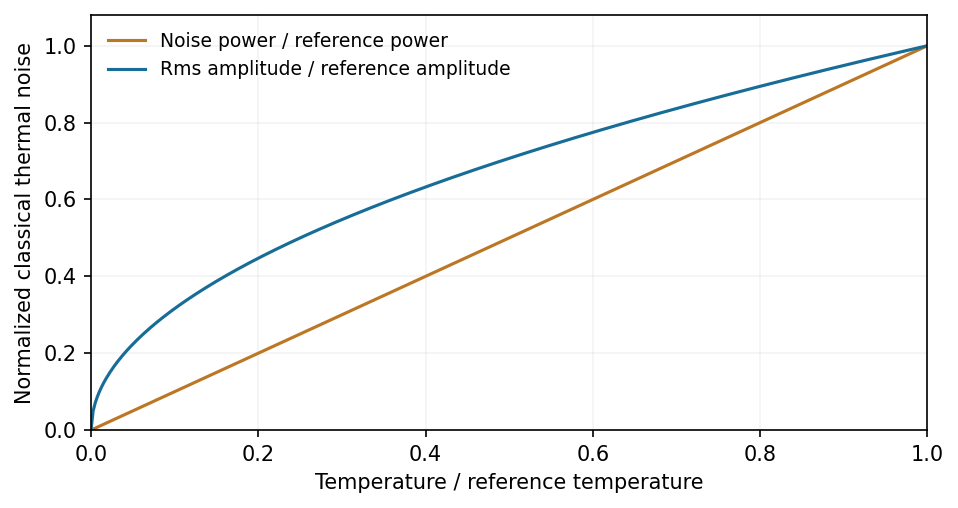
At fixed resistance and bandwidth, thermal-noise power scales with temperature and rms amplitude with its square root
. Source. Details. 
Bandwidth restriction, suitable impedance and a low-noise amplifier complement cooling. Warm leads, contacts and the amplifier can otherwise dominate the observed noise. At fixed mean current, shot noise is not generally reduced merely by cooling, and low-frequency excess noise need not follow the Johnson law. At frequencies with , quantum noise expressions replace the classical approximation.[ref]
Op-amp Noise by Analog Devices. Distinction between resistor thermal noise, amplifier noise and current-noise contributions
Uniform signal sampling at rate multiplies a continuous signal by a time-domain Dirac comb, giving frequency-domain replicas spaced by :If a baseband signal is restricted to and , these replicas can be separated by an ideal reconstruction filter. Frequencies differing by integer multiples of have the same sampled phase progression; for real signals they fold into the interval from zero to . This ambiguity is aliasing.
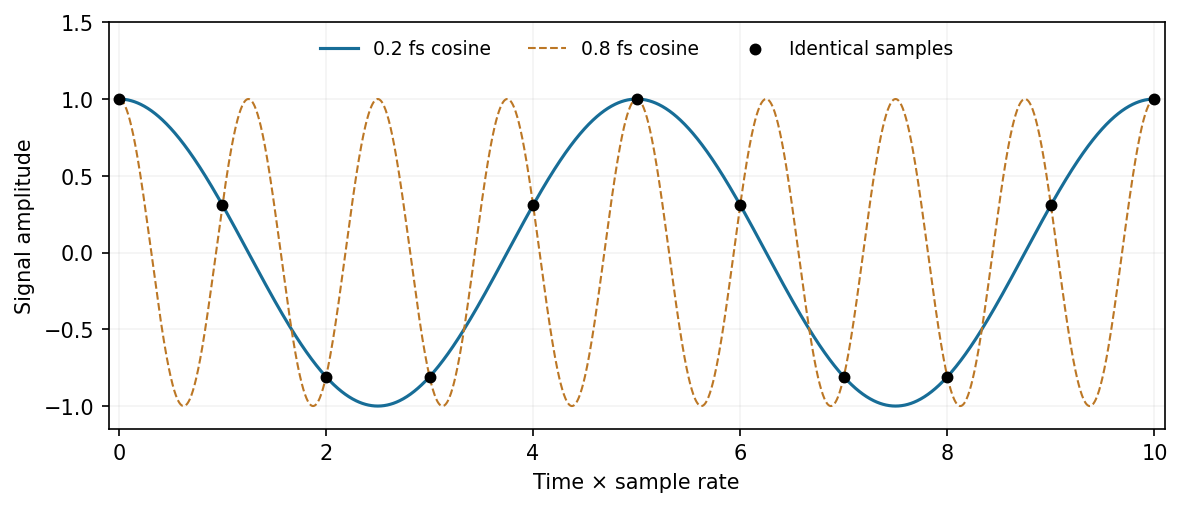
Two different continuous cosine frequencies produce the same samples when one lies above Nyquist
. Source. Details. 
For example, and cosines produce identical sample values. Apply an analogue Anti-aliasing filter before digitization and choose enough sample-rate margin for its finite transition band. A digital filter applied afterward cannot distinguish components already folded onto one another. Out-of-band noise also aliases unless filtered. The sample rate sets temporal/spectral coverage; quantization resolution sets amplitude precision and is a separate limitation. Bandpass Signal sampling has additional conditions beyond the simple baseband rule.[ref]
What the Nyquist Criterion Means to Your Sampled Data System Design by Walt Kester. MT-002: spectral replicas, aliases and practical filtering
Articles by others on the same topic
There are currently no matching articles.