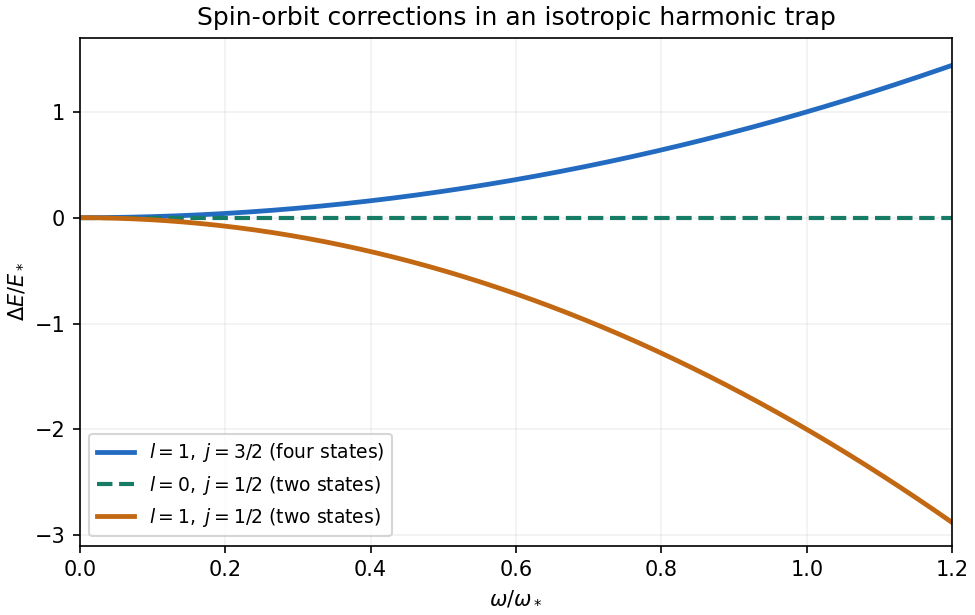
For the isotropic three-dimensional quantum harmonic oscillator, , hence is constant. No radial integral remains, so the spin-orbit energy shift in a central potential reduces toFor , the only possibility is , and the bracket vanishes. For , coupling to spin one-half permits and , whose brackets are and . ThusThese spin-orbit shifts of an isotropic harmonic oscillator are a zero line, a downward parabola, and an upward parabola of half the downward magnitude. They are independent of the radial excitation number, and their magnetic multiplicities are respectively two, two and four. Their weighted mean within the manifold is zero: .

Articles by others on the same topic
There are currently no matching articles.