The total angular momentum operator is . Since orbital and spin operators act on different factors of the tensor product, they commute, and expanding givesA coupled angular momentum eigenstate is a simultaneous eigenstate of these three squared operators, with eigenvalues , and . Thus the angular factor in the spin-orbit interaction is the numberThe other factor, , is radial. It commutes with the angular operators, and a central-potential energy eigenstate separates into a radial wavefunction and an angular spinor. Taking its radial expectation value therefore givesThis spin-orbit energy shift in a central potential is independent of , so rotational symmetry preserves the magnetic degeneracy within a fixed multiplet. It is a first-order fine structure correction; the given coefficient already includes the relativistic factor needed for the electron's spin-orbit coupling.
The attractive Coulomb potential energy is , soUse precisely the radial normalization stated in the PDF: the radial probability measure is . The supplied function hasIts integral is one, since . In particular,This calculation uses the supplied convention, rather than multiplying a separately normalized standard radial function by an extra .
The addition of angular momentum bracket is . Substitution in the spin-orbit energy shift in a central potential therefore givesHere is the supplied Bohr radius. The negative sign means the member of the pair is shifted downward by this spin-orbit interaction; it is not the total hydrogen binding energy.
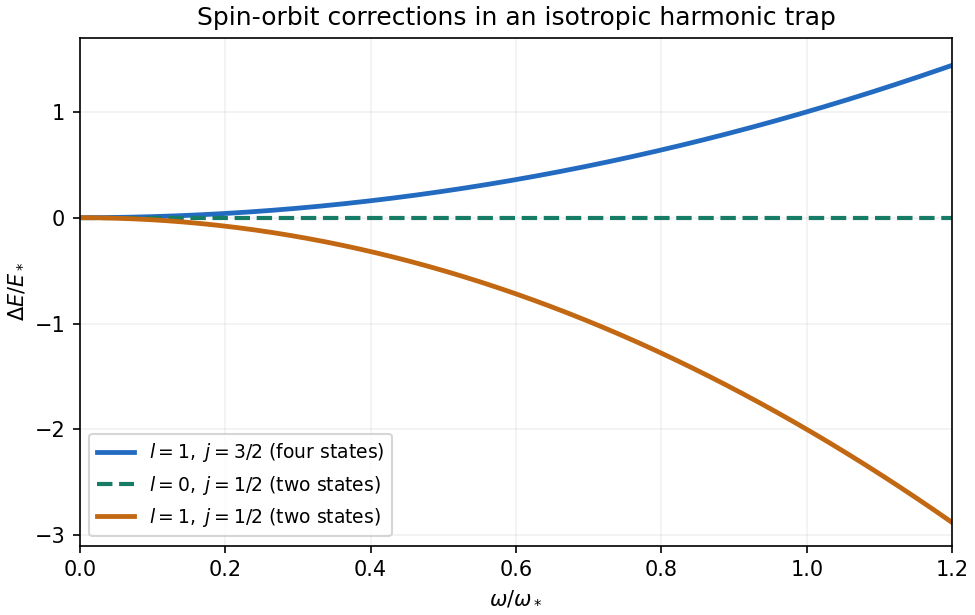
For the isotropic three-dimensional quantum harmonic oscillator, , hence is constant. No radial integral remains, so the spin-orbit energy shift in a central potential reduces toFor , the only possibility is , and the bracket vanishes. For , coupling to spin one-half permits and , whose brackets are and . ThusThese spin-orbit shifts of an isotropic harmonic oscillator are a zero line, a downward parabola, and an upward parabola of half the downward magnitude. They are independent of the radial excitation number, and their magnetic multiplicities are respectively two, two and four. Their weighted mean within the manifold is zero: .

Write and . Inverting the annihilation operator and creation operator definitions givesThe ladder operators take to orthogonal quantum harmonic oscillator energy eigenstates and . Thus , andFor , the lowering term is simply zero. The conclusion concerns an individual energy eigenstate; interference between different eigenstates can produce nonzero expectation values.
For the harmonic-oscillator number-state second moments, the number operator gives , while the canonical commutation relation gives . Terms with or have zero diagonal matrix elements, since they change the occupation number by two. ThereforeConsequently the potential energy and kinetic energy means areTheir sum is the oscillator energy eigenvalue . Their equality is also the virial theorem result for a quadratic potential, here derived directly from the ladder operators.
The standard deviations defining the position and momentum uncertainties satisfy and . Part (a) makes both means zero. Using the second moments from part (b),Multiplication givesThe Heisenberg uncertainty relation requires only . Among the oscillator energy eigenstates, equality occurs solely for the ground state ; the excited states have larger uncertainty products.
Each energy eigenstate picks up its own phase under unitary time evolution. The relative phase therefore changes at . After removing an irrelevant global phase, the state isThe diagonal position matrix elements vanish, but the annihilation operator and creation operator giveThe two off-diagonal cross terms in the expectation value yieldThus the angular frequency is , and the magnitude of the oscillation, meaning its amplitude, isThe peak-to-peak displacement is . The phase fixes where the oscillation starts but does not change . A pure or preparation has no mean oscillation, whereas an equal-weight quantum superposition maximizes its amplitude within this two-state family. The motion is produced by interference between energy eigenstates, rather than by a changing occupation of either one.
Articles by others on the same topic
There are currently no matching articles.