Use the original diagram's positive distances: from the object to the vertex, from the vertex to the image, and from the vertex toward the centre of curvature on the outgoing side. Let a paraxial light ray strike at height . Its incoming inclination is above the optical axis, its outgoing inclination is below it, and the inward surface normal is inclined by below it. Thus the incidence and refraction angles relative to that normal are respectively and .
The local tangent-plane form of Snell's law, using the small-angle approximation, givesSubstitute the three height-to-distance ratios and cancel :This refraction at a spherical surface result keeps only first-order ray angles. The surface sag shifts the height's axial reference only at higher order. Distances for other object, image or curvature orientations must be signed consistently; the displayed positive-distance form follows the particular orientation in the paper.
Keep the paper's as magnitudes for the two convex faces. With the standard signed-curvature convention measured to the right, the first surface has signed radius and the second . This explains why the requested formula contains a sum of the two reciprocal magnitudes.
Let the axial lens thickness be , and let be the distance from the first vertex to the intermediate focus that its refracted rays would reach without the second surface. The first refraction at a spherical surface givesAt the second face those rays are still converging toward that intermediate focus, so its object distance is negative, , with . Applying the signed spherical-surface equation again givesIn the thin lens limit, . Adding cancels the intermediate-focus terms:The focal length is the image distance for parallel incident light rays, , hence the lensmaker's equation isThe same surrounding refractive index is assumed on both sides. For this biconvex thin lens has positive focal length. With signed radii , , the equivalent familiar expression is .
Use positive object distance and focal length . The thin lens equation givesThe transverse magnification is , so the signed height isThe real image lies beyond the lens, is inverted, and has positive height magnitude .
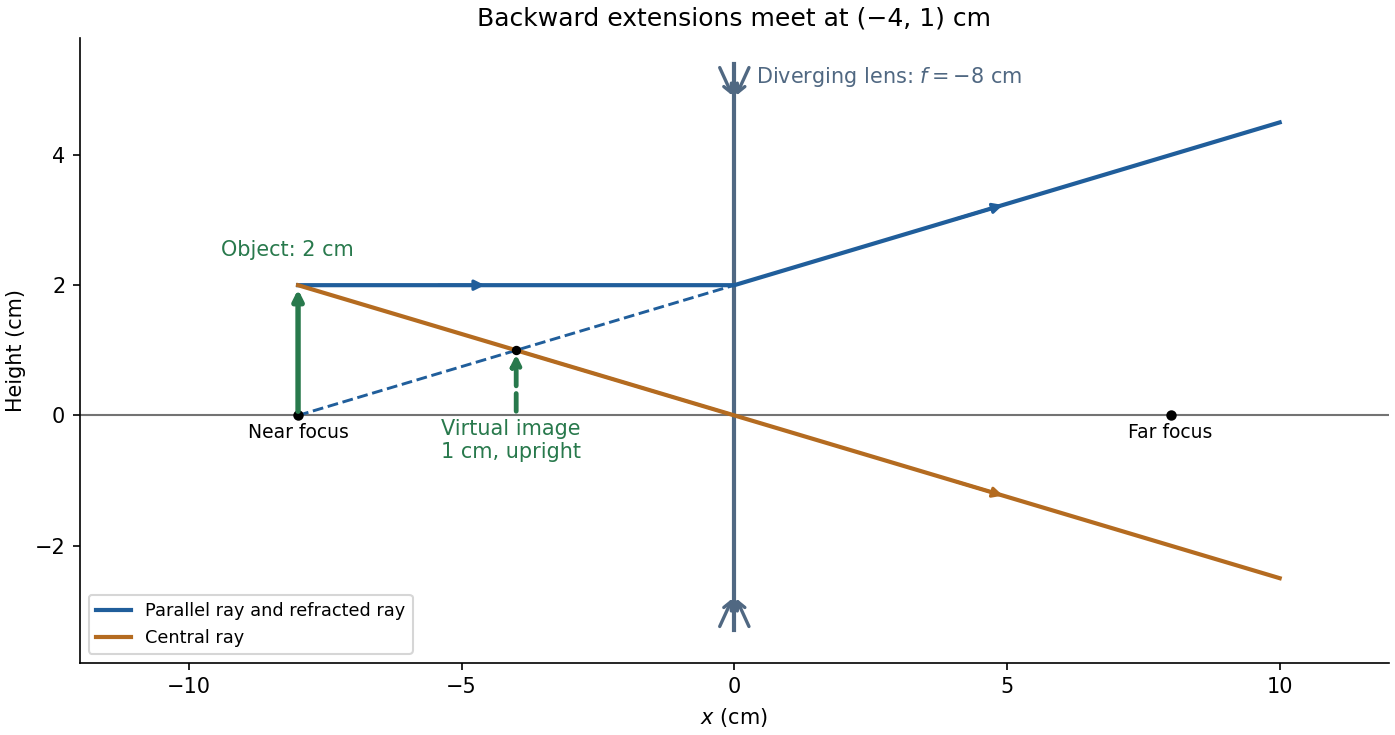
For and negative focal length ,The transverse magnification is , soThus the virtual image is upright, half the object's height, and from the lens on the object's side. A parallel incident light ray diverges after the lens as though it originated at the near optical focus; the central light ray continues undeviated in the ideal thin lens model. Their backward extensions meet at the image tip, .

Articles by others on the same topic
There are currently no matching articles.