
For an embedded regular surface and , the affine tangent plane isIt is a set of points through , whereas the tangent space is a vector space of displacements with zero vector. Some texts also call that two-dimensional tangent space the tangent plane; here the translation by distinguishes the two uses. For a regular parametric surface with ,where the partial derivatives are evaluated at . Regularity means that these tangent vectors are linearly independent, equivalently . Their cross product is a normal vector. [ref]
https://www.math.uga.edu/sites/default/files/inline-files/ShifrinDiffGeo.pdf. Theodore Shifrin, Differential Geometry: A First Course in Curves and Surfaces, Chapter 2, §1: regular parametrizations and tangent planes
For an implicit regular surface , require a smooth function with . ThenDifferentiating proves that every surface velocity lies in the displayed kernel of a linear map; the implicit function theorem gives a local graph with two independent coordinates, proving equality. The gradient is the normal vector with respect to the ambient dot product. [ref]
For the sphere , , and the affine tangent plane has equation . At the unit sphere's north pole , compare the plane with the displacement tangent space . The regular parametric surface , for , gives and , confirming the same answer.
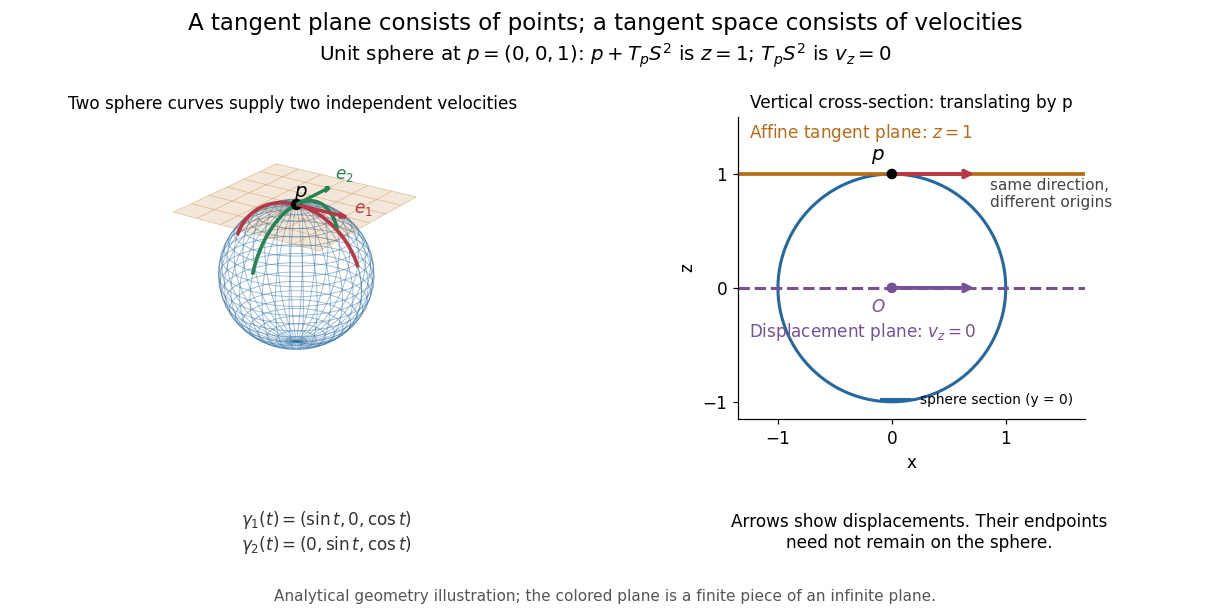

This analytical illustration shows a unit sphere and a vertical cross-section. The smooth curves and give the two displayed tangent vectors at . The straight point for any nonzero is outside the sphere when , since . A tangent plane therefore captures first-order motion, not an exact patch of the regular surface.
The same idea makes local approximation useful. For the graph of a function with a smooth function, the affine tangent plane is . [ref]
https://openstax.org/books/calculus-volume-3/pages/4-4-tangent-planes-and-linear-approximations. Gilbert Strang and Edwin Herman, OpenStax Calculus Volume 3, §4.4: tangent planes and linear approximations
With continuous second partial derivatives, the vertical error is in Big O notation. On the unit sphere near its north pole, : the tangent plane loses quadratic bending while preserving all first-order velocities.A failed regularity test needs interpretation. Replacing the sphere equation by makes everywhere on the same perfectly regular sphere, so this defining smooth function cannot recover its tangent plane. Similarly, the usual spherical parametric surface loses matrix rank at the poles, while the graph parametrization above remains regular there. A vanishing gradient or degenerate parametrization invalidates that calculation; it alone does not prove that the underlying geometry has no tangent plane.
New to topics? Read the docs here!