In a central potential, is conserved. Substituting it into givesWhile the string stays taut, . Circular force balance gives , hence . A radial impulse changes no angular momentum. The radial oscillation of an elastic-string orbit follows by expanding the same fixed- effective potential about its minimum:soFor an outward impulse, one convenient linear approximation is and . The angular modulation follows from and is needed for a consistent trajectory sketch.
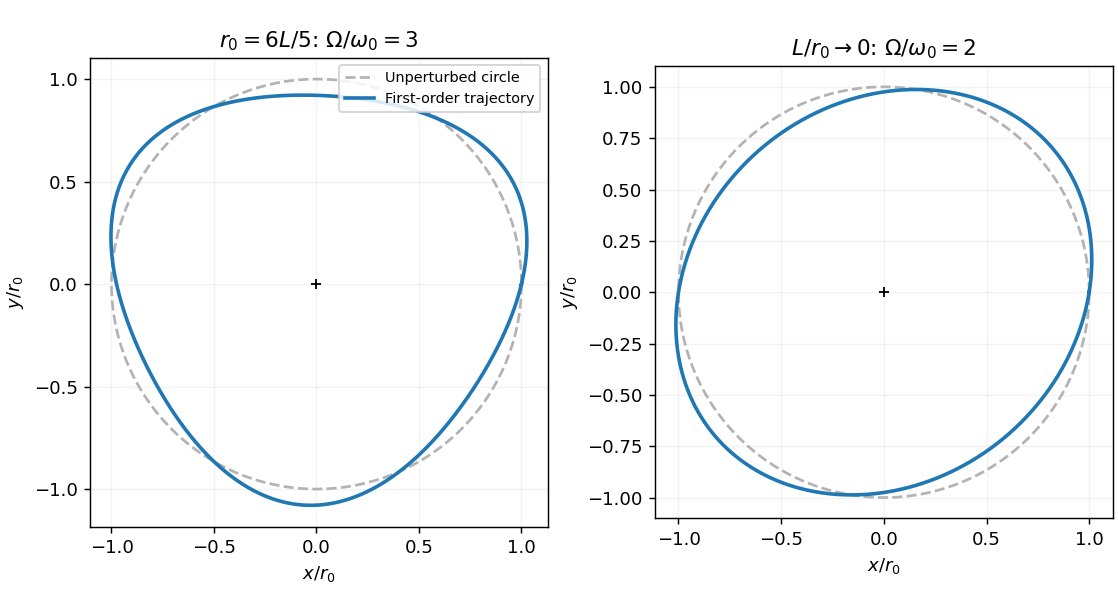

At , the frequency ratio is . There are three radial oscillations during one mean revolution, giving a nearly circular orbit with three outward and three inward extrema. The leading small-amplitude sketch closes after one revolution. Finite-amplitude corrections generally change the frequency ratio and can produce apsidal drift; the linear ratio does not prove an exactly closed finite-amplitude orbit for the full stretched-string potential.
For , . The potential approaches the isotropic harmonic-oscillator form , and the perturbed path is approximately a small-eccentricity ellipse centered on the fixed point. The radius has two maxima and two minima per revolution. For finite nonzero , the ellipse is an approximation and slow precession can remain.
Articles by others on the same topic
There are currently no matching articles.