In a central potential, is conserved. Substituting it into givesWhile the string stays taut, . Circular force balance gives , hence . A radial impulse changes no angular momentum. The radial oscillation of an elastic-string orbit follows by expanding the same fixed- effective potential about its minimum:soFor an outward impulse, one convenient linear approximation is and . The angular modulation follows from and is needed for a consistent trajectory sketch.
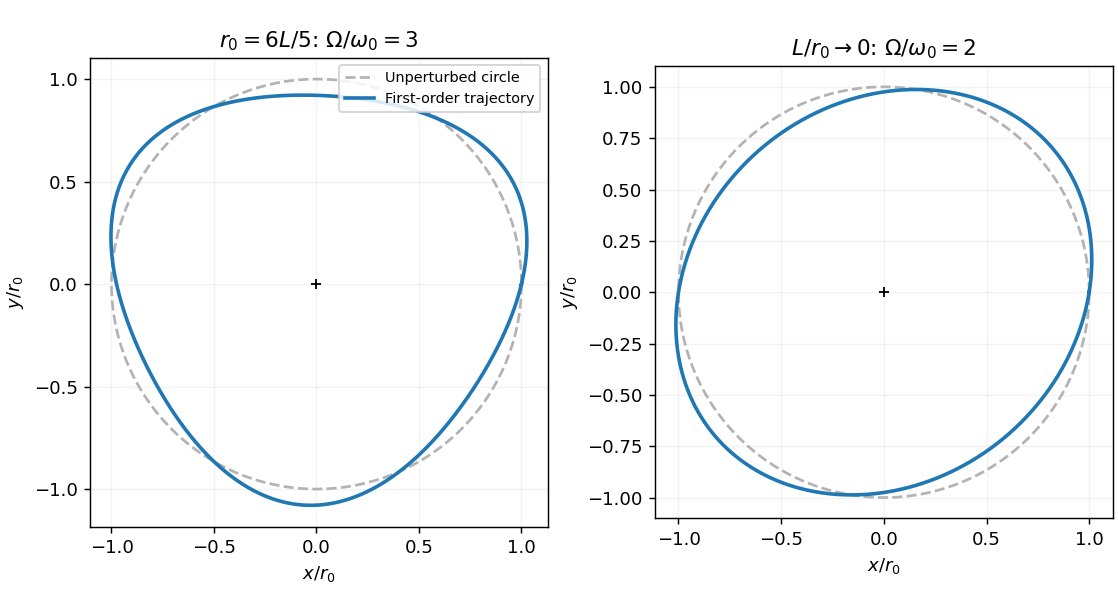
At , the frequency ratio is . There are three radial oscillations during one mean revolution, giving a nearly circular orbit with three outward and three inward extrema. The leading small-amplitude sketch closes after one revolution. Finite-amplitude corrections generally change the frequency ratio and can produce apsidal drift; the linear ratio does not prove an exactly closed finite-amplitude orbit for the full stretched-string potential.
For , . The potential approaches the isotropic harmonic-oscillator form , and the perturbed path is approximately a small-eccentricity ellipse centered on the fixed point. The radius has two maxima and two minima per revolution. For finite nonzero , the ellipse is an approximation and slow precession can remain.
Expand the propagation distance at small angles:The first two terms supply an aperture-independent phase. If the aperture quadratic phase is small, , it too may be dropped from the integrand. The remaining Fraunhofer diffraction amplitude is the aperture's Fourier transform at transverse wavevector , as required.
For slit width and center spacing , adding the two shifted top-hat transforms gives the normalized intensityThe aperture outer half-width is ; its maximum quadratic phase is only about radians at the given wavelength and distance, so the Fraunhofer approximation is excellent. Fringe spacing is and the first single-slit envelope zero is at .
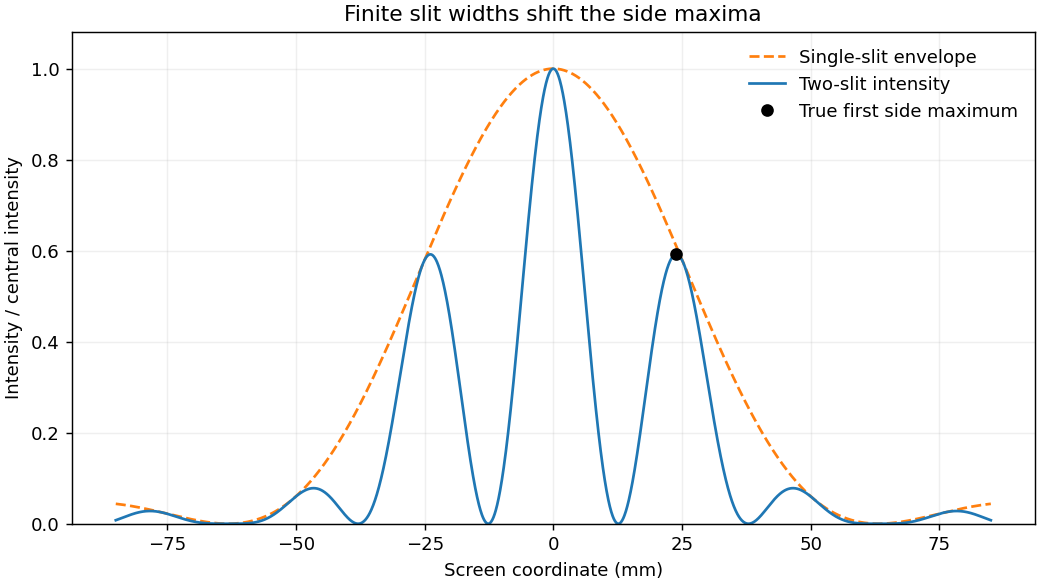
Two finite-width slits: interference fringes, diffraction envelope and shifted side maximum
. Details. The side maximum of a finite-width double-slit pattern shifts slightly inward from . Differentiating the full intensity gives, away from zeros,Its first side maximum is at with . The expected rate is therefore . Poisson shot noise gives signal-to-noise ratio , so one needs counts:Using the common fringe-center approximation instead gives relative intensity and . Both express the same order of exposure; the first uses the true maximum. Dark counts, background subtraction and uncertainty in the reference rate are excluded by the ideal stated noise model.
An ideal linear polarizer projects onto . Thus its Jones matrix is , immediately giving the specified entries. For time convention , a birefringent plate of thickness produces relative phase . A quarter-wave thickness gives, after removing a common phase, when is fast.
For incident linear state , the original order givesThe transmitted state is circular wherever its amplitude is nonzero. Reversing the components givesand the output is linearly polarized at . The incident circular state , called left-circular in the paper's convention, becomes after and is extinguished by . Explicit Jones vectors fix the handedness convention without relying on an ambiguous viewing direction.
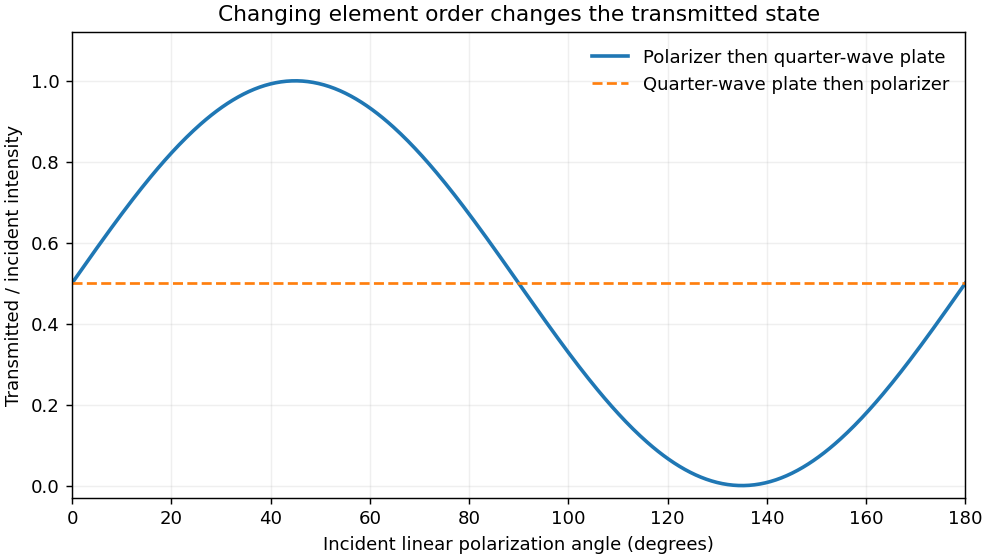
Transmitted intensity versus incident linear polarization for the two element orders
. Details. With the stated normal mirror after the original system, an arbitrary incident field is first projected onto and then made circular. In fixed laboratory transverse axes, the mirror contributes a common reflection phase, and the reciprocal return plate contributes another . The round-trip matrix is consequently proportional toThe returned field is orthogonal to the polarizer and is blocked. This suppresses the stipulated specular return toward a source, useful for avoiding optical feedback. The result concerns that mirror and return geometry; a reciprocal circular-polarizer assembly does not provide the general nonreciprocal two-port property of a Faraday optical isolator.
Configurational entropy counts the arrangements compatible with a macroscopic configuration: . Let , and . The multiplicity is . Stirling's approximation therefore givesWith downward positive, the gravitational potential energy is . Minimizing the Helmholtz free energy gives , henceRaising temperature reduces the extension: the entropic preference for many up/down arrangements opposes alignment by the load. For small loads, .
For the positive-feedback entropic chain with replacement force , , the conservative potential is . Using would overcount it by a factor two. The stationary equation becomesExpansion about givesFor the stable extension is zero. Below , nonzero minima appear, with close to the transition and as . Restricting to downward extensions selects the positive branch. The onset is continuous in this model, with a nonanalytic mean-field change at ; a finite jump in does not follow from the printed force law, despite the question's discontinuity wording. A finite chain has rounded fluctuations rather than a literal thermodynamic singularity.
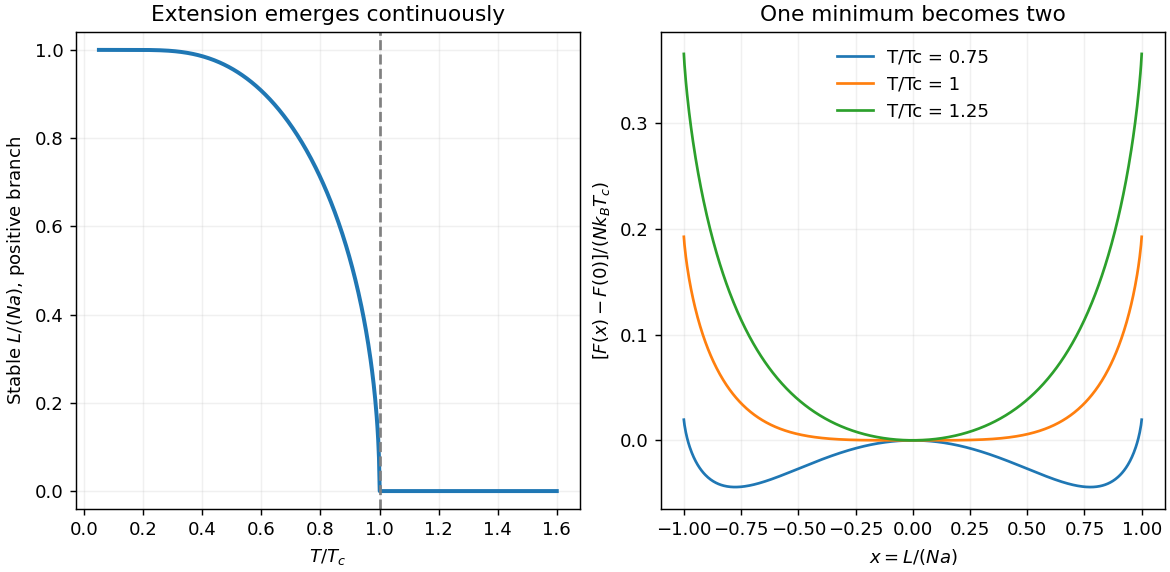


This is the same self-consistency equation as the zero-field mean-field treatment of the Ising model: the segment orientation corresponds to a spin, extension to magnetization, and the extension-dependent force to the self-consistent molecular field. The competition between alignment energy and binary configurational entropy explains the shared temperature dependence.
In the basis , . Its normalized eigenstates are and , with eigenvalues and . Expanding the initial state in this basis and evolving the two phases gives, with ,The sign of fixes rotation sense; the probability is insensitive to that sign.
In the Stern-Gerlach experiment, a collimated atomic beam passes through a strongly nonuniform magnetic field. The force component separates magnetic-moment projections spatially. Silver atoms provide an effective spin-half moment, yielding two resolved components rather than a continuous distribution of deflections. To test the rotation above, use a first analyzer and aperture to prepare , pass that selected beam through a controlled approximately uniform -directed field, and analyze it with a second -oriented Stern-Gerlach magnet. Varying field strength or interaction time changes the two output populations as the calculated cosine and sine squares. A narrow velocity distribution and controlled field-entry geometry preserve the contrast by reducing variations of interaction time and unwanted spin evolution.
For charge per length , Gauss's law gives between the conductors. Integration gives . Similarly Ampère's law gives ; integrating the magnetic energy per length and setting it equal to givesHere are per unit length. The displayed is the external TEM inductance, appropriate to the ideal surface-current/high-frequency model. Internal magnetic energy in conductors with appreciable current penetration adds internal inductance; it cannot be determined fully from an outer conductor with unspecified wall geometry.
The distributed series resistance and inductance, with shunt capacitance and negligible leakage, give the telegrapher's equationsDifferentiate the first with respect to and substitute the second to obtainFor the forward attenuating branch has . When ,The positive imaginary part gives amplitude . Power decays twice as fast in its exponent, so its attenuation length is . Finite conductivity changes the speed only at higher order in this constant-parameter weak-loss expansion, apart from any separately retained internal inductance or dielectric response.
The proper time satisfies . The collinear transformation from the Earth frame into the instantaneous rest frame gives proper acceleration , soStarting from rest, integration gives . HenceSince , a further integration givesUsing Julian years and gives , so the star is about light years away in the Earth frame. The Earth-frame travel time is about years and the final speed is about . The model accelerates toward the star throughout; adding a braking leg would be a different itinerary.
Substitution of a plane wave in the Schrödinger equation gives . For a stationary step-scattering state, remove the common phase and write , . If , the right-side outgoing wave is , . A finite step with no delta-function potential in the Schrödinger operator requires continuous and : a discontinuous wavefunction would generate a delta derivative, and integrating the equation over a vanishing interval gives derivative continuity. Matching yieldsFor , take and the bounded right-side state . It carries no transmitted flux and . The threshold limit also has reflection probability one. Thus at ,For the two-step profile, set , and . With all regions propagating, the net reflection amplitude isThe given quarter-wave condition makes . Zero reflection then requires , equivalent to . ConsequentlyFor an increasing intermediate step this needs and , together with the stipulated thickness condition. In this quarter-wave matching layer for a quantum potential step, two reflected amplitudes cancel while the transmitted flux equals the incident flux.
Articles by others on the same topic
There are currently no matching articles.