The quasistatic pressure-volume work done on the body is . If its volume remains constant throughout the process, every vanishes, so the work is zero. Equal initial and final volumes alone would not suffice: an expansion and compression cycle can have nonzero work. Other work modes are excluded by this simple elastic-volume model.
Within the stated small-volume-change approximation, treat in the differential constitutive law as constants. ThenPath (a) first changes temperature at pressure , then changes pressure at fixed temperature . The two contributions are and . ThereforeWork is path dependent even though the endpoints and approximate total volume change are the same.
Path (b) changes pressure before temperature. Its pressure integral is unchanged, but the thermal expansion occurs at :Along the straight path (c), . Thus , while depends only on the pressure endpoints. ConsequentlyThis pressure-temperature path-work identity is a consequence of the linearized volume law and the straight interpolation. It need not hold for strongly varying compressibility or expansion coefficient.
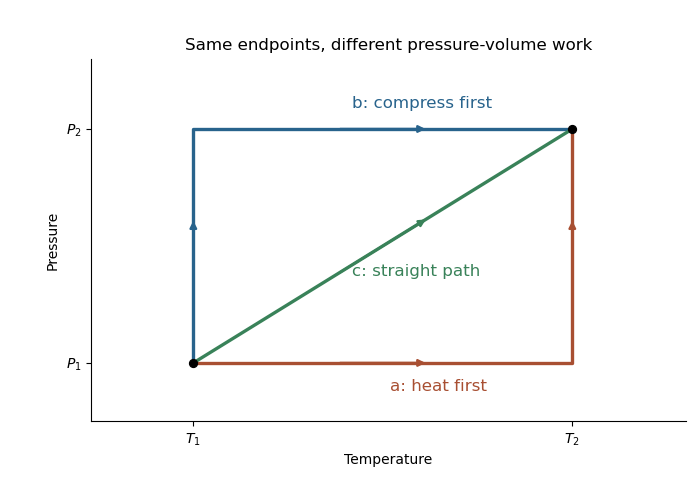

The depicted endpoints have and . For positive thermal expansion coefficient,Thus path (b) requires the least work on the solid, path (a) the most, and path (c) lies midway between them. Heating at the higher pressure produces more negative work on the system. The ordering would reverse for a negative expansion coefficient; if the product vanishes, the paths have equal work in this approximation.
Articles by others on the same topic
There are currently no matching articles.