For a finite step in a one-dimensional potential and constant mass, the stationary Schrödinger equation requires continuity of the wavefunction and its first derivative. A discontinuous derivative would introduce a delta-function term in its second derivative, unsupported by a merely finite step. A discontinuous wavefunction is still more singular. A delta-function potential has a different derivative jump condition; an infinite wall instead imposes zero wavefunction and does not require matching to an exterior zero derivative.
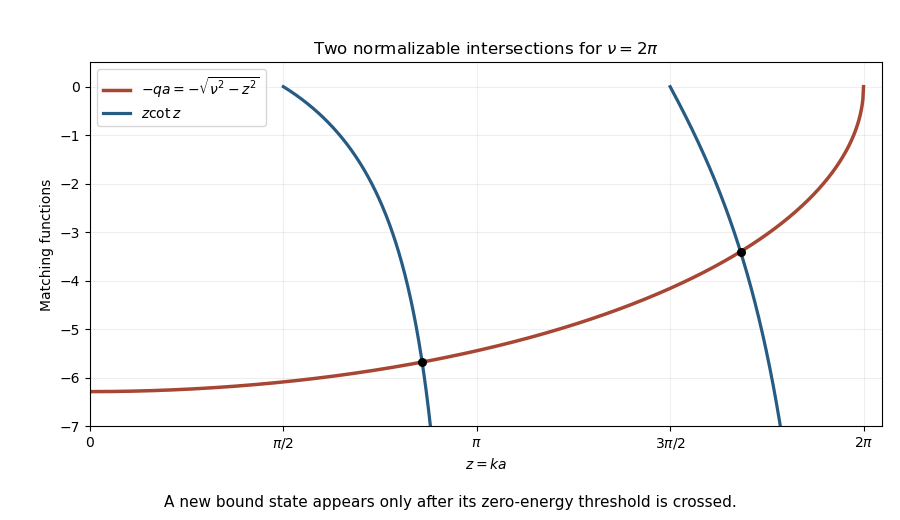
For a bound state of the half-well, . The wall at zero excludes a cosine term, and square integrability excludes exponential growth outside. WriteContinuity at gives and . HencePut , , and . Matching becomes with , . The negative branches of occur on . There is one bound-state intersection in the th interval exactly whenAt equality the new level has , so its outside tail is constant and not normalizable: it is a threshold state, not a bound state. Thus no bound state exists for , including the strict inequality asked in the question.
Exactly two negative-energy bound states require the second threshold to have been crossed and the third not crossed:The lower endpoint is excluded and the upper endpoint included precisely because a zero-energy threshold state does not count as bound. This half-line finite-well bound-state count differs from an unrestricted symmetric one-dimensional well, which has no hard wall at its centre.

Black-body radiation is the equilibrium electromagnetic radiation associated with a perfect absorber, whose spectrum is fixed by its temperature and the available modes. Photons can be emitted and absorbed, so their equilibrium chemical potential is zero. The model here retains two transverse polarizations in an effectively one-dimensional cavity; the resulting pressure is a one-dimensional mechanical force, not a three-dimensional pressure in pascals.
Standing-wave wave numbers are , with one positive mode index and two polarizations. Since , the continuum density of states isThe factor two counts polarizations; counting independent positive and negative traveling momenta in addition would double count standing modes. The thermal energy isThus the one-dimensional photon-gas thermodynamics givesReplacing the mode sum by an integral requires the stated temperature to be large compared with the level-spacing scale. This is thermal energy above the vacuum contribution; a separate boundary-dependent vacuum energy is not included.
Differentiating at fixed length gives the heat capacityThe linear temperature dependence reflects the constant one-dimensional mode density, in contrast to the cubic dependence of a three-dimensional photon gas.
Write , so . At fixed length, , giving with the entropy constant fixed by the unique photon vacuum. The thermal Helmholtz free energy and generalized pressure follow:The entropy constant can also be checked from the exact discrete photon partition function; the continuum approximation should not be extrapolated blindly below its level-spacing regime. In one dimension , whereas the isotropic three-dimensional relation is . Both follow from the number of spatial directions carrying momentum flux.
The quasistatic pressure-volume work done on the body is . If its volume remains constant throughout the process, every vanishes, so the work is zero. Equal initial and final volumes alone would not suffice: an expansion and compression cycle can have nonzero work. Other work modes are excluded by this simple elastic-volume model.
Within the stated small-volume-change approximation, treat in the differential constitutive law as constants. ThenPath (a) first changes temperature at pressure , then changes pressure at fixed temperature . The two contributions are and . ThereforeWork is path dependent even though the endpoints and approximate total volume change are the same.
Path (b) changes pressure before temperature. Its pressure integral is unchanged, but the thermal expansion occurs at :Along the straight path (c), . Thus , while depends only on the pressure endpoints. ConsequentlyThis pressure-temperature path-work identity is a consequence of the linearized volume law and the straight interpolation. It need not hold for strongly varying compressibility or expansion coefficient.
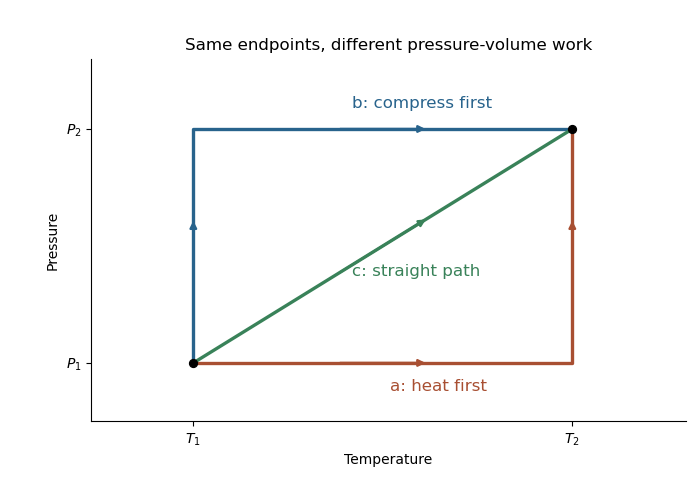

The depicted endpoints have and . For positive thermal expansion coefficient,Thus path (b) requires the least work on the solid, path (a) the most, and path (c) lies midway between them. Heating at the higher pressure produces more negative work on the system. The ordering would reverse for a negative expansion coefficient; if the product vanishes, the paths have equal work in this approximation.
Three experimental tests probe different consequences of special relativity. The Michelson-Morley experiment compares light round trips along perpendicular interferometer arms while changing the apparatus orientation. Its small observed orientation-dependent fringe shift contradicts the simple stationary-aether prediction and supports orientation-independent round-trip light speed. It does not, alone, exclude every alternative theory.[ref]
On the Relative Motion of the Earth and the Luminiferous Ether by Albert Abraham Michelson and Edward W. Morley. 1887 apparatus and fringe-shift comparison
In the muon storage-ring time-dilation experiment, fast circulating muons live longer in laboratory time than muons at rest. Measuring decay counts versus elapsed laboratory time and independently determining the beam Lorentz factor tests . Circular motion includes acceleration, so this also tests the applicability of accumulated proper time along the stored trajectory.[ref]
Measurements of relativistic time dilatation for positive and negative muons in a circular orbit by J. Bailey and others. storage-ring lifetime measurements and comparison with the relativistic factor
Bertozzi's electron speed-energy experiment measures electron time of flight and deposited kinetic energy independently. An electrostatic accelerator and a linear accelerator increase the energy while the measured speed approaches the light-speed limit. Calorimetry checks that the additional beam energy is real, rather than inferring it only from an assumed voltage-to-speed relation. The result supports relativistic rather than extending to arbitrarily large speeds.[ref]
Speed and Kinetic Energy of Relativistic Electrons by William Bertozzi. 1964 abstract: time-of-flight measurements over 0.5–15 MeV and independent calorimetry
For the two ships, set launch time to zero and measure Earth time in years. Their Lorentz factors are and . Bob's thirtieth birthday occurs after one year of his proper time, so its Earth coordinates areIf Alice sends at Earth time , her position is . The left-going light signal obeys . Intersection with Bob givesAlice's elapsed proper time is thereforeShe sends two months after her twenty-ninth birthday. This compares the emission and reception events; the captains' clocks need only be synchronized at launch, not kept numerically synchronized afterward.
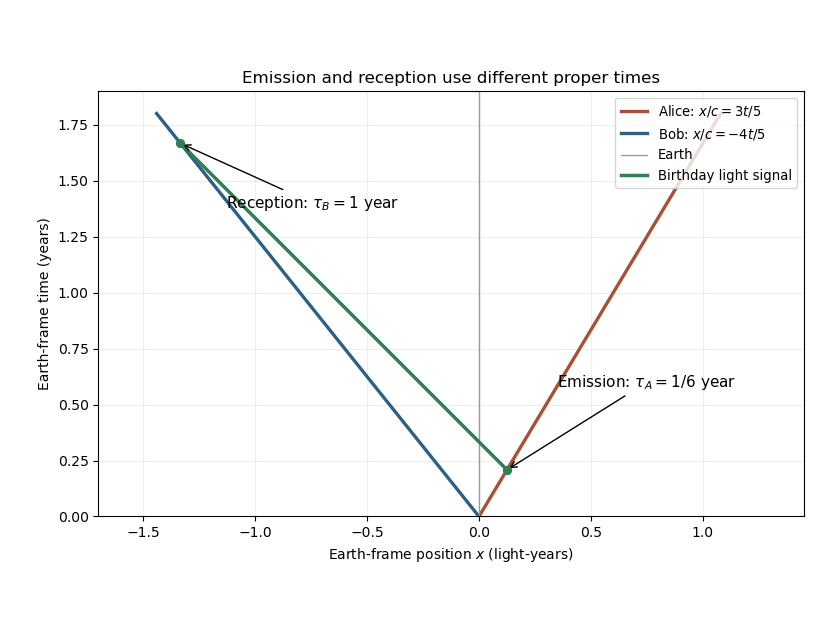

The relative recession speed isThe longitudinal relativistic Doppler effect then givesEquivalently, the left-going photon has Earth frequency , and Bob's frame supplies another factor . Both methods give the same redshift.
Newton's law of universal gravitation gives the force on a test mass a distance from a point source. Gauss's law for gravity statesThe inverse-square point field has the stated flux through a surrounding sphere. Superposition extends it to distributed sources; the divergence theorem relates the integral and local forms. Symmetry is still needed to turn a flux into a pointwise field value.
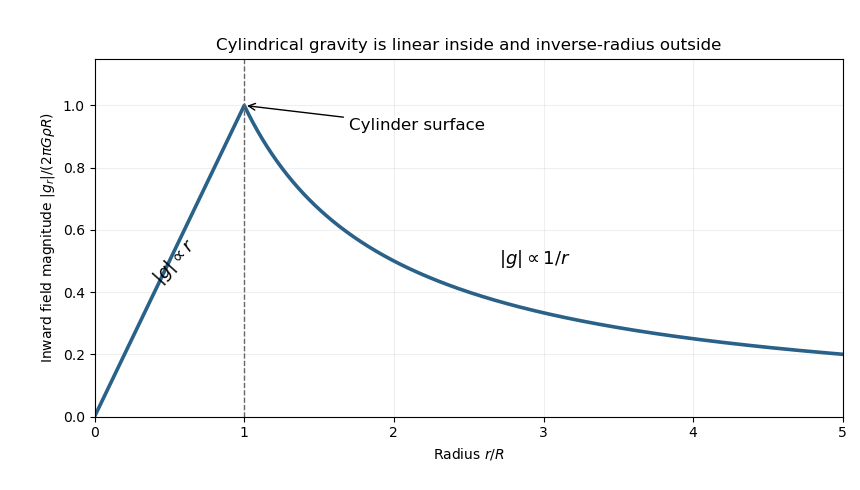
For the gravitational field of an infinite uniform cylinder, a coaxial cylindrical Gaussian surface has no end-cap flux and constant inward field on its curved surface. The enclosed mass per unit length is inside and outside. HenceIts magnitude rises linearly from zero, reaches at the surface, then decreases as . The field is continuous at , while its radial derivative changes because the density has a sharp edge.

Use signed distance along the diameter hole. A rod displaced by occupies , so its force is . At equilibrium symmetry makes . Differentiating the moving endpoints givesThus the leading restoring force and oscillation frequency areFor an explicit positive-displacement check, put and integrate the inside and outside pieces for :Its first-order term is , agreeing with the endpoint argument. The result is the diameter-rod oscillation in cylindrical gravity; it assumes a sufficiently long source cylinder and a narrow hole whose removed mass can be neglected.
The electric displacement field is . A homogeneous linear isotropic dielectric has , so . At a free-charge-free interface the normal component of D is continuous, while electrostatics requires continuity of tangential E.
At half immersion the conductor centre lies in the flat air-liquid interface. Set in both media, with potential zero at infinity. The sphere is an equipotential, and the potential is continuous across the liquid plane. On that plane the radial E field is tangential, so tangential E agrees while both normal D components vanish. Each half-space also satisfies the source-free potential equation. The fields outside the sphere areGauss's law for D on a sphere gives . ThereforeThe half-immersed conducting sphere in a dielectric has radial E lines with equal field strength at equal radius on either side, whereas the D flux density is times larger in the liquid. The corresponding free surface charge is larger on the lower hemisphere. The unchanged field direction at this particular interface follows from its tangential geometry, not from a claim that electric fields never refract at dielectric interfaces.
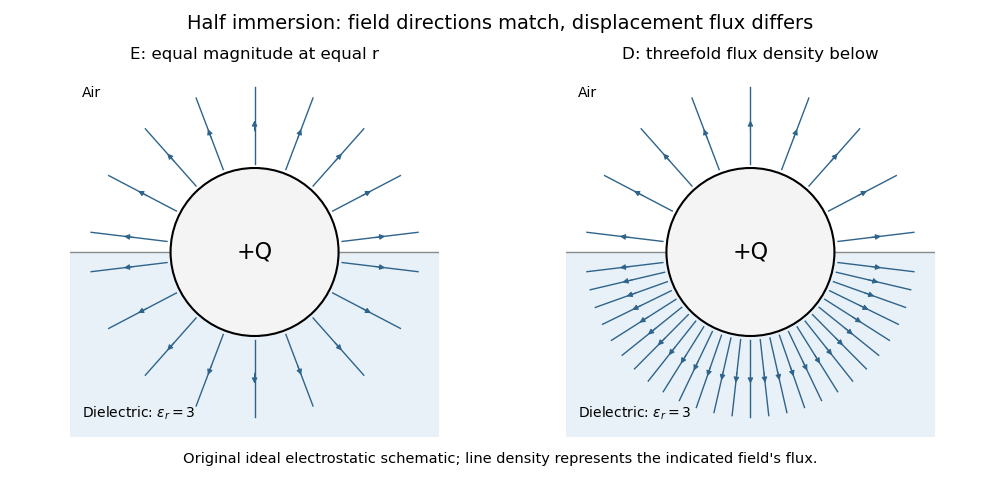

The outward electrostatic pressure is . Integrating its vertical component over the two hemispheres uses and the negative of that integral below. ThusThe force is downward for . Initially, buoyancy on the uncharged sphere gives . At half immersion the upward buoyancy is therefore , leaving a required downward electric force . Equating the two givesThis uses the ideal flat-interface, linear-dielectric model with surface tension and interface deformation neglected. If , there is no electric force of this kind, consistently preventing this mechanism from pulling an initially less-than-half-immersed sphere down to the specified level.
A magnetic dipole is the leading magnetic source moment of a localized steady current distribution. For a small planar loop, with area orientation set by the right-hand rule. A fixed permanent moment in a slowly varying external field has energy and force .
For the given purely azimuthal vector potential, the spherical curl givesThese are the magnetic dipole field components outside the localized source.
The conducting shell has and surface charge density . A latitude strip of area carries current . Its loop area is , givingIn vector form the magnetic moment of a rotating charged spherical shell isThe positive-z expression in the question takes . “Clockwise” needs a viewing direction: this rotation looks clockwise when viewed looking along from below, and counterclockwise when viewed from the positive-z side. Looking from the other end reverses the verbal label, not the vector relation.
Since the positive charge and the loop current circulate in the same stated sense, their dipole moments are parallel when judged from a common viewpoint. At , the loop's axial field magnitude is . With the sphere small compared with that variation scale,The magnetic force is attractive, pulling the sphere toward the loop. Reversing only one circulation would reverse that magnetic force. The calculation treats the rotating charge as a prescribed moment and uses the stated separated length scales; it does not add unrelated induction or electric interactions to the dipole model.
Let be the real rotation matrix with columns along the plate's fast and slow axes. Expressing the input in those axes, applying the principal retardance, then rotating back gives the rotated half-wave plate matrixEach fixed quarter-wave plate has in the supplied convention. Propagation through the three plates therefore givesThe order matters: this is a product of three propagating plates, not a similarity transformation . For input Jones vector , the Pauli matrix has eigenvalue , so . The final polarization remains at 45 degrees, but its phase depends on the rotating angle.
Take the physical field as the real part of and let . ThenThus the rotating half-wave plate frequency shift hasThe magnitude is the stated shift. Its sign follows the explicit time and rotation conventions above; reversing the physical rotation or using the orthogonal linear input reverses the shift. A time-phasor convention must be changed consistently with the plate matrices, rather than used alone to change a physical redshift into a blueshift.
The physical origin is a rotational Doppler effect and angular-momentum exchange. In the stated convention, the first fixed quarter-wave plate changes the 45-degree input into circular polarization of spin per photon. The rotating half-wave plate flips it to spin , transferring to the rotating plate. Maintaining its rotation takes mechanical energy from each photon, agreeing with the redshift. The final fixed plate restores linear polarization; fixed plates can exchange angular momentum with their supports without the rotating element's corresponding mechanical work. The instantaneous Jones treatment assumes slow rotation compared with optical and transit-time scales and ideal retardances over the small shifted bandwidth.
Articles by others on the same topic
There are currently no matching articles.