The electric displacement field is . A homogeneous linear isotropic dielectric has , so . At a free-charge-free interface the normal component of D is continuous, while electrostatics requires continuity of tangential E.
At half immersion the conductor centre lies in the flat air-liquid interface. Set in both media, with potential zero at infinity. The sphere is an equipotential, and the potential is continuous across the liquid plane. On that plane the radial E field is tangential, so tangential E agrees while both normal D components vanish. Each half-space also satisfies the source-free potential equation. The fields outside the sphere areGauss's law for D on a sphere gives . ThereforeThe half-immersed conducting sphere in a dielectric has radial E lines with equal field strength at equal radius on either side, whereas the D flux density is times larger in the liquid. The corresponding free surface charge is larger on the lower hemisphere. The unchanged field direction at this particular interface follows from its tangential geometry, not from a claim that electric fields never refract at dielectric interfaces.
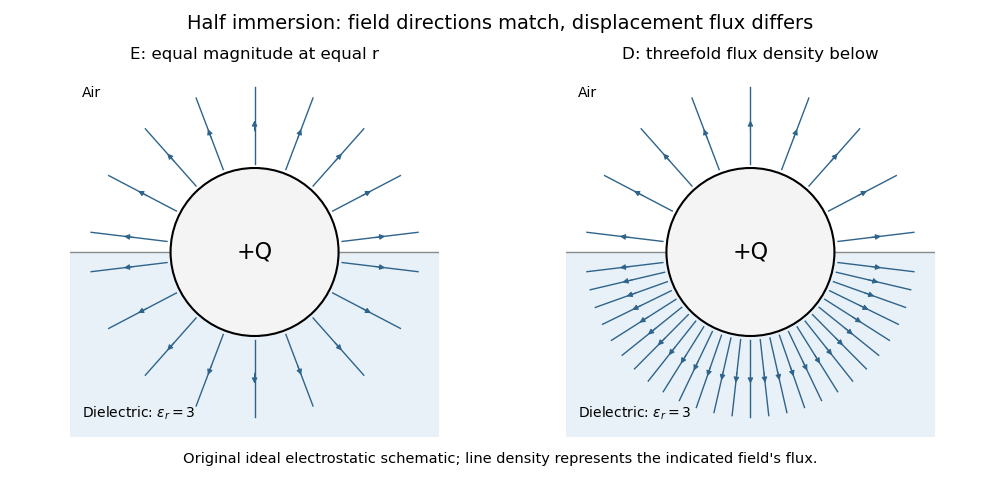

The outward electrostatic pressure is . Integrating its vertical component over the two hemispheres uses and the negative of that integral below. ThusThe force is downward for . Initially, buoyancy on the uncharged sphere gives . At half immersion the upward buoyancy is therefore , leaving a required downward electric force . Equating the two givesThis uses the ideal flat-interface, linear-dielectric model with surface tension and interface deformation neglected. If , there is no electric force of this kind, consistently preventing this mechanism from pulling an initially less-than-half-immersed sphere down to the specified level.
Articles by others on the same topic
There are currently no matching articles.