The classical minimum is , attained at . The quantum oscillator has , its zero-point energy; simultaneous zero position and momentum uncertainties are forbidden.
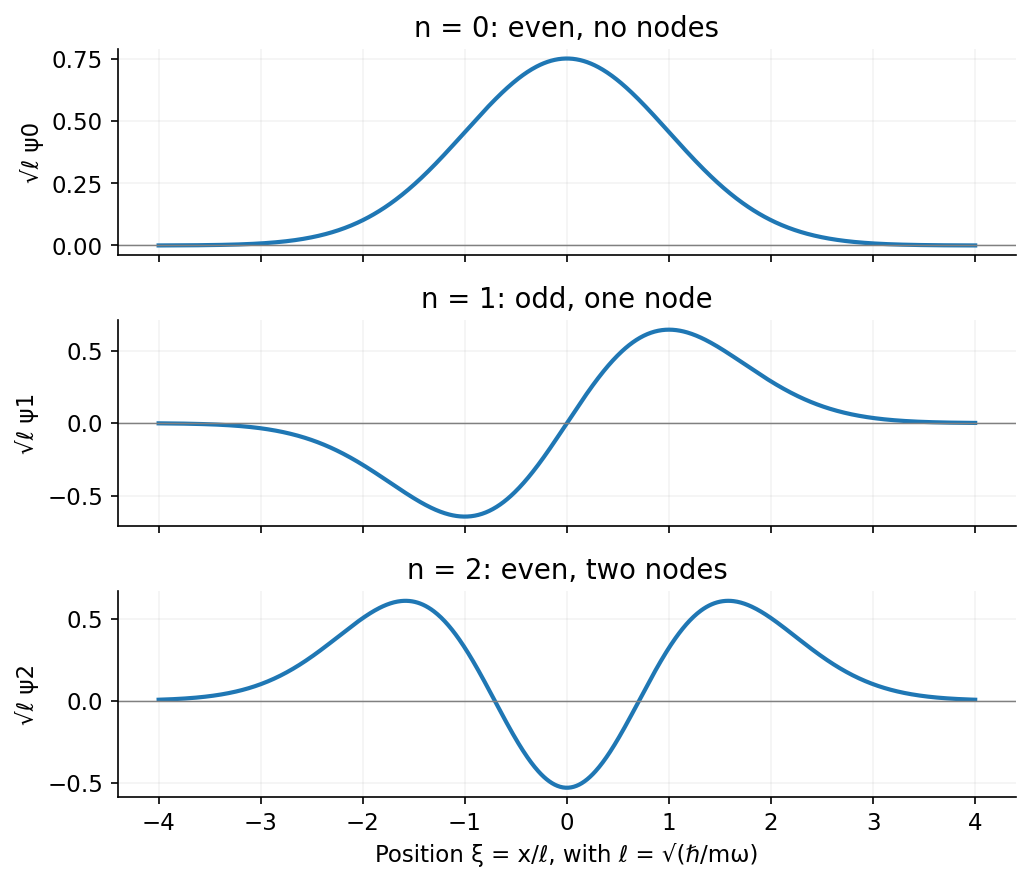
Let and . The first three normalized harmonic oscillator eigenfunctions areThey have respectively zero, one and two nodes, with even, odd and even parity. Their phases may be reversed without changing the state.[ref]

Invert the given ladder operators:Because the Energy eigenstate are orthonormal, : each operator changes the state to one orthogonal to . HenceThe result also follows from the definite parity of every oscillator energy eigenfunction, but here it follows directly from the specified operators.
Orthogonality gives , while the ladder coefficients give and . Squaring the expressions for and therefore givesThusTheir equality is the harmonic-potential case of the quantum virial theorem, and their sum is the oscillator energy .
For the uncertainty product of oscillator number states, the two means vanish, so the standard deviations are the square roots of the second moments:Consequently,Only the ground state saturates the Heisenberg uncertainty principle in this sequence of energy eigenstates; the excited number states have a larger uncertainty product.
Articles by others on the same topic
There are currently no matching articles.