The Stefan–Boltzmann law gives the radiated luminosityFor radiative mass loss at fixed luminosity, using mass-energy equivalence, the mass-loss magnitude and one-percent time areThe numerical constants are the external CODATA 2014 and ; years here mean 365.25 days.[ref]
CODATA recommended values of the fundamental physical constants 2014 by National Institute of Standards and Technology. Stefan-Boltzmann constant and vacuum light speed
This estimates radiative mass loss with the supplied radius and temperature held constant. It does not predict a real stellar lifetime or include solar-wind mass loss.For this molecular escape-speed temperature estimate, . Equating this to the surface escape-speed square givesThis evaluation keeps the paper's and , and uses externally documented , and .[ref]
Earth Fact Sheet by National Aeronautics and Space Administration. Bulk parameters: gravitational parameter GM
[ref]CODATA recommended values of the fundamental physical constants 2014 by National Institute of Standards and Technology. Atomic mass constant and Boltzmann constant
The corresponding escape speed is about .This is the requested speed-scale comparison. Atmospheric escape can occur from the high-speed tail at lower temperature; molecular dissociation and ionization also prevent treating an actual gas at this temperature as unchanged neutral nitrogen molecules.
For the potential of an inverse-radius spherical charge density, assume there is no additional point charge at the origin and choose . The enclosed charge is for , and outside. Gauss's law then givesIntegrating the field inward from infinity,The potential and its first radial derivative are continuous at , since there is no surface charge there. The integrable density singularity has a finite potential limit .
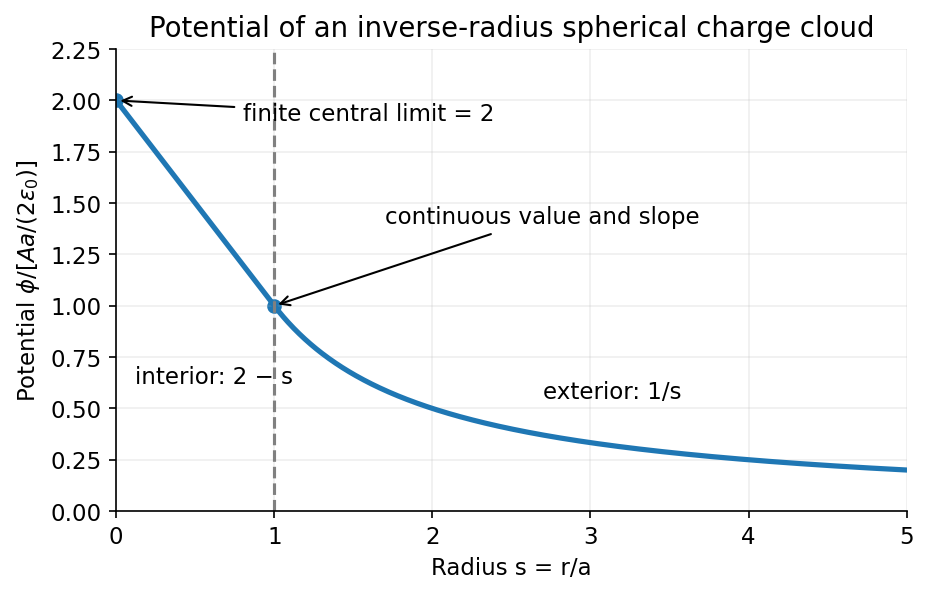
The potential falls linearly inside the inverse-radius charge cloud and joins a reciprocal-radius exterior tail
. Source. Details. For the ultrarelativistic magnetic bending radius, the Lorentz force supplies the transverse momentum change, so . At this energy the proton is ultrarelativistic, giving andThe electronvolt-to-joule conversion cancels the elementary-charge factor numerically. This uses external CODATA light speed and charge definitions.[ref]
CODATA recommended values of the fundamental physical constants 2014 by National Institute of Standards and Technology. Vacuum light speed and electronvolt conversion
If the stated beam energy means total energy, ; if it means kinetic energy, . Either interpretation gives the quoted radius at the precision of the supplied numbers.For contact loss on a smooth sphere, let be the angle from the upward vertical. In the limit of an infinitesimal initial displacement, conservation of energy gives . The inward radial equation isContact is lost at , so and . The distance travelled along the sphere is thereforeThe vertical drop is instead ; it is not the requested arc length. Exact rest at the unstable top would persist in the ideal mathematical solution, so the infinitesimal-displacement limit in the question is essential.
For the focal length of a rotating liquid mirror, consider steady rigid rotation at angular frequency . The free surface is an equipotential of . HenceA paraboloidal mirror has , givingThe numerical estimate uses the conventional standard acceleration , rather than an asserted local measurement or a recovered handbook entry.[ref]
NIST Guide to the SI, Footnotes by National Institute of Standards and Technology. Footnote 23: conventional standard acceleration of free fall
The mercury density cancels; the ideal surface shape follows from gravity and rotation.The first ideal linear polarizer transmits half of an unpolarized beam. Each subsequent polarizer is from the preceding transmitted polarization, so Malus's law givesIntensities, rather than coherent field amplitudes for different input polarization components, are averaged for the unpolarized beam. The output is polarized along the last polarizer's axis.
The wave numbers before and after the drop are and . Continuity of and at the finite step givesThus the reflected probability flux fraction isThe transmission probability is , rather than simply . Reflection is possible at a downward potential step even though both sides are classically allowed.
For hyperfine coupling for a spin-one nucleus, let the electron spin be and the nuclear spin . First couple , giving , then , giving .
| Allowed | ||
|---|---|---|
For each , the projection is ; electron projections similarly satisfy . Summing gives 18 states for and 30 for , agreeing with .
Notation qualification: if the printed leading “2” denotes the principal quantum number, a hydrogenic bound state does not exist because ; a physical state needs . If a doublet term symbol or was intended, its leading 2 instead means , and the angular-momentum table applies without fixing . The answers above use the explicitly specified values, while retaining this ambiguity.[ref]
Quantum Mechanics by David Tong. Three-dimensional angular momentum and hydrogenic quantum-number restrictions
The fastest clearly resolved late oscillations occupy roughly – per cycle when compared with the major-tick spacing. Thus is of order – and the Nyquist–Shannon sampling theorem requiresA sampling rate of order is the estimated lower boundary for the plotted signal bandwidth; practical acquisition needs anti-alias filtering and margin. This is not a determination of LIGO's actual acquisition rate.[ref]
What the Nyquist Criterion Means to Your Sampled Data System Design by Walt Kester. MT-002: bandwidth-limited sampling and anti-alias filtering
The bit-depth requirements for waveform digitization need a specified precision. The numerical bit depth is underdetermined by the figure. If the digitizer covers a full-scale range and the required quantization step is at most , thenFor a uniform quantizer its ideal quantization-noise rms is approximately . No permitted quantization error, noise criterion or calibrated digitizer range is specified. The plotted reconstruction band does not itself define one. Therefore no unique finite bit count, or exact lossless digitization of an arbitrary real-valued waveform, follows from the supplied data.
In the paper's convention is measured in units of , and is dimensionless. For , the magnetic moment and its Zeeman energy areIf instead denotes dimensional angular momentum, its coefficient must contain . This resolves the units of the printed moment formula.
Write . Summing the Boltzmann factors gives the one-atom partition functionSince , the Brillouin magnetization formula isHere is the total magnetic moment used by the question; the magnetization per unit volume is . For independent distinguishable atoms, , with no indistinguishability factor.
Putting yieldsThe apparent singularities of the hyperbolic cotangents at cancel; the finite sum makes the zero-field limit explicit.[ref]
Statistical Physics by David Tong. Chapter 1: canonical partition functions and independent two-state systems
For , at fixed selects , so all moments align with the field:This is magnetic saturation. The Curie response of an arbitrary independent spin follows at weak field: givesThis is the Curie law of independent moments with paramagnetism. Thermal populations are symmetric at zero field, so the model has no spontaneous magnetization. Both limits hold at fixed positive temperature; taking first is a different limiting procedure.
The Van der Waals equation replaces the freely available volume by to represent short-range repulsion and excluded volume. The attractive mean field reduces the pressure by : particles near the boundary are pulled back into the gas, lowering their momentum transfer to the walls. Both are effective corrections, rather than an exact microscopic interaction law.
The total internal energy and particle number are conserved. The outer container is rigid and isolated, so there is no external work or heat transfer. Its total volume stays , while the volume accessible to the gas increases from to . Neither the gas temperature nor its entropy is generally conserved: this is an irreversible free expansion, with increasing entropy.
At fixed particle number, . The stated Maxwell relation givesFor the intended classical monatomic Van der Waals gas, equipartition supplies : the attractive mean-field term is temperature independent and there are three translational quadratic degrees of freedom. Consequently,The caloric closure of the van der Waals equation is essential. Caloric assumption: the pressure equation alone determines the volume dependence, but not the function . The monatomic kinetic-energy model is the additional assumption behind the claimed formula.[ref]
Statistical Physics by David Tong. Chapter 2: classical monatomic gases and the van der Waals mean-field interaction
Equating the initial and final internal energies, with the same additive constant,soThis is cooling in free expansion of a van der Waals gas. The gas cools because separating attractive particles raises their potential energy at the expense of kinetic energy. The excluded-volume coefficient cancels from this caloric model. The result assumes a homogeneous equilibrium gas with and positive ; a two-phase final state would require a coexistence calculation rather than this homogeneous formula. The ideal-gas limit has no temperature change.
For a fixed contour, Faraday's law of induction isThe second equation is the differential Maxwell equation, related to the first by Stokes theorem. For a moving wire, the relevant motional electromotive force is . Thus a static magnetic field can induce current in a moving circuit even when .
For translational magnetic damping of a square wire loop, while the upper horizontal leg remains in the field, a downward speed reduces the flux at rate . Hence , , and the upward magnetic braking force is . With negligible electrical self-inductance,Let the wire cross-sectional area be , mass density , and resistivity . Since and ,These use the printed copper values and . The wire dimensions cancel. The terminal-speed approximation is restricted to the interval before the upper leg leaves the field, as assumed in the question.
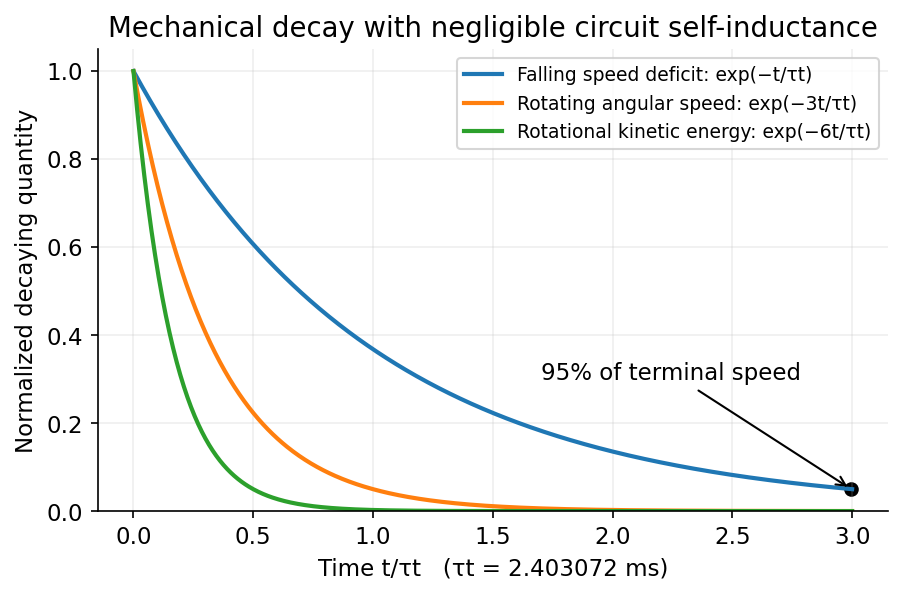
For rotational magnetic damping of a square wire loop, consider rotation about the central axis in a uniform field, the flux is . The induced current produces torque . A thin square loop has moment of inertia : the two legs parallel to contribute , and the other two . Averaging over a rotation givesIf “decay time” means rotational kinetic energy rather than angular speed, gives . This distinction, and the assumed separation between rotation period and slow decay, are essential. The electrical and mechanical time scales in magnetic braking must be separated: electrical self-inductance is neglected in both calculations.
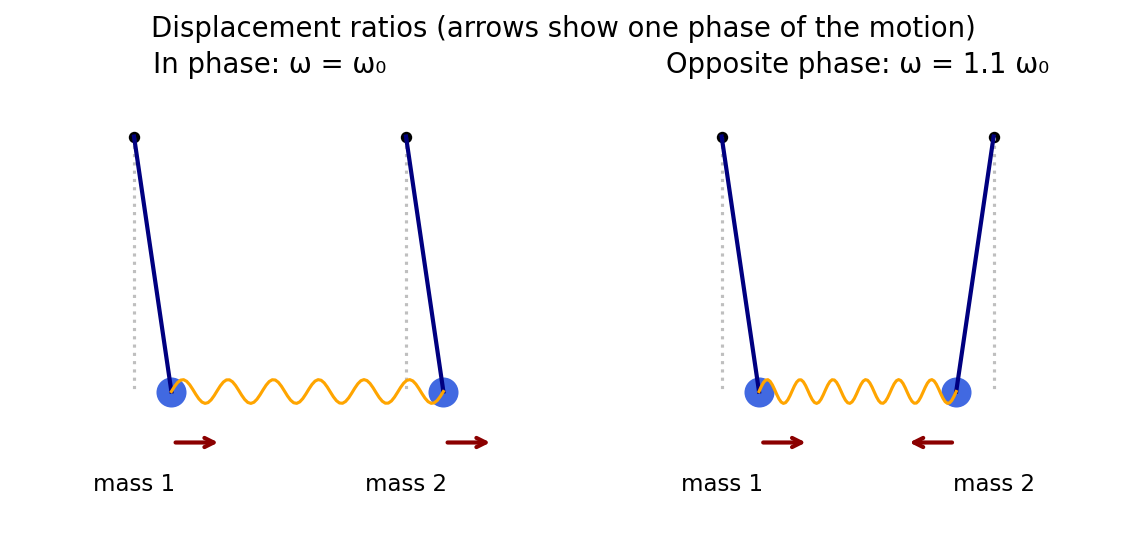
For the normal modes of two spring-coupled equal pendulums, a normal mode has every coordinate oscillating at the same frequency with a fixed displacement ratio. The linearized equations here areTheir normalized displacement patterns and angular frequencies areThe spring is unstretched in the in-phase mode, and stretched or compressed in the opposite-phase mode. The numerical ratio follows from .
The initial displacement is the equal sum of the two mode patterns, and the initial velocities vanish. ThereforeWith the printed this is , with in seconds. The fast oscillation has frequency and the amplitude is bounded by . The first complete displacement transfer is at , when , and both velocities vanish; the original state returns at . Distinguishing absolute and signed beat envelopes, the absolute beat envelope repeats every , although its signed sine factor has period .
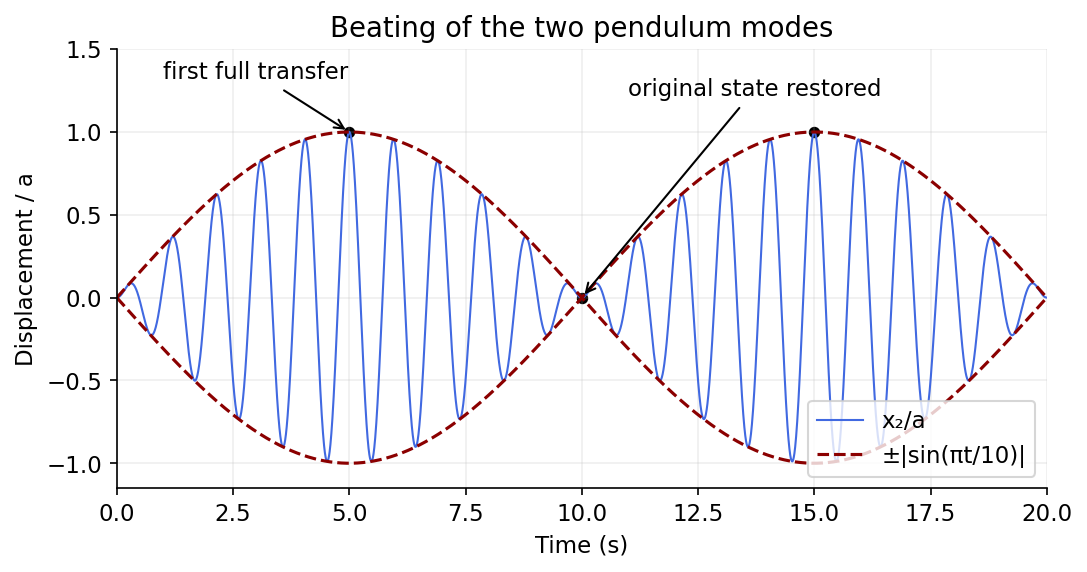
The second pendulum oscillates inside a ten-second beat envelope and first receives the full displacement at five seconds
. Source. Details. Nonrelativistic momentum conservation gives , while an elastic collision conserves kinetic energy, . Squaring the momentum equation yields . The two nonzero outgoing velocities are perpendicular. In the degenerate case where one outgoing particle is at rest, its direction is undefined.
For relativistic collisions conserve total four-momentum, with , and . Rest energies must be included; for photons .
For the symmetric relativistic equal-mass scattering angle, the incident momentum is . Energy conservation gives each final particle , hence . Transverse momenta cancel and , givingThe nonrelativistic limit has , so the outgoing angle is as above.
For the symmetric two-photon annihilation angle in the specified electron-positron annihilation, each photon has energy . Momentum conservation gives , soAs the two photons become back-to-back, transverse to the limiting incident direction; as they are forward collimated. Equal photon energies follow from the specified equal angles, and are not a general property of annihilation in a moving laboratory frame.
Two applications of optical interferometry are precision displacement or strain measurement, and Fourier transform spectroscopy, which recovers a spectrum from an interferogram.
For the round-trip phase in a Michelson interferometer, take a lossless 50:50 beam splitter with and , and mirror reflection amplitude . At the depicted detector, each returning path has one beam-splitter transmission and one reflection. Their amplitudes are and . Consequently,The factor 2 in the phase is the return journey: the labelled is a one-way arm-length difference. The other output port has the complementary intensity. The printed cannot be an intensity: it becomes negative, and does not match the depicted path difference. No choice of normalization fixes that negative minimum. The expression above is the physically consistent result for the drawn output port.
For mutually incoherent spectral components with incident power density ,The plot labels are and ; these printed centres are used here. In the narrow-line, equal-power limit, each line has incident intensity andThere are rapid carrier fringes with approximately mirror-displacement spacing and a slowly varying Interferometric visibility envelope. The first visibility zero is at , and successive visibility revivals are separated byFor the unequal-line visibility in a spectral doublet, with incident line powers , replace the intensity by . The visibility becomesThe visibility minima rise from zero to . The finite widths drawn in the spectrum also make coherence decay with path difference. For example, Gaussian lines of common wave-number standard deviation multiply the oscillatory term by ; the actual linewidth is not specified numerically. Thus the narrow-line plot gives the beat positions, while the true long-delay oscillations die away.[ref]
Interference and Coherence by Sander Konijnenberg, Aurèle J.L. Adam and H. Paul Urbach. Temporal coherence and interference of incoherent spectral components
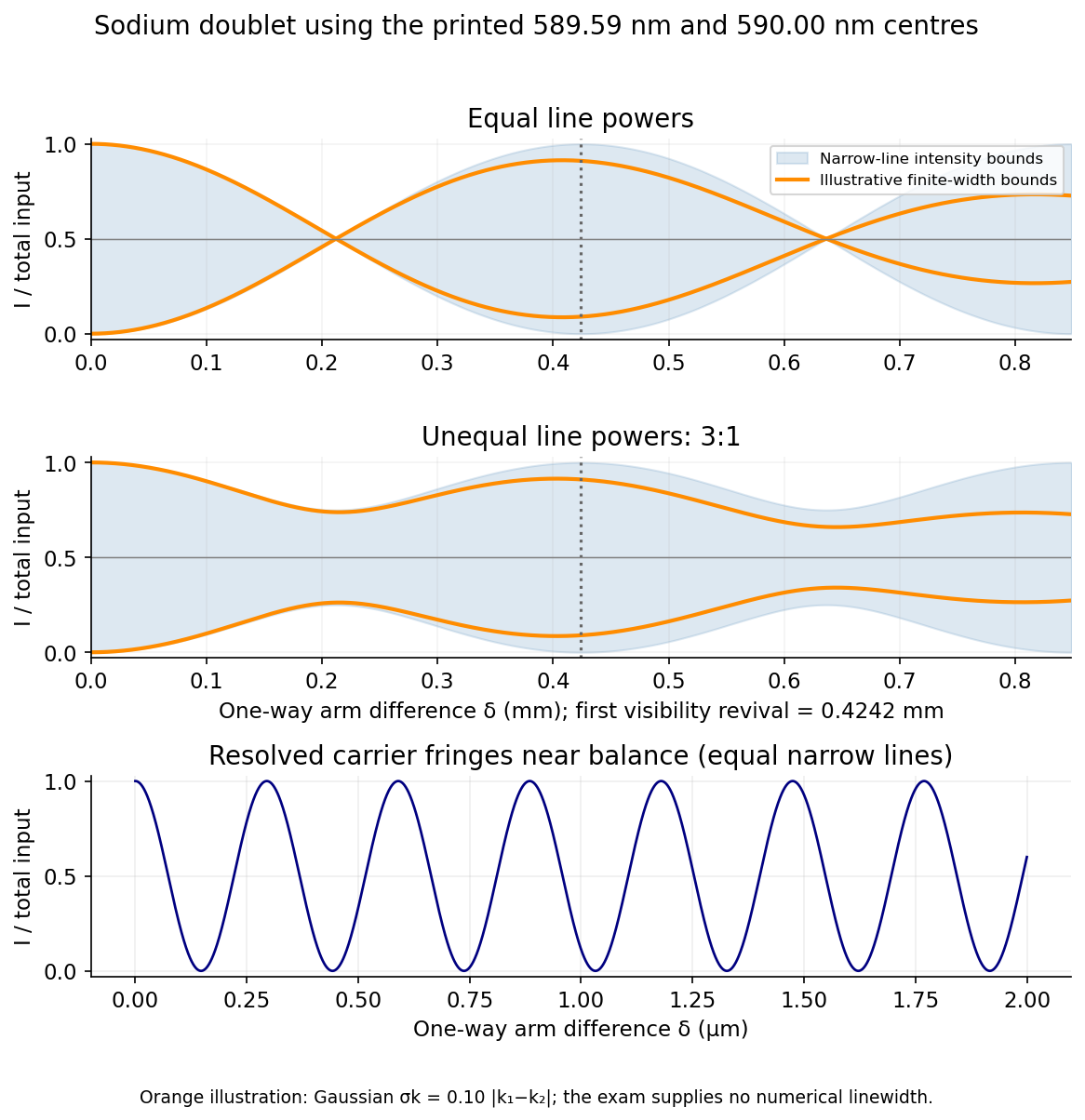
Doublet interferograms: unequal line powers prevent complete loss of visibility; finite linewidth damps the revival envelope
. Source. Details. The common-arm phase cancellation in a balanced interferometer means there is no smallest positive common mirror distance in a balanced interferometer. With the common factor cancels from every intensity, and both paths interfere constructively at this detector for every . Their infimum is zero. The beat length describes changes of arm difference, not of the common arm length. It therefore cannot answer the final request as printed.
The classical minimum is , attained at . The quantum oscillator has , its zero-point energy; simultaneous zero position and momentum uncertainties are forbidden.
Let and . The first three normalized harmonic oscillator eigenfunctions areThey have respectively zero, one and two nodes, with even, odd and even parity. Their phases may be reversed without changing the state.[ref]
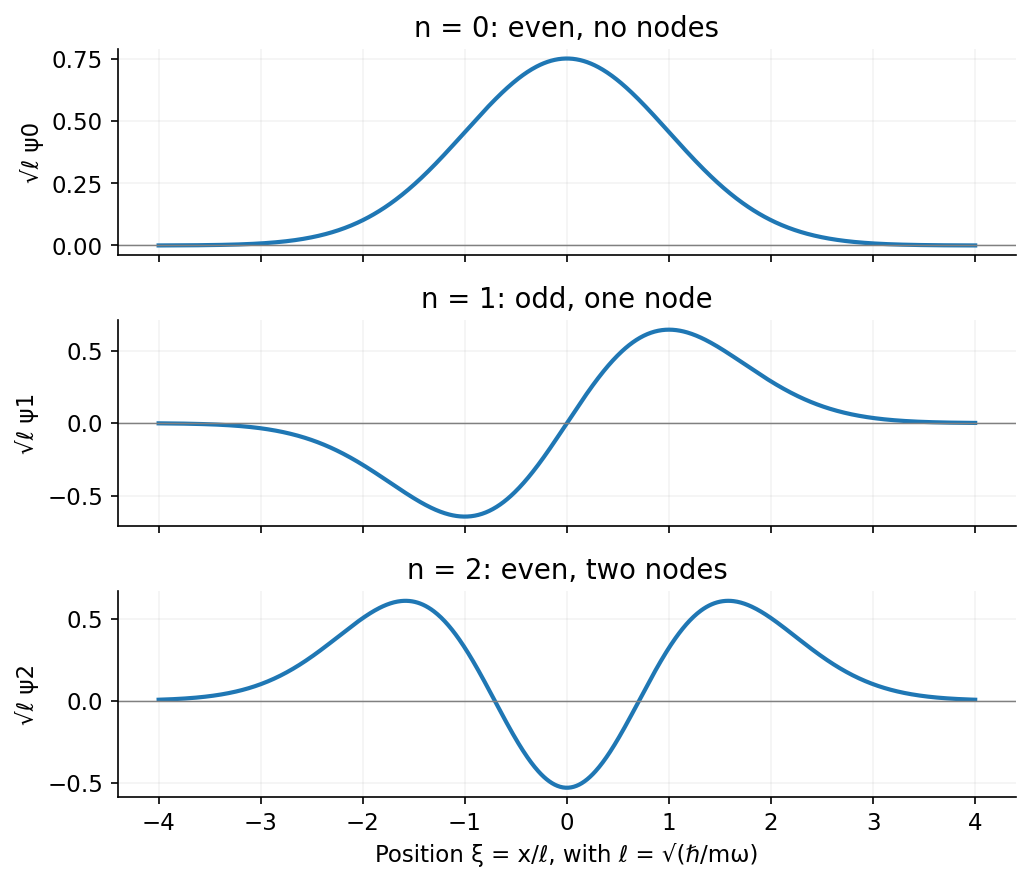


Invert the given ladder operators:Because the Energy eigenstate are orthonormal, : each operator changes the state to one orthogonal to . HenceThe result also follows from the definite parity of every oscillator energy eigenfunction, but here it follows directly from the specified operators.
Orthogonality gives , while the ladder coefficients give and . Squaring the expressions for and therefore givesThusTheir equality is the harmonic-potential case of the quantum virial theorem, and their sum is the oscillator energy .
For the uncertainty product of oscillator number states, the two means vanish, so the standard deviations are the square roots of the second moments:Consequently,Only the ground state saturates the Heisenberg uncertainty principle in this sequence of energy eigenstates; the excited number states have a larger uncertainty product.
In the position representation, the momentum operators are and . Thereforesince at fixed radius. Solving the eigenvalue equation on the circle and imposing periodicity givesTheir normalization uses the angular measure on .
For the half-ring sine-squared angular state, write . The stated wavefunction is normalized because . It and its first derivative match continuously to zero at the boundaries, so the integrations by parts have no boundary contributions. The angular momentum expectation and second moment areHence . The jumps in the second derivative do not invalidate this result: the periodic wavefunction has a square-integrable second derivative and a continuous first derivative.
The probability of is the squared projection onto :The odd sine term gives the imaginary overlap; a real wavefunction need not have zero probability of nonzero angular momentum. Its positive and negative angular-momentum probabilities are equal.[ref]
Quantum Mechanics by David Tong. Chapters 3–4: operator expectation values, angular momentum and eigenstate projections
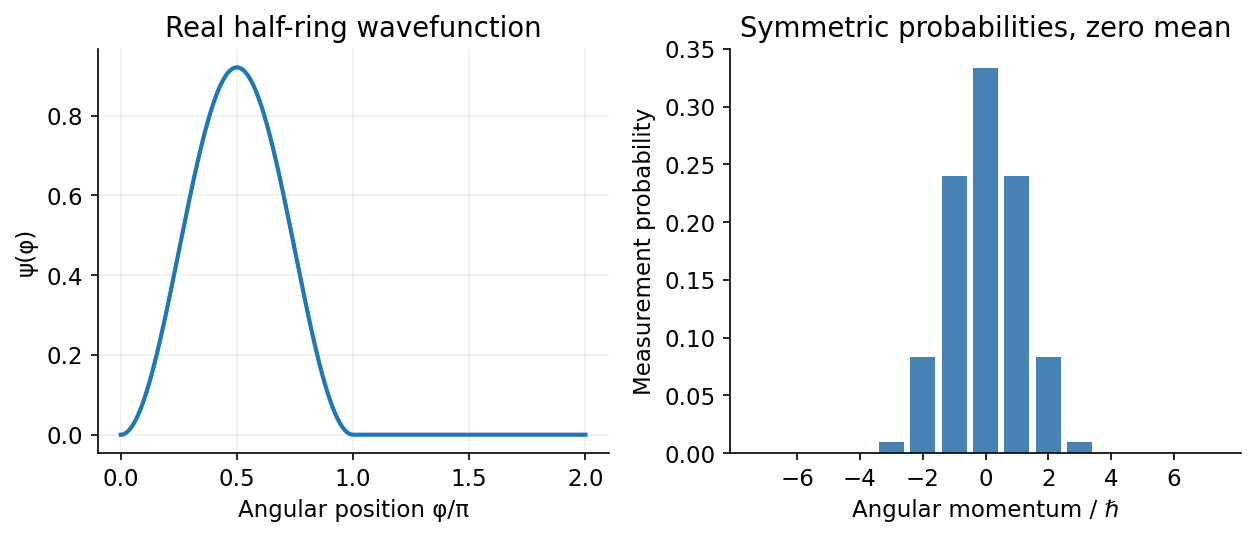
A real state confined to half a ring has zero mean angular momentum and symmetric nonzero measurement probabilities
. Source. Details. 
Articles by others on the same topic
There are currently no matching articles.