Neglecting , the no-settling trajectory is , while the settling trajectory is a downward-curving parabola, . For the given coefficients . At ,The radius is then , with terminal speed , still much less than the updraft. Such droplets are carried almost to cloud top rather than falling as rain. Condensation alone would take about to reach , much longer than the approximately cloud transit time. It also reduces relative radius differences because grows at the same rate for every droplet, leaving inefficient differential gravitational collection. This is the warm-rain growth bottleneck, not a claim that condensation is absent.
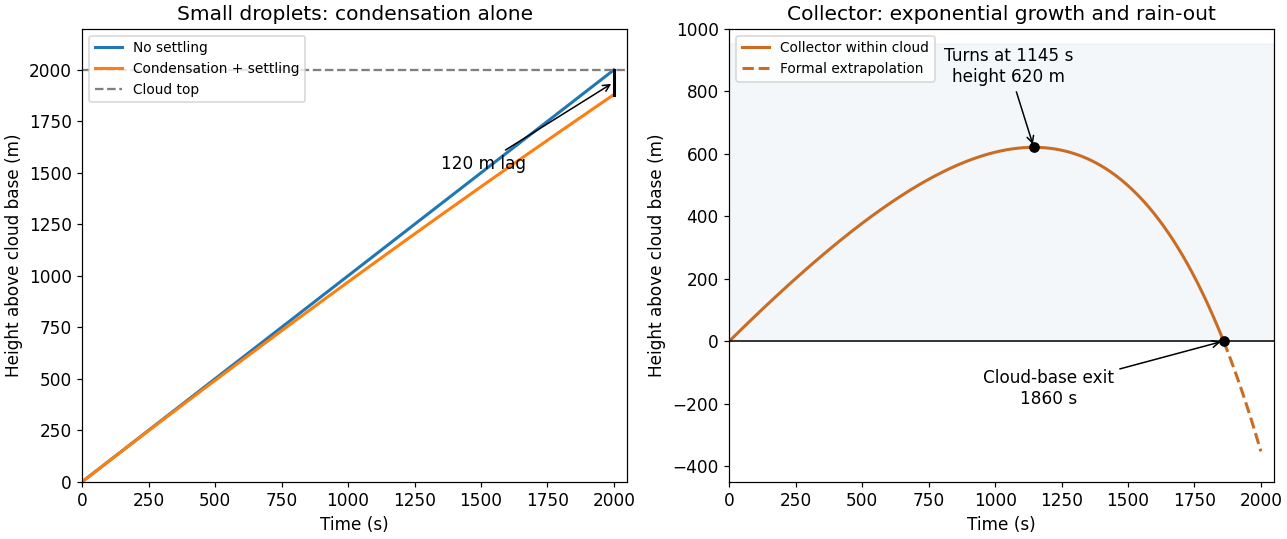
Condensational droplets rise through the cloud while rapidly collecting drops can turn and precipitate
. Trajectories calculated from the two growth models in question 4; the collector curve is solid only while the drop remains within the cloud. The dashed extension below cloud base is a formal extrapolation. Details.
Articles by others on the same topic
There are currently no matching articles.