The first term describes collision-coalescence: a collector sweeps area , overtakes small droplets at relative terminal speed , encounters liquid mass per volume , and retains a fraction of that intercepted liquid. The second term describes diffusion-limited condensational growth, with vapour supersaturation and combined thermal and vapour-diffusion resistances . Condensation is positive for and reverses to evaporation for . The liquid-water content here is a local mass-per-volume quantity, not a vertically integrated liquid-water path.
For an initially monodisperse cloud the relative settling speed vanishes, so there is no gravitational collection term in this model. Set and use . Condensational growth givesTaking upward height from cloud base as positive, the droplet speed relative to the ground is the updraft minus its downward terminal velocity:For a launch at ,This assumes the prescribed uniform updraft and supersaturation persist along the trajectory, and that the Stokes-type radius-squared fall law remains applicable.
Neglecting , the no-settling trajectory is , while the settling trajectory is a downward-curving parabola, . For the given coefficients . At ,The radius is then , with terminal speed , still much less than the updraft. Such droplets are carried almost to cloud top rather than falling as rain. Condensation alone would take about to reach , much longer than the approximately cloud transit time. It also reduces relative radius differences because grows at the same rate for every droplet, leaving inefficient differential gravitational collection. This is the warm-rain growth bottleneck, not a claim that condensation is absent.
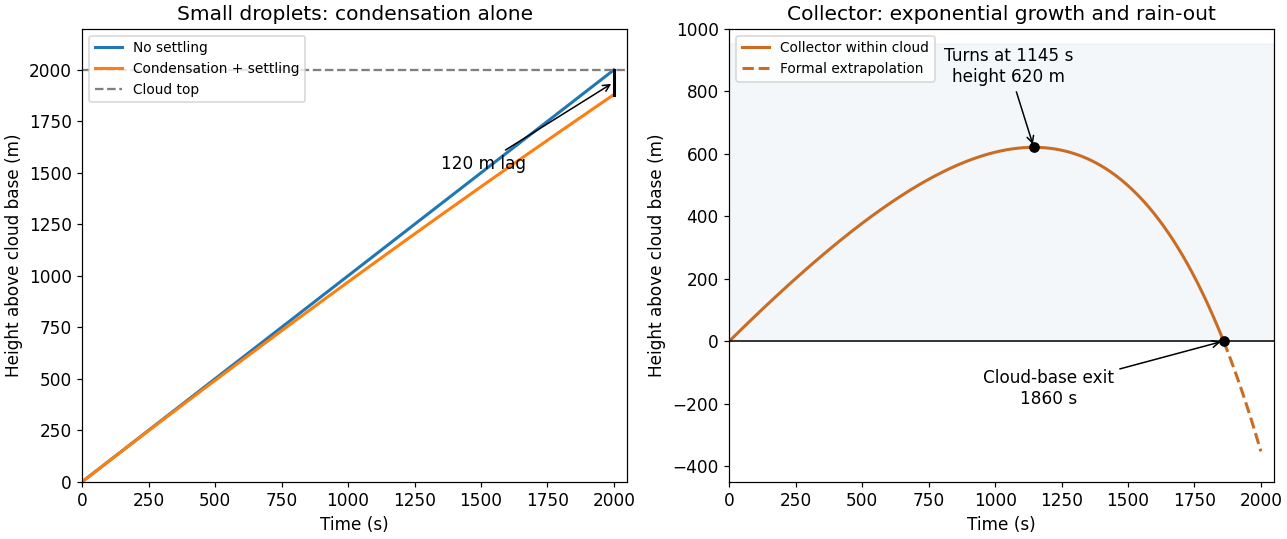
Condensational droplets rise through the cloud while rapidly collecting drops can turn and precipitate
. Trajectories calculated from the two growth models in question 4; the collector curve is solid only while the drop remains within the cloud. The dashed extension below cloud base is a formal extrapolation. Details.
Neglect condensation and the smaller droplets' fall speed, while retaining their specified liquid-water content. For exponential cloud collector growth, the collection law and spherical collector mass giveThus . The growing terminal speed eventually exceeds the updraft, andwhere the last expression uses in seconds and . Numerically,The trajectory reaches maximum height when , at , and . It returns to cloud base near , with radius about . The left-to-right sketch in the preceding figure shows this rise and subsequent fall.
Once the drop leaves the cloud, the prescribed in-cloud , and collection law need not persist. Consequently the negative -second value describes the requested constant-coefficient model's extension, not a prediction that collection continues below cloud base. Its actual subsequent height needs an outside-cloud model. Within the cloud, the exponential feedback between increasing radius and increasing swept volume explains how a minority of collector drops can escape the condensation bottleneck and initiate warm rain; depletion, breakup and changes in fall law eventually limit indefinite exponential growth.
A broad initial cloud-droplet size distribution can be seeded by giant or unusually soluble cloud condensation nuclei, producing a minority of larger droplets before gravitational collection becomes efficient. Variable supersaturation histories, entrainment and mixing can broaden the distribution relative to a perfectly homogeneous monodisperse model. Turbulent relative motion and preferential concentration can increase encounters, and rare successful collisions can create unusually rapid stochastic collectors. These mechanisms can work together; a single deterministic condensational law applied equally to identical droplets cannot create the initial differential fall speeds by itself. For warm rain, the subsequent amplification is liquid collision-coalescence, distinct from ice-phase precipitation mechanisms.
Articles by others on the same topic
There are currently no matching articles.