Assume straight rays in a homogeneous medium. At horizontal distance the source distance is . With ,where and . Clock offsets cancel in a difference measured at one station. The difference curve is symmetric about the epicentre and reaches its minimum directly above the source.
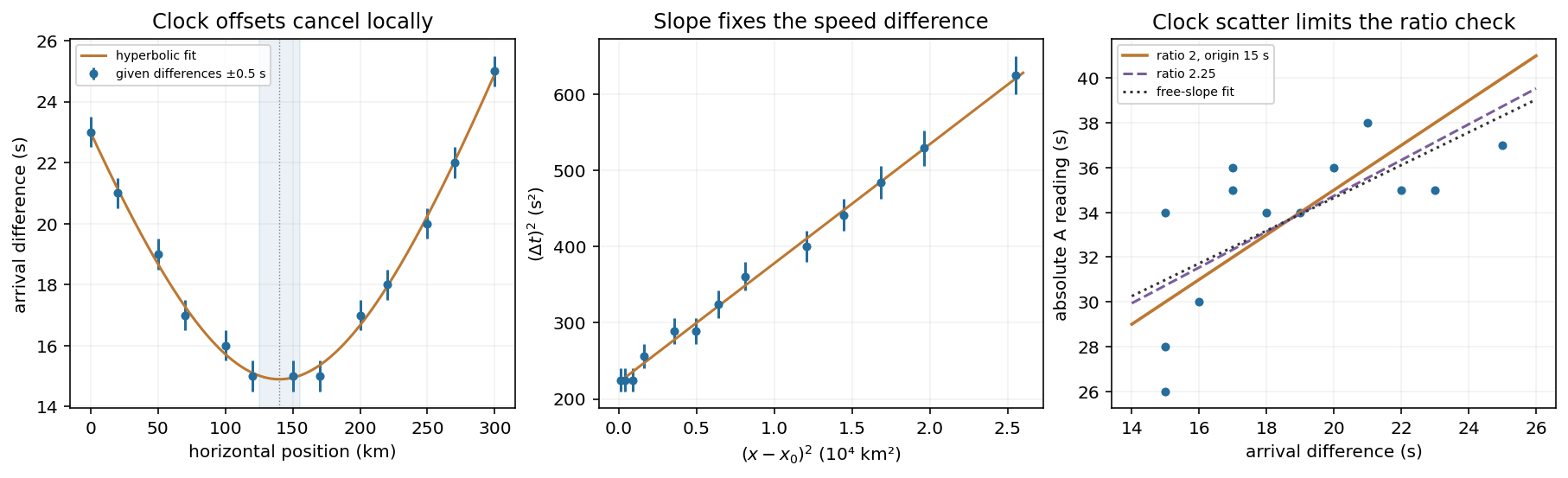
The original plot uses the given numerical observations. Its broad minimum is consistent withThese are conservative graph-reading estimates, allowing for one-second rounding; the three equal smallest entries do not imply a flat physical minimum. A quadratic fit to squared differences refines the vertex to and . These extra digits describe the fit, not the precision of an individual observation. Formal statistical errors require a model for the rounding and other measurement errors.
Earthquake location fit
. Details. 
With the stated ratio , the time difference equals the travel time of A: . Plotting the squared differences against squared epicentral distances therefore gives a straight line of slope and intercept .
Using the fitted vertex from (a), an ordinary least-squares line givesConsequentlyFor graph-level uncertainties, taking and givesThus a defensible graphical depth estimate is . It is not a calibrated confidence interval. If each difference has independent uniform rounding error within , a direct nonlinear fit to the unsquared differences gives , , and ; the fitted depth is again . A covariance calculation must include correlations between fitted slope, intercept, and vertex, rather than treating all three as independent precise measurements. Unmodelled velocity heterogeneity would add uncertainty beyond rounding.
For a general assumed speed ratio ,When , each station estimates by . Averaging givesThe individual estimates have sample standard deviation and range to . If station clock errors are independent with zero mean, the standard error of their mean is . Thus one may quote as a conditional one-standard-error mean, with about scatter for an individual station. The problem does not bound a common clock bias: adding the same offset to every clock shifts this inferred origin time by that offset without changing any time difference. Therefore no unconditional absolute-time accuracy follows from the supplied data.
The speed-ratio check is an origin-time and speed-ratio regression of on . It giveswhere the uncertainty is a residual-based standard error of slope. The factor-two hypothesis predicts slope , about standard errors from the fitted value: the ratio 2 is satisfactory at the accuracy allowed by these clocks, but is not precisely verified. Formally , with a local propagated standard error about . This inference assumes clock errors have no systematic dependence on station position or time difference. With completely unrestricted station offsets, a regression cannot identify at all.
Let . The difference curve determines , , and , regardless of the particular value assigned to . Changing the ratio to while refitting the individual speeds givesHenceThe conditional standard error of this new mean is . Its predicted slope is also compatible with the regression. Holding one speed fixed while changing would alter the depth, but that adds a constraint not present in this question: here both speeds are inferred from the same difference data and chosen ratio.
In the three-dimensional Earth, a network identifies P- and S-wave arrivals and fits source coordinates and origin time using a travel-time model. Time differences constrain path lengths without requiring a common absolute clock zero; calibrated absolute times then fix the origin time. Real inversions trace refracted rays through a layered or heterogeneous velocity model and use many stations, azimuths, and phases, rather than literal circles at fixed wave speed. Residuals and the sensitivity matrix quantify uncertainty and expose poor station geometry or a poor velocity model.
Depth and origin time are often the weakest pair, especially for a shallow event observed by distant surface stations. In the homogeneous example,If the depth sensitivities are small or nearly alike across the network, a deeper source's longer travel time can be offset by an earlier origin time. In contrast, horizontal displacement often gives opposite-sign residuals on opposite sides of an event and is better constrained by good azimuthal coverage. Nearby stations and depth-sensitive reflected phases can break the earthquake depth–origin-time trade-off; the ranking is not universal for every network or event depth.
Articles by others on the same topic
There are currently no matching articles.