Phosphorylation converts ABA perception into regulated ion transport, coordinates calcium-dependent and calcium-independent inputs, and makes stomatal closure reversible. Its role is distributed across a network of kinases, phosphatases and transport targets. ABA does not close the pore by directly supplying a mechanical force.
The opening and closing machinery is a pair of guard cells surrounding a stoma. Accumulation of osmotically active solutes favors water entry and increased turgor pressure; solute loss favors water exit and reduced aperture. During water stress, abscisic acid shifts the balance toward anion and potassium loss. Changes in transport can precede slower changes in gene expression, allowing the existing guard-cell machinery to respond rapidly.
The core ABA switch involves inhibition of an inhibitor. Without the activating ABA signal, selected clade-A protein phosphatase 2C enzymes, including ABI1, restrain ABA-responsive SnRK2 kinases. ABA binding to a PYR-PYL-RCAR ABA receptor promotes inhibition of these phosphatases. This permits activating kinase phosphorylation to persist and supports activation of OST1, also called SnRK2.6. Thus a hormone-dependent change in phosphatase activity changes the phosphorylation state and catalytic activity of downstream signaling proteins. The effect is specific to the relevant receptor, phosphatase and kinase combinations; it is not a claim that all phosphatases inhibit closure or all phosphorylation promotes it.
Biochemical reconstitution supports this causal ordering: defined receptor, phosphatase and kinase components can reconstruct ABA-dependent regulation without requiring an intact plant. This separates a sufficient core perception-and-relay module from the many parallel processes present in a stressed cell. However, a reconstructed molecular or transcriptional readout alone does not prove that the full mechanical response of a stoma has been rebuilt.[ref]
In vitro reconstitution of an abscisic acid signalling pathway by Hiroaki Fujii and others. pp. 660–664, reconstituted ABA signaling components
A crucial transport target is SLAC1. OST1-dependent phosphorylation activates this slow anion channel, allowing anions to leave the guard cell. Anion efflux depolarizes the membrane potential, favoring outward potassium current through GORK. Loss of these solutes reduces the osmotic drive retaining water, so water exits and turgor pressure falls. Activation of an anion channel can therefore initiate a larger electrical and osmotic response without the kinase phosphorylating every ion that moves. Suppression of opening-associated transport further reinforces the shift toward closure.
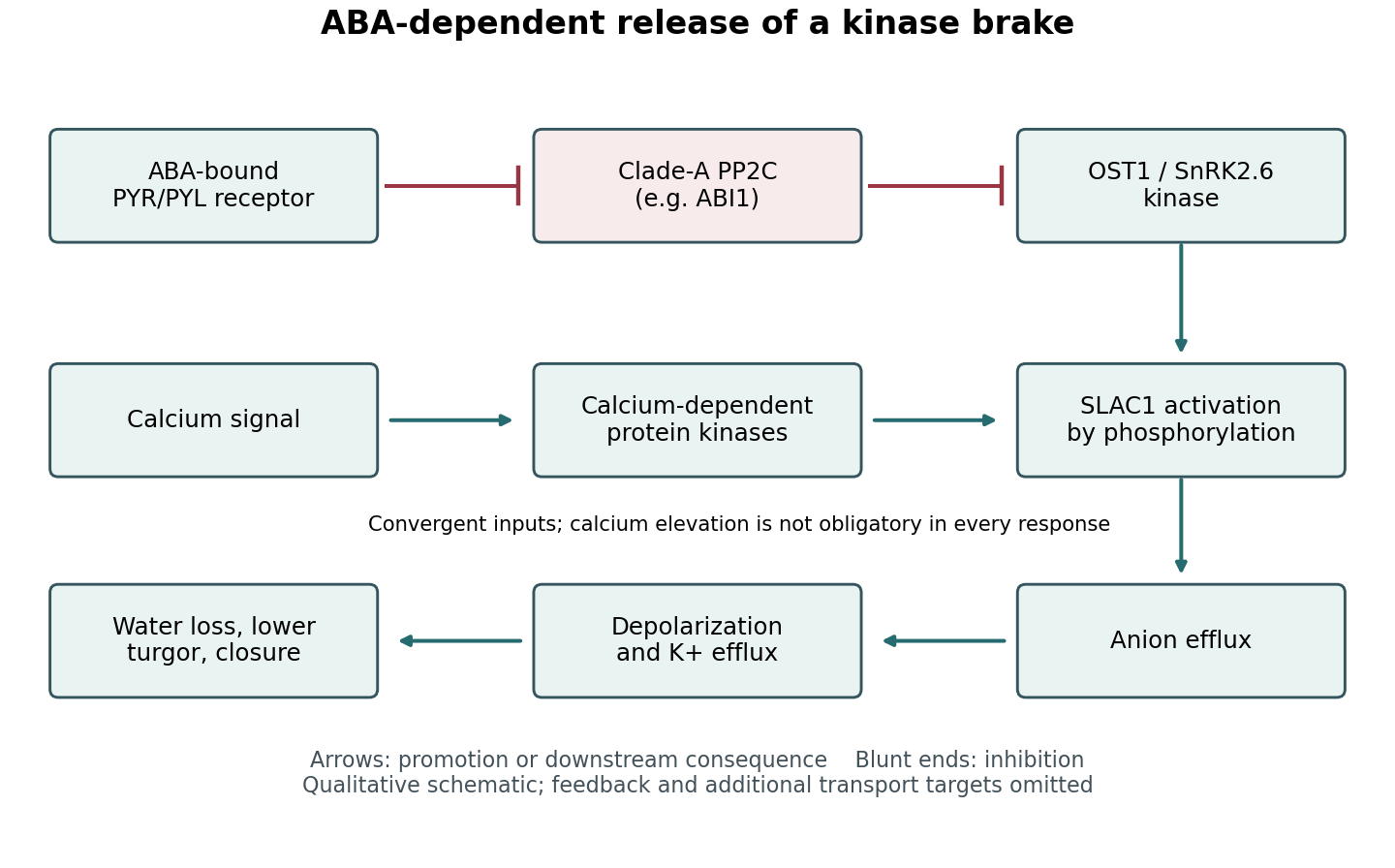

Channel activation experiments provide an important bridge between the core ABA switch and physiology. Coexpression and electrophysiology showed that OST1 activates SLAC1, whereas phosphatase action antagonizes activation; kinase activity and channel regulatory regions are therefore functionally important. These findings are stronger than simple colocalization. Together with guard-cell genetic and current measurements, they support a route from a phosphorylation-dependent channel change to altered aperture. A heterologous cell nevertheless lacks the complete transport and mechanical environment of a real guard cell.[ref]
Activity of guard cell anion channel SLAC1 is controlled by drought-stress signaling kinase-phosphatase pair by Dietmar Geiger and others. Figures 1–4, channel currents and kinase–phosphatase regulation
Calcium-dependent signaling converges on this machinery. Calcium-dependent protein kinases can activate SLAC1, and different kinases have different calcium sensitivities. Consequently, phosphorylation can combine hormone-dependent release of the phosphatase brake with a calcium signature. This is a convergence network, not a mandatory linear sequence in which ABA must always cause a measurable global calcium rise before any closure can occur.[ref]
Guard cell anion channel SLAC1 is regulated by CDPK protein kinases with distinct Ca2+ affinities by Dietmar Geiger and others. pp. 8023–8028, kinase-specific calcium dependence and anion-channel regulation
Regulation of plant NADPH oxidases and reactive oxygen species can further couple kinase activity, redox signalling and calcium entry. The physiological contribution of these branches varies with conditions.Reversal is as important as activation. Phosphatases, calcium clearance and renewed opening-associated transport reset the system when conditions change. Phosphorylation can alter activity, interactions and localization without waiting for protein replacement. The outcome is a tunable balance of kinase and phosphatase activities that connects ABA-dependent sensing to solute flux, water movement and pore mechanics, while integrating additional environmental inputs.
Articles by others on the same topic
There are currently no matching articles.