Orient the body contour counterclockwise. The outward normal from the body satisfies , so pressure produces complex force . Bernoulli's theorem gives ; the constant term integrates to zero. On an impermeable boundary the velocity is tangent, so is real, equivalently . Consequently and
Choose the square-root branch analytic off the slit with at infinity. Continuation from through the upper half-plane gives the upper-face value ; continuation through the lower half-plane gives the lower-face value . Both have the required square and the sign is fixed by the branch normalization.
Differentiate the potential:At infinity, , so has no term. Deforming a contour around the plate to a large circle in its analytic exterior therefore gives zero integral. The force is . The contour formulation includes the endpoint behavior and avoids assigning separate divergent endpoint pressure contributions.
For , use the two face values of the square root. The upper tangential velocity is , vanishing at on the upper face. The lower value is , vanishing at on the lower face. Squaring the equation gives only these candidates, and the branch signs locate the correct faces. At both face stagnation points have coordinate zero. At the exterior velocity is identically one, so there is no finite stagnation point; the endpoints are merely limits of the two locations as the angle tends to zero.
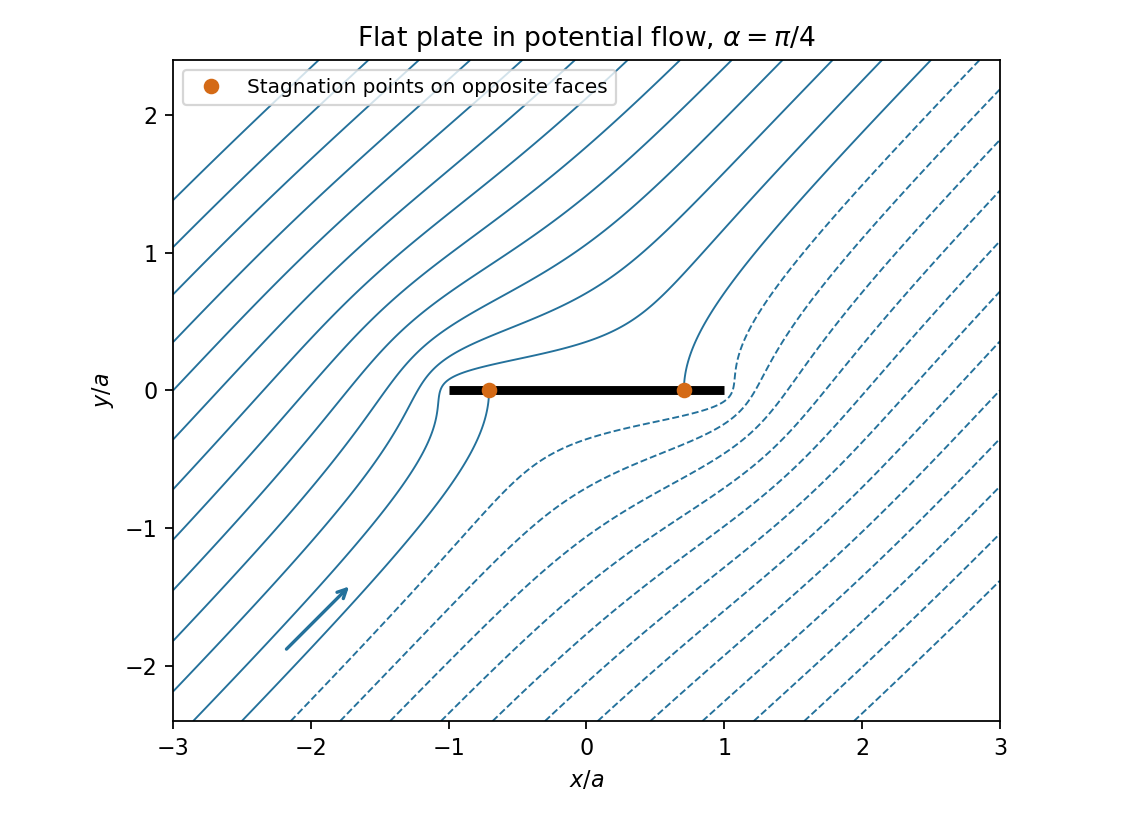

The plotted streamlines are contours of the imaginary part of the potential, with the two boundary stagnation points marked. The far-field velocity is , giving a flow from the lower left toward the upper right at the plotted angle.
Euler's momentum equation is . For irrotational flow , integration gives the Unsteady Bernoulli equation . On the zero-pressure surface , linearization gives . Differentiate with respect to to remove the spatially constant term, giving . These are the cross-sectionally averaged shallow-water approximations encoded in the stated assumptions.
Differentiate the mass equation in time and use the momentum equation to getFor this is . A time-harmonic amplitude satisfies . Write to obtainSpatially oscillating waves therefore occur exactly when the coefficient is positive:Below threshold the solutions have real exponential spatial factors and are evanescent rather than propagating; equality gives the zero-wavenumber threshold. For a concrete outgoing wave let . Then obeys the oscillating boundary condition, and follows from mass conservation. The phase moves into .
Articles by others on the same topic
There are currently no matching articles.