Potassium has a closed 18-electron core and one valence electron. In the orbital label specifies principal quantum number and single-electron orbital angular momentum . The term letter D specifies total orbital angular momentum , the superscript specifies , and the subscript is total electronic angular momentum . The state instead has , , the same spin, and . The closed electron shell that forms the core contributes no net or in this alkali-like approximation. The dash identifies a pair of levels rather than by itself specifying the direction of emission.
The leading electric dipole transition rules for one active electron areThe electronic parity must change, since the electric dipole operator is odd under spatial reflection. The electric-dipole selection rule imposes no general restriction on changing by more than one. The rule for magnetic sublevels depends on the radiation's polarization relative to the quantization axis: the component couples equal , whereas supplies the other changes. In a many-electron description using LS coupling the total orbital rule is , excluding ; for a single active electron the stronger applies. Thus the displayed D–P pair satisfies the leading rules. Relativistic mixing and higher-multipole transitions can permit weaker lines outside the approximation of electric dipole transitions.
Use the common ionization continuum consisting of a divalent calcium ion and a free electron as the upper reference, with the singly ionized calcium ground state at zero energy. The resonance doublet isThe higher- P component is higher in energy because its emission to the common lower level has the shorter wavelength. The full series is . As , its two upper levels approach the same continuum, so the ground-state ionization energy is approximately eV.
The second doublet has a common upper S level and two lower P levels:Both combinations put near eV above the ground state. The series is with . Its two limits measure the ionization energy from each lower P level, giving slightly different limit wavelengths near 142 nm, not two unrelated continua. From the rounded wavelengths, eV and eV, leaving roughly eV to the same continuum. The tabulated level ordering and labels independently agree with these assignments.[ref]
Energy Levels of Singly Ionized Calcium (Ca II) by National Institute of Standards and Technology. 4s,4p and5s entries and Ca III continuum limit
The quoted wavelengths and limits are rounded; air and vacuum conventions also matter for precision spectroscopy. They justify a labelled schematic and the approximate energy differences, not an artificial claim of exact closure at every printed decimal.
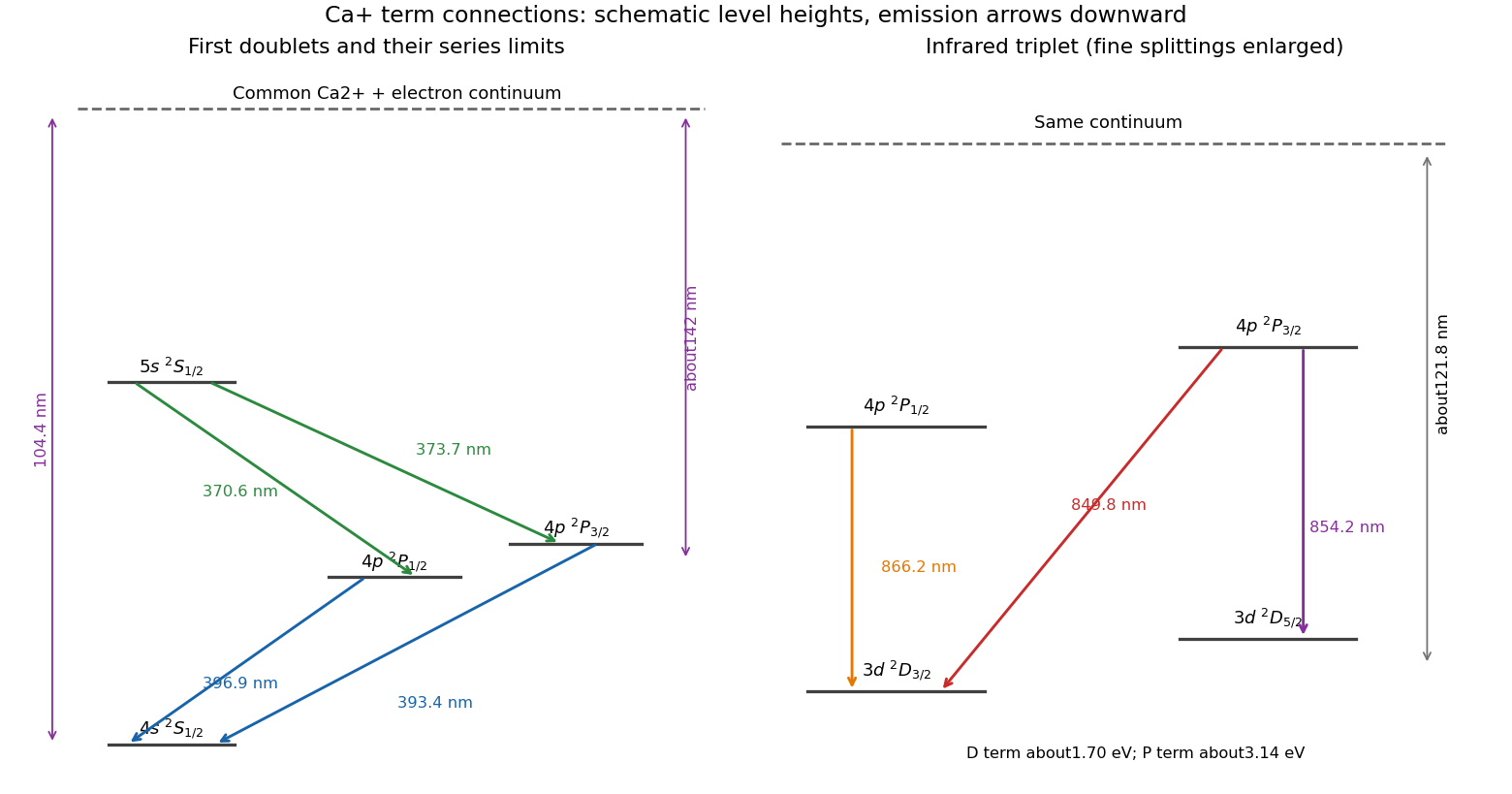
Common-continuum assignments of the Ca+ doublets and infrared triplet
. Original schematic showing every first-doublet and infrared-triplet transition and the three approximate series limits. Fine splittings are visually enlarged; vertical positions are not a precision energy scale. Details.
The limit near 121.8 nm lies about eV above its lower term. Subtracting from the approximately eV ground-state ionization energy puts that lower term near eV: the pair. The first upper levels are the already identified pair. Their allowed decays areThe fourth possible pairing, , has and is forbidden as an electric dipole transition. The three lines therefore arise from doublet terms, not a spin-triplet term: “triplet series” counts three spectral lines.
For example, the first two wavelengths together with the energy give eV and eV. The longer 854.2 nm wavelength from the same upper level places its lower D level higher. The 866.2 nm transition independently returns the lower D energy within the rounding precision. Increasing the upper principal quantum number gives triplets with two nearby lower-term ionization limits near 121.8 nm. The arrows are included in b; their emission direction is P to D, not the reverse. The independent tabulation confirms the D-term position and ordering.[ref]
Energy Levels of Singly Ionized Calcium (Ca II) by National Institute of Standards and Technology. 3d entries at13650.20 and13710.89 inverse centimetres
In the regime of weak-field Zeeman splitting, remain good labels and . For the 393.4 nm line, in and in . The Landé g-factors are and . Apply to the four upper and two lower sublevels. The allowed pairs areTheir frequency displacements in units of are respectively , so none coincide. Looking perpendicular to the field permits both the radiation from transitions and the radiation from transitions. ConsequentlyA linear polarizer parallel to the field isolates the two components; a transverse polarizer selects the four components. Without polarization selection both sets are present. This count assumes a field small compared with fine structure coupling and neglects isotope-dependent hyperfine structure; the strong-field Paschen-Back effect or a resolved nonzero-spin isotope would require a different model. The spectral spacings are unnecessary for the count, but the distinct shifts verify that counting allowed transitions does not inadvertently count degenerate lines twice.
Articles by others on the same topic
There are currently no matching articles.