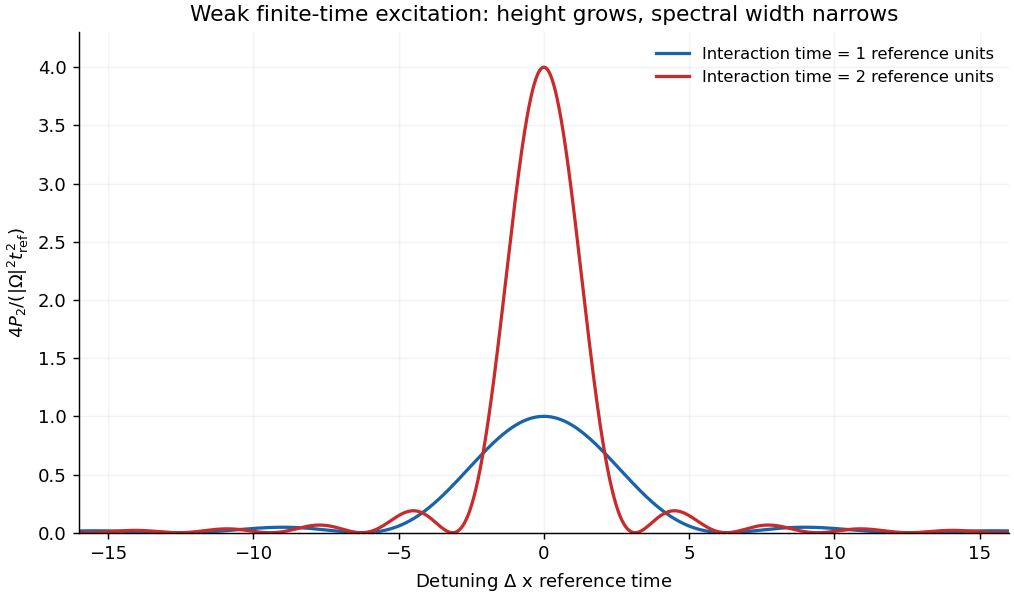
Let . Near resonance, , and for weak enough driving , the term oscillating near averages rapidly compared with the slow response. On times long compared with an optical period it contributes a bounded amplitude of order , whereas the resonant contribution can accumulate. Dropping that counter-rotating term givesAt exact resonance the continuous limit is . This remains a weak-excitation result, requiring ; rotating-wave averaging alone does not justify ignoring depletion forever. Far from resonance or on subcycle timescales, the discarded term may no longer be negligible for the comparison being made.
If one retains the coupled amplitudes instead of fixing , the rotating-wave propagator is a unitary operator. The resulting population in the Driven two-level Rabi model isIt gives bounded Rabi oscillations and reduces to the weak-excitation expression over its common range. This distinction prevents the resonant quadratic approximation from being mistaken for a population law valid at arbitrary time.

Articles by others on the same topic
There are currently no matching articles.