Use an orthonormal basis of stationary states and project the Time-dependent Schrödinger equation onto state 2 after removing its free-evolution phase. The stationary Hamiltonian terms cancel the derivatives of those phases, leavingDefine and . With the supplied time-dependent quantum perturbation,and therefore . The state phases may be chosen so and are real for this single driven pair; otherwise probabilities depend on and the conjugate matrix element appears in the equation for . Our is the resonant Rabi angular frequency in the usual convention whose rotating-wave off-diagonal Hamiltonian is .
For a field-free atom with symmetry under spatial reflection, each selected nondegenerate stationary orbital can be chosen with definite parity. Since is odd, , so ; the same reasoning gives . Being an energy eigenstate alone is not sufficient. As an explicit mathematical counterexample, a displaced quantum harmonic oscillator with potential proportional to has energy eigenstates with , giving when . The vanishing used in the atomic model rests on its parity assumption, not merely on stationarity.
At first order in time-dependent perturbation theory set and use the parity result . Decomposing the cosine into its two exponentials givesBoth exponentials contribute to the exact first-order result:Each apparent zero denominator has a continuous limit. In particular the near-resonant fraction tends to as , while the counter-rotating fraction remains bounded on the optical timescale. One may equivalently write the expression asThis form makes explicit and avoids cancellation at resonance. At extremely short time both sinc functions tend to one, so , agreeing with the initial derivative of the original cosine-driven equation. No rotating-wave approximation has yet been made. The separate assumption of weak excitation remains necessary: the first-order expression must not be extended until it predicts probabilities comparable to or larger than one.
Let . Near resonance, , and for weak enough driving , the term oscillating near averages rapidly compared with the slow response. On times long compared with an optical period it contributes a bounded amplitude of order , whereas the resonant contribution can accumulate. Dropping that counter-rotating term givesAt exact resonance the continuous limit is . This remains a weak-excitation result, requiring ; rotating-wave averaging alone does not justify ignoring depletion forever. Far from resonance or on subcycle timescales, the discarded term may no longer be negligible for the comparison being made.
If one retains the coupled amplitudes instead of fixing , the rotating-wave propagator is a unitary operator. The resulting population in the Driven two-level Rabi model isIt gives bounded Rabi oscillations and reduces to the weak-excitation expression over its common range. This distinction prevents the resonant quadratic approximation from being mistaken for a population law valid at arbitrary time.
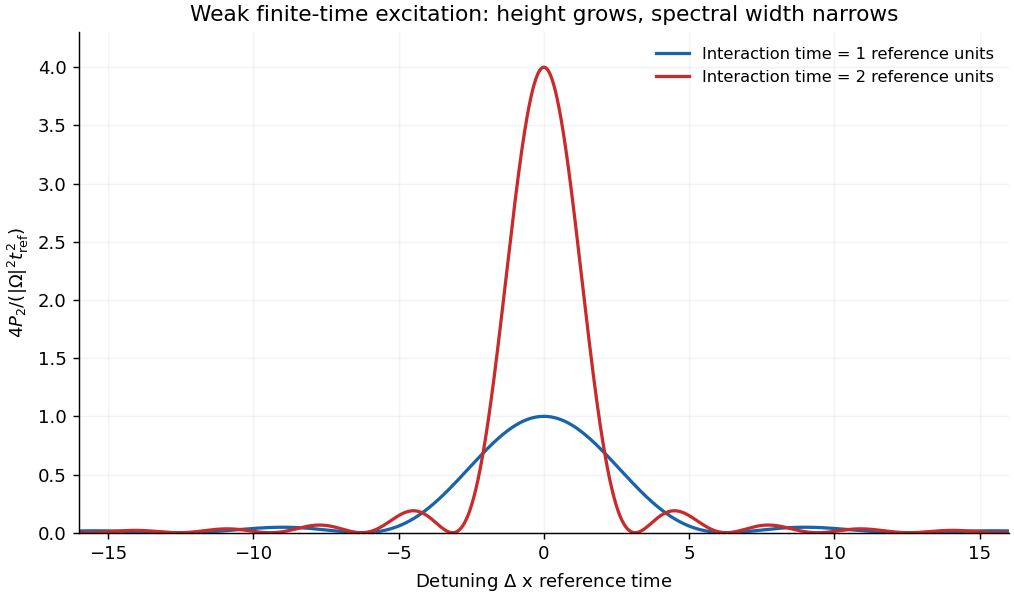

Resolve the weak broadband radiation into narrow frequency intervals whose relative phases are uncorrelated. The transition probabilities, rather than the coherent amplitudes, can then be added after ensemble or time averaging. For the x-polarized field, the energy density in one interval is , so its squared coupling is . Inserting this into the weak rotating-wave result givesFor times long compared with the optical coherence time of the field, the narrow resonant kernel samples a nearly constant . Provided the resonance is well away from the zero-frequency boundary, extend the Rabi detuning integral to the full real line. Its value is , yieldingThis is the stimulated absorption rate for the specified polarization and spectral radiation energy density per angular-frequency interval. The averaging window should also satisfy while the lower state is treated as undepleted. A deterministic phase-locked broadband pulse would not in general permit adding these probabilities without its interference terms.
For isotropic unpolarized radiation with total spectral radiation energy density , orientational averaging instead gives . The factor one third is not inserted into the original x-polarized formula. If ordinary frequency is used, and the isotropic coefficient becomes multiplying . The spectral convention and polarization must be stated together to avoid spurious factors of three or .
Articles by others on the same topic
There are currently no matching articles.