Choose an isolated pair of energy levels, with ground state and excited state . Use the Pauli matrices in the ordered basis , so . After subtracting the mean energy, prescribe the laboratory Hamiltonian operatorThe unperturbed energy gap is , the drive has angular frequency , and fixes its oscillation phase at the chosen time origin. All of , , the Rabi angular frequency and the Rabi detuning are in radians per second; ordinary frequency is angular frequency divided by . In particular, here is the coefficient multiplying the cosine in , not twice that coefficient.
Write with . Transforming the Schrödinger equation gives . The rotating-wave approximation drops terms at angular frequency , leavingThis approximation requires , and an interaction duration over which omitted corrections remain small. It also assumes that other energy levels can be neglected. Resonance alone does not justify either assumption. An exactly co-rotating drive has no discarded counter-rotating component; the linearly oscillating laboratory drive above does.
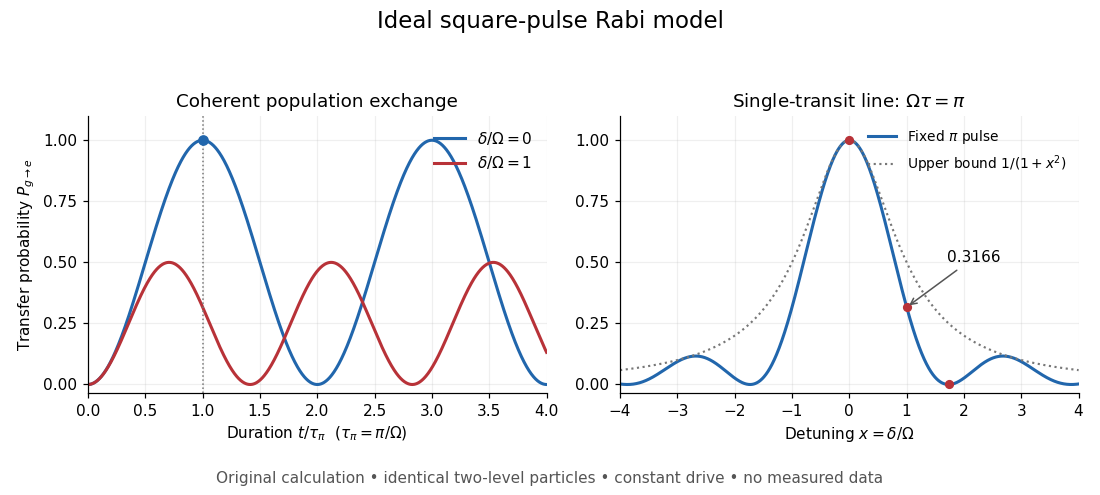
The Pauli matrix multiplication law gives . Separating even and odd terms of the matrix exponential therefore proveswith the continuous limit when . Starting from , the upper probability amplitude is . The Born rule givesThe rotating transformation only changes the quantum phases of these basis states, so their laboratory populations are the same. Rabi detuning tilts the rotation axis of the Bloch vector: it increases the oscillation rate to but caps the transferred population at . A fixed drive oscillation phase cancels from this single-pulse population when the initial state is . It still fixes the relative quantum phase of a resulting quantum superposition and matters when another pulse supplies a phase reference.
The Rabi angular frequency is the on-resonance population oscillation rate in the specified Driven two-level Rabi model. The rotating-frame off-diagonal Hamiltonian operator entry has magnitude . Stating this convention avoids a factor-of-two ambiguity between drive coefficients and oscillation rates. The generalized rate off resonance is .
The Rabi detuning is the unperturbed transition angular frequency minus the drive angular frequency in this convention. Its sign controls the longitudinal rotation of the Bloch vector; the single-pulse population formula is even in . Reversing the definition of Rabi detuning requires reversing its sign in the rotating-frame Hamiltonian operator as well.
For a constant-amplitude square pulse on resonance, a Rabi pi pulse lasts and gives in the rotating frame. A half-duration pulse prepares . The quantum pulse area determines these rotations only under the stated resonant, constant-axis assumptions; a detuned drive rotates about a different axis.
As an original numerical illustration, choose and hence . These are chosen model parameters, not historical apparatus settings. Holding that duration fixed givesThus , , and . The last zero comes from completing a full rotation about the tilted axis, rather than switching the drive off. At zero Rabi detuning, doubling the pulse duration restores the ground-state population; continuous driving does not keep transferring population irreversibly.

Articles by others on the same topic
There are currently no matching articles.