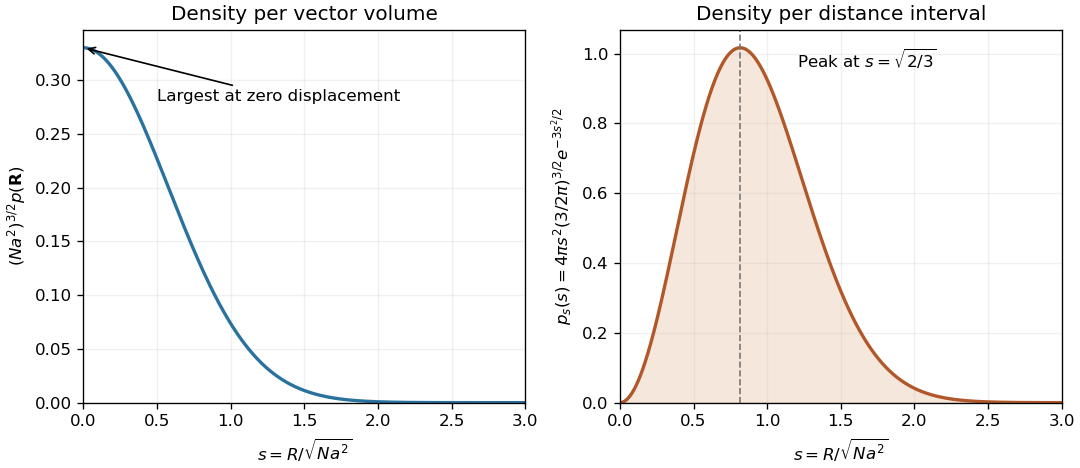
An ideal chain can be treated as a random walk when effective segment orientations are independent and isotropic, segment length is fixed, and interactions such as long-range excluded volume are absent or effectively screened. A large number of segments is needed for the Gaussian continuum approximation. Write . Each Cartesian component has mean zero and variance , so the central limit theorem gives the Gaussian limit of the end-to-end distribution of a freely jointed chainEquivalently, one step has characteristic function ; taking its th power and expanding its logarithm gives , whose inverse Fourier transform is this density. It is a density per vector volume . The scalar end-to-end-distance density is . Thus the printed expression must be interpreted as a vector density; it is also a large- approximation, not the exact finite-chain distribution near .
For a freely rotating chain, neighboring forward bond vectors have fixed angle , and independently uniform torsion angles give with . Squaring the sum of bonds therefore givesThere are pairs separated by bonds, so the characteristic ratio of a freely rotating chain isFor fixed , the geometric sums give . The correction vanishes as , yieldingFor the specified polyethylene parameters, , so and . HenceThe negative sign of the stated angle does not affect its cosine. The forward-bond angle is supplementary to the chemical internal bond angle. This freely rotating estimate includes fixed-angle correlations but omits torsional energy preferences; the Kuhn length of a freely rotating chain expresses the same long-chain persistence as .

Articles by others on the same topic
There are currently no matching articles.