A nematic liquid crystal has long-range orientational order without a three-dimensional positional lattice. Its nematic director identifies the preferred molecular axis, with and equivalent for apolar molecules. The scalar nematic order parameter is zero for isotropic orientations and one for perfectly parallel axes. The tensor describes alignment without choosing a sign for the director.
Ordering balances orientational entropy against interactions and packing. For long rods, alignment can increase available translational configurations by reducing mutual excluded volume; thermotropic materials additionally have temperature-dependent energetic preferences. Spatially varying alignment costs Frank elastic energy through splay, twist and bend. Surface anchoring and electric or magnetic fields select the director in a finite specimen.
Crossed polarizers reveal birefringence and defect textures, while scattering tests positional order independently. A particularly direct response experiment is the Fréedericksz transition: confine a planar-aligned layer between anchored plates, apply a transverse field and monitor the transmitted polarization as the director tilts above an elastic threshold. This tests orientational elasticity and dielectric anisotropy rather than presuming that an optically anisotropic fluid has crystalline positional order.
A lipid bilayer self-assembles from amphiphiles: hydrophilic head groups face the surrounding water, while hydrocarbon tails form a hydrophobic interior. In a fluid membrane, molecules diffuse laterally within each membrane leaflet. Closing the bilayer into a vesicle avoids an exposed edge. The interior is a substantial barrier to isolated ions and many polar solutes; membrane proteins provide selective transport pathways in a cell membrane.
The Helfrich energy describes long-wavelength bending:Here and are mean curvature and Gaussian curvature, is spontaneous curvature, the bending modulus, the Gaussian-curvature coefficient and the membrane tension. Bending is comparatively inexpensive, whereas stretching the molecular area strongly is costly. Leaflet asymmetry can favor a nonzero spontaneous curvature.
In micropipette aspiration, controlled suction draws part of a large vesicle into a narrow pipette. Pressure and geometry determine membrane tension, and the aspirated length measures apparent area change. At low tension, smoothing thermal undulations supplies much of that area; stronger tension probes actual stretching. Tracking vesicle shape fluctuations provides a complementary estimate of the bending modulus.
Here the complex viscoelastic modulus is a stress-to-strain response coefficient, rather than a complex number's absolute value. Use strain and stress , withThe storage modulus measures the elastic component; the loss modulus measures dissipation. The mean power per volume is , and the energy dissipated per cycle is , fixing the sign convention.
A Hookean solid has , while a Newtonian fluid has . The Maxwell model interpolates with , giving and . It is fluid-like at low frequency and elastic on times short compared with relaxation time .
A rheometer imposes small-amplitude oscillatory shear and resolves the torque amplitude and phase relative to the imposed motion. The torsional measurement of a complex shear modulus makes the conversion from torque and twist to explicit. A frequency sweep locates relaxation scales; keeping the strain small tests the linear-response assumption.
Wetting concerns how a liquid covers a solid in contact with another phase, such as its vapor. For an ideal flat homogeneous surface, balance of the three interfacial tensions gives Young's equationwhere the contact angle is measured through the liquid. Small angle means favorable contact; partial wetting gives a finite angle. The spreading coefficient compares a covered surface with a dry one. Positive favors complete wetting, while negative permits a finite-angle droplet in the partial-wetting regime.
A sessile-drop experiment images the tangent at the contact line on a clean level substrate. Varying drop volume slowly distinguishes advancing and receding angles; their difference is contact-angle hysteresis from pinning and heterogeneity, so a single observed angle need not equal the ideal equilibrium value. A capillary-rise experiment gives a second consequence: the Young–Laplace equation and hydrostatic balance predict in a narrow circular tube when meniscus-volume corrections are negligible. A wetting liquid rises, whereas a sufficiently nonwetting one is depressed.
For a dilute suspended sphere in Stokes flow, the translational friction coefficient is , with dynamic viscosity and hydrodynamic radius . To derive the diffusion-friction relation, put particles in a weak conservative force . Their drift velocity is , while the diffusive flux is . At equilibrium the Boltzmann distribution gives . Zero total flux therefore gives , hence the Stokes–Einstein relationHere is the Boltzmann constant, absolute temperature and the translational diffusion coefficient. The sphere, no-slip continuum-fluid and dilute thermal-equilibrium assumptions enter through the drag law and flux balance.
At and the supplied viscosity, the predicted product is . The derived predictions and radii inferred from the measured diffusion coefficients are:
| Protein | Predicted | Inferred hydrodynamic radius / nm |
|---|---|---|
| Ribonuclease | ||
| Beta-lactoglobulin | ||
| Haemoglobin | ||
| Collagen |
The last three agree closely at the precision of the supplied data. The ribonuclease diffusion coefficient is about below the spherical prediction, corresponding to a larger frictional radius than the stated radius. Hydration, shape, a different operational radius and coarse measurement precision can matter; molar mass is not an independent parameter in the spherical diffusion law. A compact constant-density globule would have , whereas collagen's large frictional radius relative to its mass is consistent with an extended nonspherical molecule. The inferred Stokes radius is a friction-equivalent radius, not automatically a geometric half-length.
In analytical ultracentrifugation, scan the radial protein concentration while a rotor spins at known angular speed . Optical absorbance or refractive-index interference records a moving sedimentation boundary and its diffusive broadening.[ref]
Optical Systems Used for AUC by Beckman Coulter Life Sciences. Radial scans during rotation, absorbance spectrophotometry and Rayleigh interference detection
With solvent density , partial specific volume and molar mass in , the buoyant mass is . Force balance gives , so the sedimentation coefficient is . A boundary trajectory gives ; diffusion gives .Combining them gives the molar mass from sedimentation and diffusion:Known mass and buoyancy can instead determine friction from alone, and comparison with a compact sphere tests shape or hydration. In sedimentation equilibrium, the stationary radial profile obeys , providing buoyant mass without a friction model. This is a sedimentation-diffusion balance in a uniform solvent, rather than density-gradient banding at an isopycnic point.
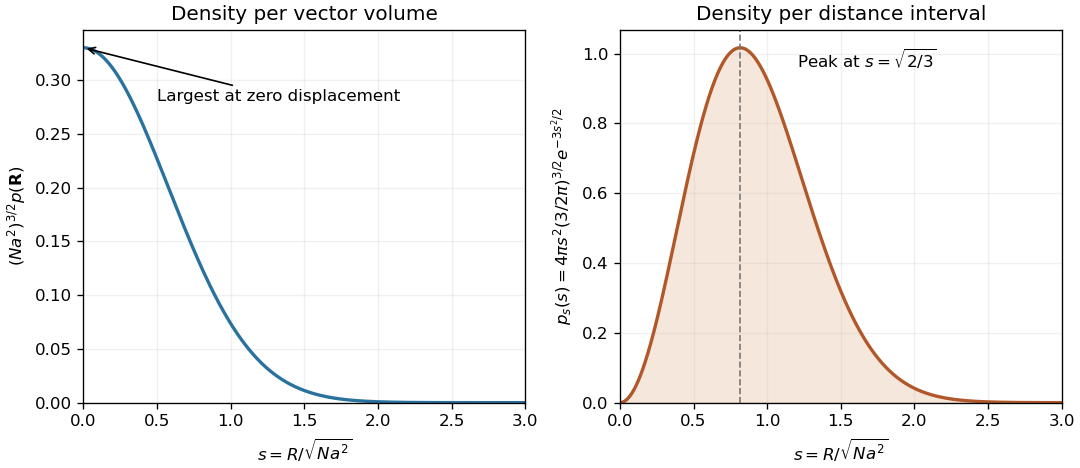
An ideal chain can be treated as a random walk when effective segment orientations are independent and isotropic, segment length is fixed, and interactions such as long-range excluded volume are absent or effectively screened. A large number of segments is needed for the Gaussian continuum approximation. Write . Each Cartesian component has mean zero and variance , so the central limit theorem gives the Gaussian limit of the end-to-end distribution of a freely jointed chainEquivalently, one step has characteristic function ; taking its th power and expanding its logarithm gives , whose inverse Fourier transform is this density. It is a density per vector volume . The scalar end-to-end-distance density is . Thus the printed expression must be interpreted as a vector density; it is also a large- approximation, not the exact finite-chain distribution near .
For a freely rotating chain, neighboring forward bond vectors have fixed angle , and independently uniform torsion angles give with . Squaring the sum of bonds therefore givesThere are pairs separated by bonds, so the characteristic ratio of a freely rotating chain isFor fixed , the geometric sums give . The correction vanishes as , yieldingFor the specified polyethylene parameters, , so and . HenceThe negative sign of the stated angle does not affect its cosine. The forward-bond angle is supplementary to the chemical internal bond angle. This freely rotating estimate includes fixed-angle correlations but omits torsional energy preferences; the Kuhn length of a freely rotating chain expresses the same long-chain persistence as .

Articles by others on the same topic
There are currently no matching articles.