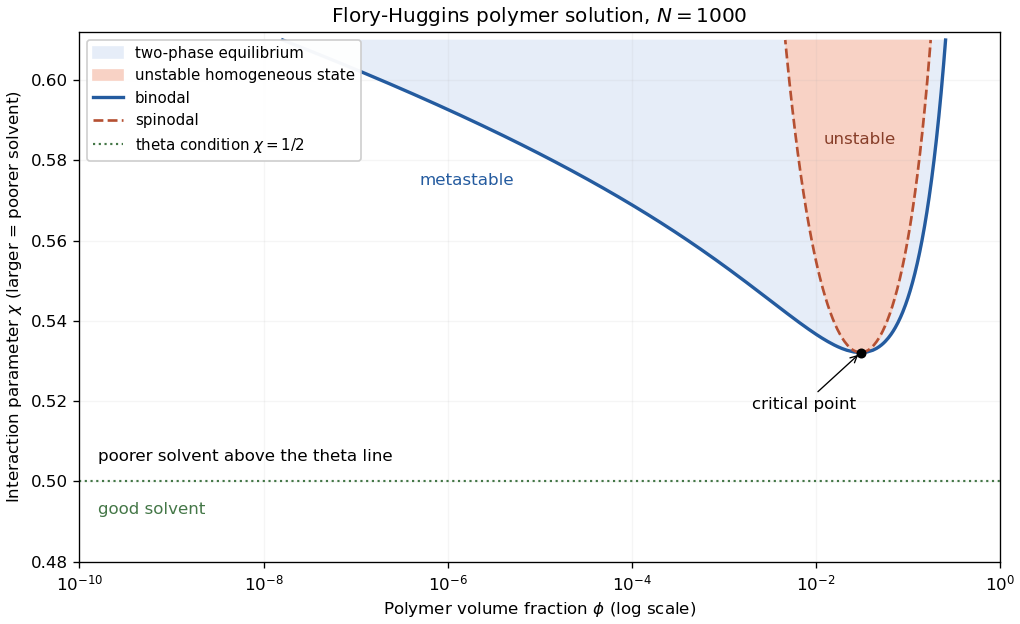
Use polymer volume fraction and interaction parameter , increasing toward poor-solvent conditions. The Flory–Huggins solution theory free energy per lattice site isThe common-tangent construction gives the binodal; gives the spinodal, . Its critical point is , . Above the binodal in this plot, the solution separates into polymer-poor and polymer-rich phases; between binodal and spinodal it is metastable, while inside the spinodal a homogeneous state is unstable.
The line is the theta solvent condition for a long dilute chain. Below it is the good solvent side; above it is the poor solvent side. Poor solvent does not imply that every composition is already phase separated. Independently, a homogeneous solution is dilute for , semidilute for below close packing, and concentrated as approaches one.

Articles by others on the same topic
There are currently no matching articles.