For a narrowly aligned nematic liquid crystal, the scalar nematic order parameter is . Hence the small-angle width of nematic orientation isThis is a root-mean-square angular width about the unoriented nematic director. The single value of does not determine a complete distribution or its full width at half maximum. For an isotropic two-component Gaussian tilt, each transverse component would have standard deviation .
For a spherical micelle of sodium dodecyl sulfate with molecules and a sharp tail-filled core of radius , volume and head-group area give and . Dividing gives the spherical micelle geometryThere is a consistency limit: exceeds the supplied maximum tail length . Equivalently the amphiphile packing parameter is , outside the strict spherical-core bound. Thus the requested spherical assumption gives these estimates, but the three molecular dimensions cannot all be exact within that ideal sharp-core geometry. Effective head area, core structure or aggregate shape must adjust; silently replacing by would no longer satisfy both packing equations.
For the polybutadiene chain in 1,4-dioxane, define from the negative end charge toward the positive one. The electric dipole energy is , so the force conjugate to end separation is , even though the two endpoint forces are opposite. Balancing it against the entropic spring force givesNumerically,The zero-field rms of just the component is , a different comparison. The mean extension is still much smaller than the contour length , consistent with the Gaussian ideal chain force law. This is an end-charged ideal polymer in an electric field; the direct endpoint Coulomb interaction is omitted as stipulated.
Long anisometric molecules cannot pack independently. In the Onsager excluded-volume mechanism, two slender rods of length and diameter exclude a relative-position volume approximately , where is their mutual angle. Aligning rods reduces this excluded volume, increasing the translational entropy available at a fixed number density. It simultaneously reduces orientational entropy. At sufficiently high concentration the positional gain wins, producing a nematic liquid crystal even for purely repulsive rods.
The nematic director is apolar: and describe the same orientation. The molecules retain liquid-like positional disorder, in contrast to a smectic phase with layered order. A typical dimensionless concentration controlling the slender-rod competition is , although finite aspect ratio, flexibility and attractions change the transition. The mechanism illustrates that ordering can increase total entropy: the lost orientational freedom is compensated by less mutual obstruction.
At a micrometre scale, viscous forces normally dominate inertia. As an illustrative Newtonian estimate, , , and give a Reynolds number . The surrounding flow is approximately a Stokes flow, satisfying and .
A body of radius translated at that speed in an unbounded Newtonian liquid would need Stokes drag . It stops almost immediately when propulsion stops. The scallop theorem rules out propulsion by a single reciprocal stroke in this ideal regime; a rotating helix or a nonreciprocal cycle of shapes can propel it. Brownian motion also randomizes position and orientation: Stokes–Einstein relation scales as and rotational diffusion as , so retaining heading becomes harder as size decreases.
The Newtonian calculation is a scale estimate, not a complete model of blood. Vessel walls alter drag, the imposed flow advects the body, and nearby red blood cells make the medium heterogeneous at this scale. Non-Newtonian fluid effects and deformable obstacles can matter; steering must be assessed against those effects rather than inertial coasting.
A lipid bilayer is fluid within its plane, so a bare equilibrated bilayer has no static in-plane shear modulus. Stretching its area is nevertheless expensive, whereas bending is much softer. The Helfrich membrane energy expresses this distinction throughwith membrane bending rigidity , mean curvature , Gaussian curvature , spontaneous curvature and membrane tension . Area dilation additionally costs approximately . For a closed surface of fixed topology, the Gauss-Bonnet theorem makes the integrated Gaussian-curvature term constant.
These energies control vesicle shapes, budding and the ease of forming membrane tubes. Asymmetric leaflet composition or bound proteins can change the preferred curvature. Real cell membranes can also be coupled to a cytoskeleton, which supplies shear elasticity absent from a free lipid bilayer. Thus a red-cell shape cannot generally be inferred from the bare bilayer model alone.
Two useful measurements probe different terms. Optical tracking of thermal membrane flickering measures fluctuation amplitudes; for small height modes, a normalization with gives . Micropipette aspiration controls pressure while measuring the membrane drawn into a narrow pipette, linking apparent area change to tension and, at larger strain, area dilation. The observables test the elastic coefficients rather than merely showing a membrane image.
In diffusion-controlled aggregation, particles meet through Brownian motion and stick with probability close to one on encounter. Diffusion-limited cluster aggregation allows already formed clusters to diffuse and join; diffusion-limited aggregation in its usual single-seed model instead adds diffusing individual particles to one growing cluster. First-contact sticking shields inner regions from later arrivals, favouring open branched structures. A reaction-limited cluster aggregation model has a small sticking probability and permits many failed encounters before attachment.
For two dilute spherical species, the Smoluchowski diffusion-controlled encounter rate is . In relative coordinates, solve the steady diffusion equation with an absorbing surface at and concentration at infinity: . The inward diffusive flux is , proving the rate coefficient. Interaction barriers and non-spherical aggregates require changes to this ideal encounter calculation.
Cluster growth can be tested by microscopy and light scattering. A mass fractal dimension relates particle number to cluster size through ; a scattering regime between the monomer and cluster length scales can reveal that scaling. The measured morphology depends on whether whole clusters move, on the sticking rule, and on possible bond rearrangement.
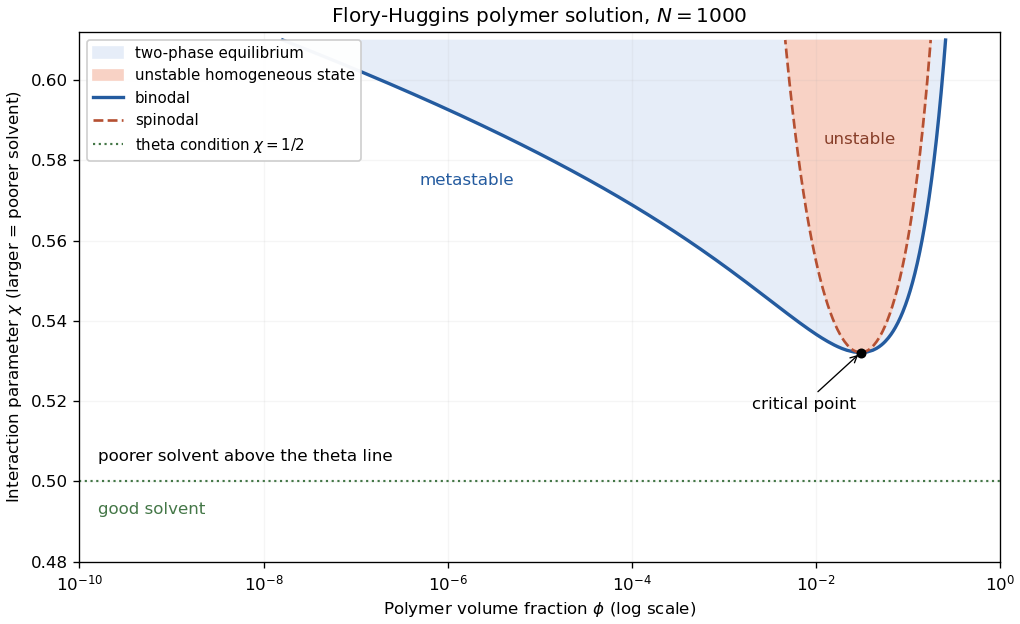
Use polymer volume fraction and interaction parameter , increasing toward poor-solvent conditions. The Flory–Huggins solution theory free energy per lattice site isThe common-tangent construction gives the binodal; gives the spinodal, . Its critical point is , . Above the binodal in this plot, the solution separates into polymer-poor and polymer-rich phases; between binodal and spinodal it is metastable, while inside the spinodal a homogeneous state is unstable.
The line is the theta solvent condition for a long dilute chain. Below it is the good solvent side; above it is the poor solvent side. Poor solvent does not imply that every composition is already phase separated. Independently, a homogeneous solution is dilute for , semidilute for below close packing, and concentrated as approaches one.

Here denotes a typical chain size, such as an rms end-to-end distance of a polymer chain, rather than the mean end-to-end vector of an isotropic solution, which is zero. The Flory approximation gives in a good solvent, an ideal chain has in a theta solvent, and a compact polymer globule has size in a strongly poor solvent. These are scaling estimates with order-one prefactors omitted, treating the stated as the segment count associated with the supplied statistical length.
In ethylbenzene, the good solvent makes effective segment repulsions swell the coil. With the Flory approximation,
At the specified theta condition in cyclohexane, the leading effective excluded volume vanishes and the ideal chain estimate is
In water, the strongly poor solvent favours a compact polymer globule. A site-volume estimate givesThe exact numerical conversion between globule radius and rms end-to-end distance depends on its density and shape; this calculation supplies the characteristic size scale.
The polymer overlap concentration corresponds to about one chain per coil volume. Approximating the occupied volume of one statistical segment by givesThus the site-volume model predicts overlap at a few percent volume fraction. A separately specified molecular segment volume or a coil-volume prefactor would change this numerical prefactor.
For a concentration blob with ideal segments, and concentration matching gives . Thus the concentration-blob size in a theta solvent isThe whole chain contains about ten blobs, so the separation of scales is moderate. Below , theta-solvent segments have ideal chain statistics; above it, screening also gives Gaussian random-walk statistics for the sequence of blobs. There is no good-solvent self-avoiding regime to insert in this particular theta-solvent calculation. Density correlations and segment dynamics can still cross over at the blob scale.
In a dilute solution, solvent-mediated hydrodynamic interactions couple distant chain segments. The Zimm model describes the resulting cooperative dynamics: an intermediate-time segment mean-square displacement scales as , while whole-chain translation has . Once internal modes relax, each tagged segment follows the chain's ordinary long-time diffusion, with mean-square displacement asymptotic to .
In a concentrated solution or polymer melt, hydrodynamic coupling is screened. The unentangled Rouse model has an intermediate segment regime and whole-chain diffusivity proportional to . Long chains with polymer entanglement are additionally confined by neighbouring chains: reptation gives a slower intermediate regime and an asymptotic chain diffusivity scaling approximately as . The time windows depend on segment, entanglement and terminal relaxation times, so these powers do not all describe the same time interval.
After sufficiently long times both dilute and concentrated chains undergo ordinary translational diffusion. The main long-time difference is the coefficient and its chain-length dependence, with entanglement strongly reducing mobility when the chains are long enough; concentration alone does not guarantee an entangled regime.
Creating a liquid surface changes the molecular environment and costs interfacial free energy. In the dispersion-only cleavage model, the attractive Van der Waals force per area has magnitude . Separating two contacting halves from a molecular cutoff to infinity takes work per areaHere denotes the Hamaker constant, to distinguish it from an area. Cleavage creates two free surfaces, giving the Hamaker estimate of liquid surface tensionThe continuum attraction diverges at zero separation and neglects molecular impenetrability and short-range repulsion. The cutoff is therefore an effective contact separation of molecular size, commonly of order –, not a limit that can be taken to zero.
An experimental limitation is the strong temperature dependence of surface tension. For water in equilibrium with its vapour, the recommended experimental values decrease from at to at , and the fitted tension vanishes at the critical point. A fixed pairwise cleavage energy misses interfacial entropy, changing density and many-body correlations.[ref]
Revised Release on Surface Tension of Ordinary Water Substance by International Association for the Properties of Water and Steam. 2014 release, printed pp. 3–4: temperature-dependent equation and Table 1
The dispersion-only model is unsuitable when cohesion is dominated by hydrogen bonds, ionic interactions or metallic bonding; liquid metals are a clear example of the latter failure.For a smooth homogeneous solid and a partially wetting liquid at equilibrium, tangential balance at the contact line gives Young's equationThe angle is measured through the liquid. Replacing solid-vapour area by solid-liquid plus liquid-vapour area changes free energy by per wetted area, where the spreading coefficient isFor partial wetting, . Positive favours a spreading film and zero macroscopic equilibrium contact angle; the finite-angle Young construction cannot be extrapolated to .
The intended chemically matched surface approximation is . It gives , so increasing the wetted area lowers free energy. The initially steep drop spreads and flattens toward complete wetting:The initial angle describes a nonequilibrium shape and must not be inserted into equilibrium Young's equation to fix . More precisely, complete wetting requires in this surface-energy model; chemical similarity alone is not a measurement of that interfacial energy.
Water on such a low-energy, oil-like surface is expected to bead into a comparatively rounded, high-angle drop because the substrate does not compensate its cohesive interactions. Its numerical contact angle needs the water-solid interfacial energy, which is not supplied.
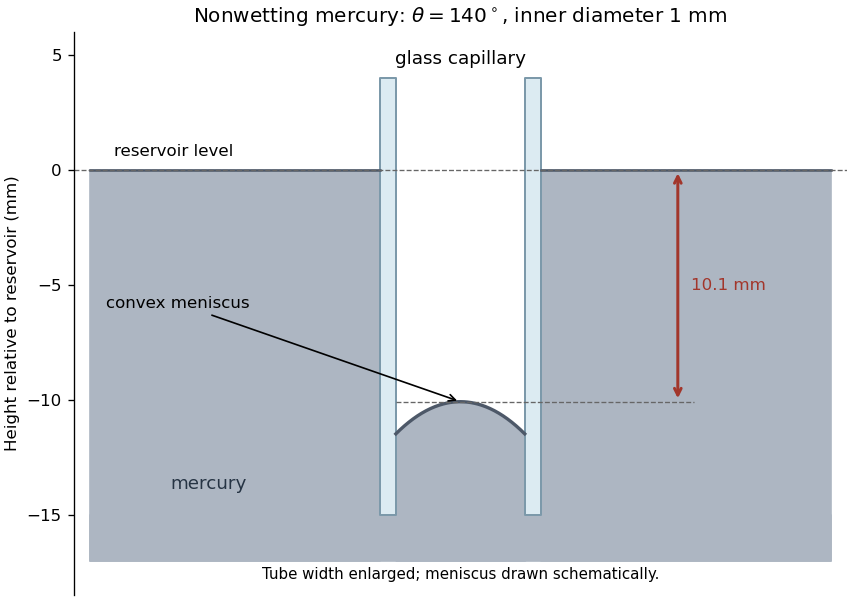
The liquid does not wet the glass because . The liquid meniscus is convex, with the capillary mercury level depressed below the reservoir. Balancing vertical surface-tension force against the hydrostatic column gives Jurin's law, using the inner radius :Thus the depression is approximately . The simple height law neglects small meniscus-volume corrections. Mercury's high surface tension reflects strong metallic bonding, not merely dispersion between weakly interacting molecular units.

A thin soap bubble has two interfaces, so the Young–Laplace equation gives . HenceAt equal surface tension, the smaller bubble has the higher internal pressure. Air diffuses through their separating film from the smaller to the larger bubble, so the smaller shrinks and the larger grows. The pressure difference increases as the smaller shrinks. This is gas transfer driven by curvature, not necessarily immediate merging of the interfaces; coalescence additionally requires film rupture.
Articles by others on the same topic
There are currently no matching articles.