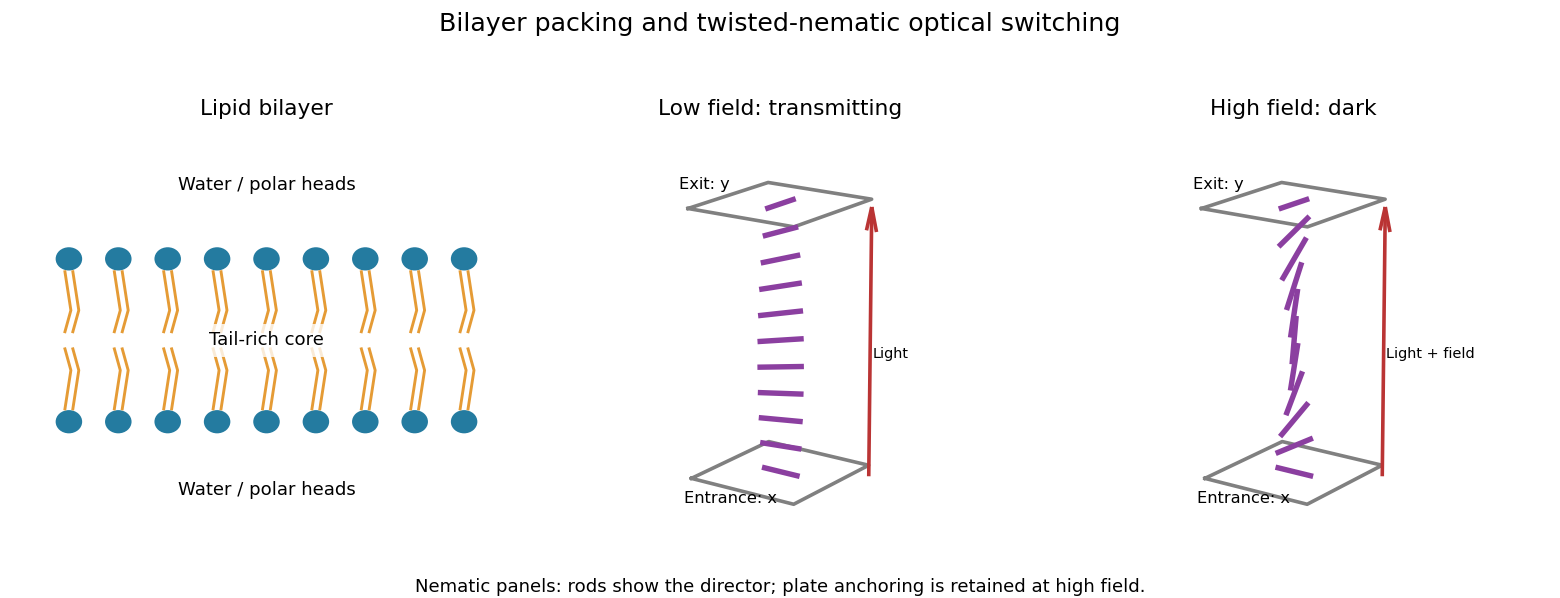
A lipid bilayer has two opposed leaflets: hydrophilic heads contact the water on either side, while hydrophobic tails meet in its interior. This arrangement reduces exposure of the tails to water through the hydrophobic effect. Approximately cylindrical molecular packing favors a lipid bilayer; a strongly wedge-shaped amphiphile can instead form a micelle. Closing a sheet into a lipid vesicle removes its costly exposed edge.
Within a fluid membrane, lipids diffuse laterally, while transfer of a polar head through the hydrophobic core is much slower without assistance. The core limits passive transport of ions and many polar solutes; membrane proteins provide selective routes. Bending costs free energy but does not require the large area compression associated with stretching the molecular packing, so a thin membrane can bend readily while strongly resisting area change. Cholesterol and tail saturation alter packing and fluidity. In a cell, the bilayer also supports embedded proteins and a difference of electric potential across the membrane.

Articles by others on the same topic
There are currently no matching articles.