The Flory interaction parameter measures the energetic preference for unlike rather than like contacts in Flory–Huggins solution theory. For polymer volume fraction and lattice sites per chain, the dimensionless mixing Helmholtz free energy per site isThe logarithmic terms represent combinatorial entropy; polymer connectivity reduces the chain's translational mixing entropy by the factor . In a simple contact model , where is the coordination number. Positive penalizes polymer-solvent contacts. Increasing it can overcome mixing entropy and cause phase separation; a negative second derivative of the mixing free energy marks the spinodal region. For a long dilute chain, corresponds to a good solvent, to the idealized theta condition, and to a poor solvent. Real effective parameters can depend on temperature and concentration, rather than being universal chemical constants.
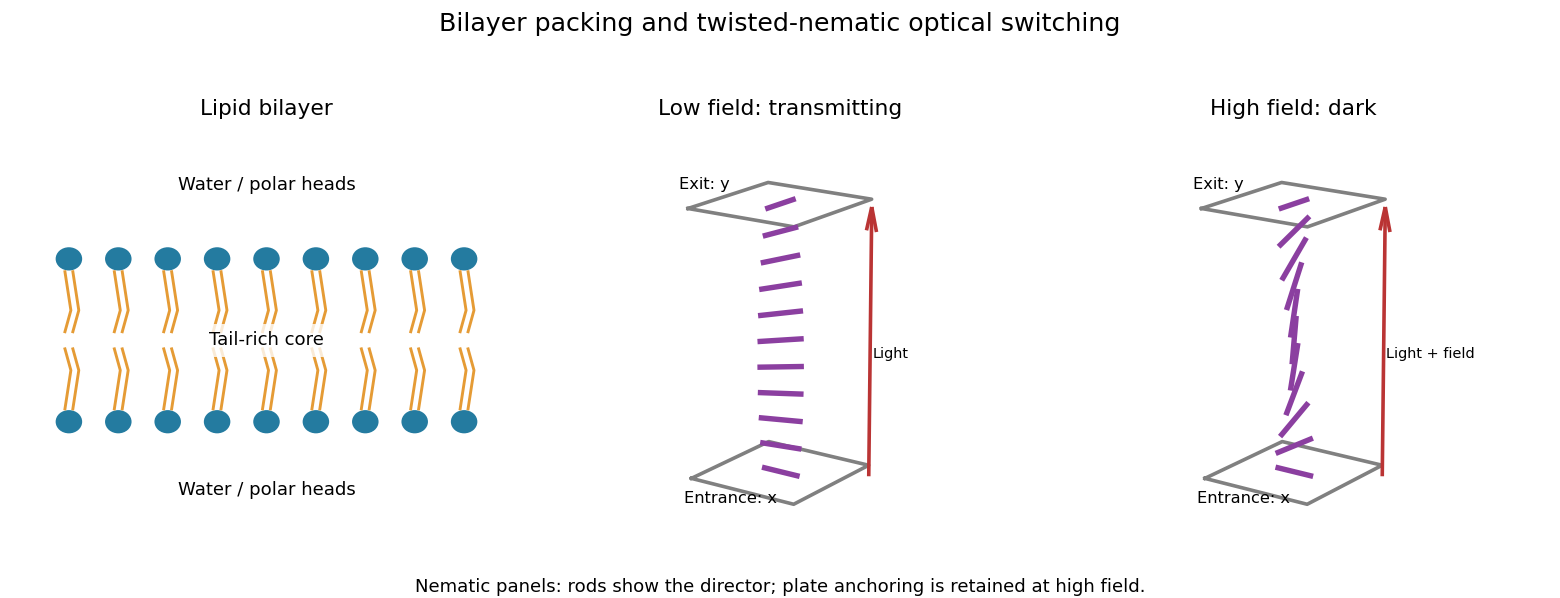
A lipid bilayer has two opposed leaflets: hydrophilic heads contact the water on either side, while hydrophobic tails meet in its interior. This arrangement reduces exposure of the tails to water through the hydrophobic effect. Approximately cylindrical molecular packing favors a lipid bilayer; a strongly wedge-shaped amphiphile can instead form a micelle. Closing a sheet into a lipid vesicle removes its costly exposed edge.
Within a fluid membrane, lipids diffuse laterally, while transfer of a polar head through the hydrophobic core is much slower without assistance. The core limits passive transport of ions and many polar solutes; membrane proteins provide selective routes. Bending costs free energy but does not require the large area compression associated with stretching the molecular packing, so a thin membrane can bend readily while strongly resisting area change. Cholesterol and tail saturation alter packing and fluidity. In a cell, the bilayer also supports embedded proteins and a difference of electric potential across the membrane.

A polymer melt has an observation-time-dependent response because chains need time to rearrange. Short compared with their terminal relaxation time, entangled chains constrain one another and can store elastic free energy. Long compared with that time, chains escape their original constraints by reptation and the uncrosslinked melt flows. A permanently crosslinked elastomer instead retains a long-time elastic modulus.
A single-time approximation is the Maxwell fluid: a spring of shear modulus and a viscous dashpot of viscosity in series. Their common stress and additive shear strains give , with relaxation time . For sinusoidal deformation proportional to , the storage modulus and loss modulus areAt low frequency dominates; at high frequency within this coarse-grained model dominates. Real melts have a spectrum of relaxation times and additional segmental or glassy regimes, so the single-time model does not describe every frequency. A step-strain experiment measures the decay of stress, whereas oscillatory rheometry separates stored energy from dissipated energy through the phase of the response.
Articles by others on the same topic
There are currently no matching articles.