The Stokes–Einstein relation gives the translational diffusion coefficientat . For isotropic three-dimensional Brownian motion, the mean squared displacement is . Thus after one hour the root mean square displacement isThe phrase “on average” needs a convention: the mean displacement vector is zero; the mean displacement magnitude of three-dimensional Brownian motion is , obtained by integrating the three-dimensional Gaussian distribution. These are displacements, not the total microscopic path length. The estimate assumes dilute unconfined water, a spherical hydrodynamic radius and constant temperature.
For a spherical micelle with tails, core radius , molecular tail volume and head-group area , volume and surface counting give and . Consequently . A tail cannot span a core radius larger than its maximum length , so the amphiphile packing parameter condition isThis is a minimum area, not a maximum. The printed request reverses the geometric inequality. The limiting value corresponds to fully extended tails with ; larger head groups permit smaller spherical aggregates in this simple packing argument. The supplied data alone impose no finite maximum head-group area, and geometry alone does not guarantee thermodynamic micelle formation.
In the planar Debye–Hückel approximation, a surface potential decays as , with at fixed temperature and solvent permittivity; is the ionic strength. For a monovalent salt, reducing its concentration by ten reduces by . Calibrating the first decay from the supplied potential ratio, and assuming unchanged , givesHere the printed meV unit is interpreted as the electrostatic potential energy of a singly charged probe; the same ratio calculation applies to potentials in mV.
This numerical answer uses an effective exponential decay calibrated from the data. The inferred initial Debye length is , whereas the standard dilute aqueous-electrolyte expression at room temperature gives about for monovalent salt. The numbers therefore are not consistent with that absolute ideal-electrolyte model. Moreover a spherical colloid has an additional radius-dependent geometric factor, and its surface potential need not remain constant when salt is changed. Without a surface boundary condition and geometry, the new potential is not uniquely specified beyond the stated planar, fixed-potential approximation.
The Flory interaction parameter measures the energetic preference for unlike rather than like contacts in Flory–Huggins solution theory. For polymer volume fraction and lattice sites per chain, the dimensionless mixing Helmholtz free energy per site isThe logarithmic terms represent combinatorial entropy; polymer connectivity reduces the chain's translational mixing entropy by the factor . In a simple contact model , where is the coordination number. Positive penalizes polymer-solvent contacts. Increasing it can overcome mixing entropy and cause phase separation; a negative second derivative of the mixing free energy marks the spinodal region. For a long dilute chain, corresponds to a good solvent, to the idealized theta condition, and to a poor solvent. Real effective parameters can depend on temperature and concentration, rather than being universal chemical constants.
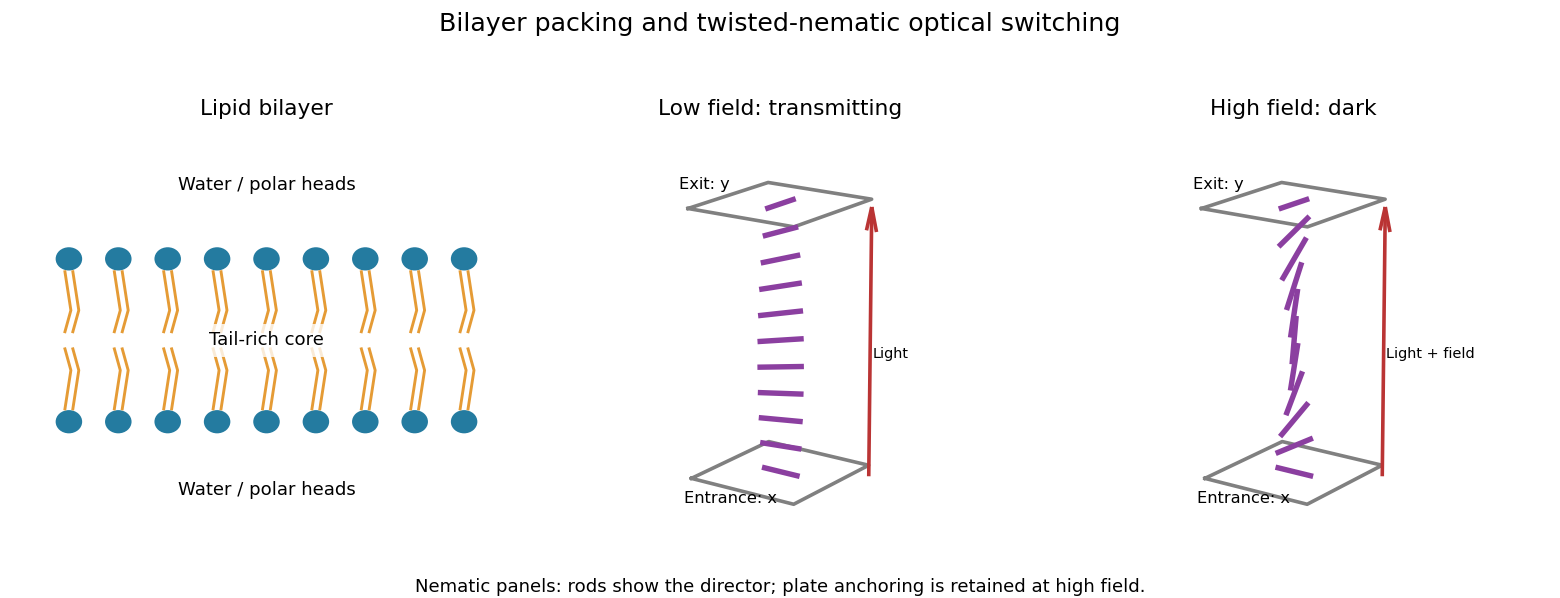
A lipid bilayer has two opposed leaflets: hydrophilic heads contact the water on either side, while hydrophobic tails meet in its interior. This arrangement reduces exposure of the tails to water through the hydrophobic effect. Approximately cylindrical molecular packing favors a lipid bilayer; a strongly wedge-shaped amphiphile can instead form a micelle. Closing a sheet into a lipid vesicle removes its costly exposed edge.
Within a fluid membrane, lipids diffuse laterally, while transfer of a polar head through the hydrophobic core is much slower without assistance. The core limits passive transport of ions and many polar solutes; membrane proteins provide selective routes. Bending costs free energy but does not require the large area compression associated with stretching the molecular packing, so a thin membrane can bend readily while strongly resisting area change. Cholesterol and tail saturation alter packing and fluidity. In a cell, the bilayer also supports embedded proteins and a difference of electric potential across the membrane.

A polymer melt has an observation-time-dependent response because chains need time to rearrange. Short compared with their terminal relaxation time, entangled chains constrain one another and can store elastic free energy. Long compared with that time, chains escape their original constraints by reptation and the uncrosslinked melt flows. A permanently crosslinked elastomer instead retains a long-time elastic modulus.
A single-time approximation is the Maxwell fluid: a spring of shear modulus and a viscous dashpot of viscosity in series. Their common stress and additive shear strains give , with relaxation time . For sinusoidal deformation proportional to , the storage modulus and loss modulus areAt low frequency dominates; at high frequency within this coarse-grained model dominates. Real melts have a spectrum of relaxation times and additional segmental or glassy regimes, so the single-time model does not describe every frequency. A step-strain experiment measures the decay of stress, whereas oscillatory rheometry separates stored energy from dissipated energy through the phase of the response.
In a nematic liquid crystal, elongated molecules have orientational order around a nematic director , but lack the long-range positional order of a crystal. Head-tail symmetry identifies and . Molecular anisotropy and sufficient density favor collective alignment: for long hard rods this can increase translational entropy by reducing excluded-volume constraints, while attractive interactions can also favor alignment. Thermal orientational disorder competes with these effects.
The scalar nematic order parameter convention here isThus means . The effective orientation angle from nematic order isThis is not enough information to determine the literal mean angle : different orientation distributions can have the same second moment. Isotropic orientations have , and perfect axial alignment has .
In the supplied threshold expression, is the cell thickness; are the splay, twist and bend elastic constants of the Frank elastic energy. The dimensionless relative dielectric anisotropy of a nematic is , and is the vacuum permittivity. Positive anisotropy favors a director along the applied electric field. Strong surface anchoring fixes orthogonal in-plane directions on the two plates. The low-field director therefore twists by a quarter-turn through the cell. Between crossed polarizers, with the entrance polarization matched to the first surface director, adiabatic optical following in a twisted nematic rotates the polarization and allows transmission. A sufficiently large normal field tilts the interior director towards the field, suppressing that rotation and making the crossed-polarizer cell dark; the anchored boundary layers remain distorted. Reversing the polarizer arrangement can reverse the optical contrast.
The threshold is a Fréedericksz transition: the electric energy gain overcomes the restoring elastic energy of an allowed distortion. Using the expression explicitly supplied by the paper givesThe thickness cancels for this strong-anchoring model. This is the onset of director reorientation, not an assertion that every molecule instantaneously becomes perfectly aligned. The quoted elastic combination is taken as given for this numerical task; a threshold derived from a specified full director-energy model must use that model's own elastic combination consistently. The companion illustration in A2(b) shows the plate anchoring, polarizers and bulk field-aligned state.
For a freely jointed Gaussian chain, independent isotropic segment vectors have zero mean and coordinate variance . The central limit theorem gives the end-to-end vector densityThe number of conformations in a fixed small vector-volume element is proportional to this density. Taking its logarithm gives the configurational entropyThis is the vector-constrained entropy appropriate to an anchored strand. A density for the scalar length alone also has a shell factor and is a different constraint. The approximation requires many segments and extensions well below .
If the internal energy has negligible extension dependence, the Helmholtz free energy is . Differentiation gives an entropic force with effective spring constant . In an affine isotropic network, averaging over initially oriented strands gives rubber elasticityfor an incompressible material; is the number of elastically active strands per volume. For example a volume-preserving stretch with principal factors has strain-energy density . Its nominal tensile stress is , proving the stated small-strain Young's modulus.
Chemically, increasing the effective cross-link density, for example by changing vulcanization, generally increases the modulus by shortening strands between cross-links. Dangling ends, loops and changes of network structure mean the chemical junction count need not equal .
The reference area is . Neglect self-weight, thermal expansion and energetic elasticity, keep the same permanent network, and heat quasistatically in the rubbery regime. Then increases from to . With a constant suspended load, the exact affine-network balance isIt gives and . ThusLinear elasticity instead gives extensions and , a rise, consistent at this small strain. Incompressibility makes the area , already included by using nominal stress. Heating increases entropic stiffness, so the loaded rubber contracts and performs work on the mass. Strong thermal expansion, changes in cross-linking or leaving the rubbery regime would require additional material data.
Articles by others on the same topic
There are currently no matching articles.