In the isotropic parabolic-band approximation implied by the single supplied curvature, the hole mass from a valence-band maximum isThe hole has charge , so its cyclotron angular frequency isIf “frequency” means cycles per second, . The curvature unit is , so has mass units. The external constants used are , and .[ref]
CODATA recommended values of the fundamental physical constants 2014 by National Institute of Standards and Technology. Reduced Planck constant, elementary charge and electron mass
A genuinely anisotropic band would require the cyclotron mass for the orbit plane, not a single arbitrary directional curvature.Let the atomic spacing be and define the nearest-neighbour matrix elements , using the same translated orbital convention on every site. ThenFor the opposite sigma and pi hopping signs in a p-orbital chain, consider first: neighbouring lobes above the chain have the same sign, so the in-phase Bloch sum is bonding. Thus andFor , the lobes facing one another have opposite signs for equal site coefficients. Bonding therefore needs alternating coefficients, giving andEnd-on overlap is normally stronger than side-on overlap, so the band is wider, with bandwidths and . The curve orientations require a stated hopping-sign convention; a Hamiltonian written with an explicit minus sign in front of the hopping uses correspondingly opposite parameter signs.[ref]
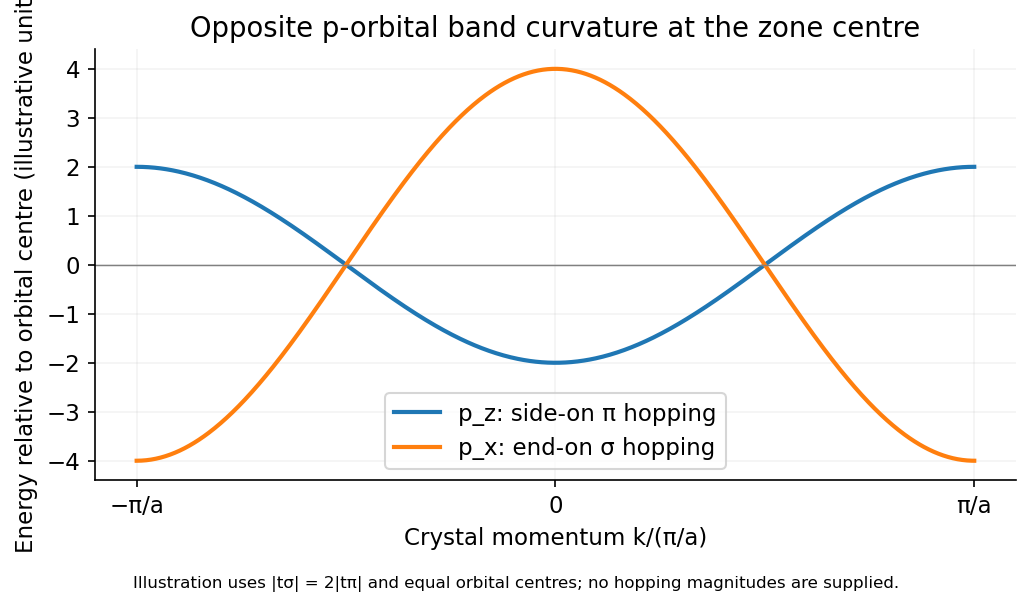
End-on and side-on p-orbital hopping give opposite tight-binding band orientations
. Source. Details. 
A hydrogenic donor has the effective Bohr radius of a hydrogenic donorusing the external .[ref]
CODATA recommended values of the fundamental physical constants 2014 by National Institute of Standards and Technology. Bohr radius
Increasing donor density causes donor states to overlap and screens their binding, allowing a metallic impurity system rather than isolated frozen-out donors.Using the standard approximate Mott criterion, , givesThe factor 0.25 is an externally documented empirical criterion, not supplied exam data or an exact universal threshold.[ref]
The Mott criterion: So simple and yet so complex by Alexander Pergament and others. Abstract and discussion of the effective-Bohr-radius criterion
An order-of-magnitude overlap argument without that prefactor would give . Compensation, disorder and multivalley anisotropy affect a real material's transition; this estimate uses the scalar mass and permittivity actually supplied, without substituting other germanium parameters. Articles by others on the same topic
There are currently no matching articles.