In the isotropic parabolic-band approximation implied by the single supplied curvature, the hole mass from a valence-band maximum isThe hole has charge , so its cyclotron angular frequency isIf “frequency” means cycles per second, . The curvature unit is , so has mass units. The external constants used are , and .[ref]
CODATA recommended values of the fundamental physical constants 2014 by National Institute of Standards and Technology. Reduced Planck constant, elementary charge and electron mass
A genuinely anisotropic band would require the cyclotron mass for the orbit plane, not a single arbitrary directional curvature.Let the atomic spacing be and define the nearest-neighbour matrix elements , using the same translated orbital convention on every site. ThenFor the opposite sigma and pi hopping signs in a p-orbital chain, consider first: neighbouring lobes above the chain have the same sign, so the in-phase Bloch sum is bonding. Thus andFor , the lobes facing one another have opposite signs for equal site coefficients. Bonding therefore needs alternating coefficients, giving andEnd-on overlap is normally stronger than side-on overlap, so the band is wider, with bandwidths and . The curve orientations require a stated hopping-sign convention; a Hamiltonian written with an explicit minus sign in front of the hopping uses correspondingly opposite parameter signs.[ref]
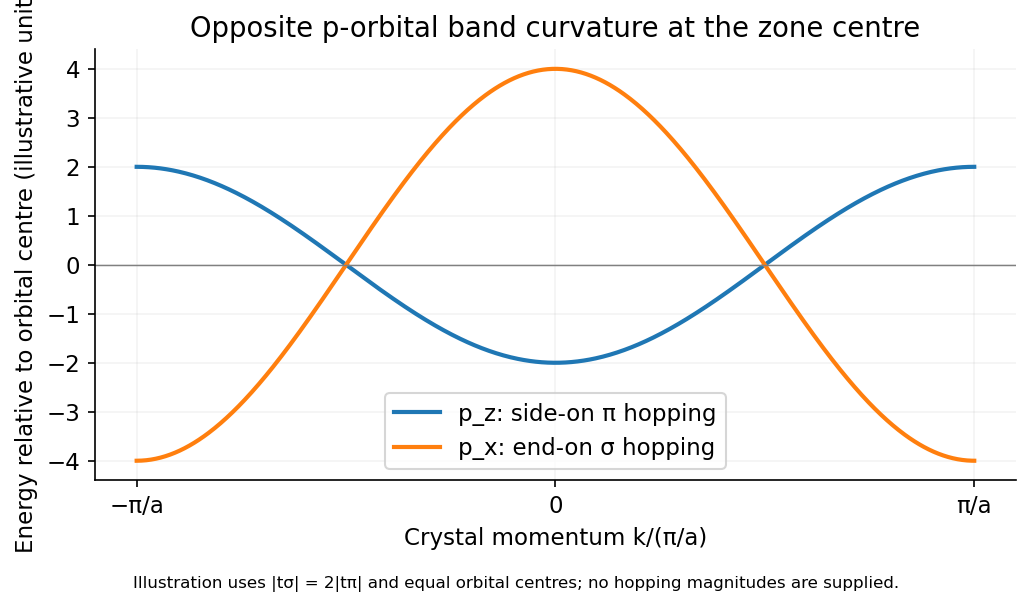
End-on and side-on p-orbital hopping give opposite tight-binding band orientations
. Source. Details. 
A hydrogenic donor has the effective Bohr radius of a hydrogenic donorusing the external .[ref]
CODATA recommended values of the fundamental physical constants 2014 by National Institute of Standards and Technology. Bohr radius
Increasing donor density causes donor states to overlap and screens their binding, allowing a metallic impurity system rather than isolated frozen-out donors.Using the standard approximate Mott criterion, , givesThe factor 0.25 is an externally documented empirical criterion, not supplied exam data or an exact universal threshold.[ref]
The Mott criterion: So simple and yet so complex by Alexander Pergament and others. Abstract and discussion of the effective-Bohr-radius criterion
An order-of-magnitude overlap argument without that prefactor would give . Compensation, disorder and multivalley anisotropy affect a real material's transition; this estimate uses the scalar mass and permittivity actually supplied, without substituting other germanium parameters.Heavy fermion materials are correlated metals whose low-energy quasiparticles have exceptionally large effective masses. Partly localized -electron moments hybridize with broader conduction states. The Kondo effect and coherence below the Kondo-lattice coherence temperature produce a narrow low-energy band, so a small energy change corresponds to a large momentum-space state density.
For the electronic heat capacity of a heavy Fermi liquid, the resulting density of states gives a large low-temperature electronic specific-heat coefficient,and often an enhanced magnetic susceptibility. Here includes both spins and must be expressed per sample, mole or volume consistently with . A coherent Fermi-liquid regime often has with an enhanced coefficient . Above coherence, scattering by local moments can instead give a Kondo-like resistivity upturn.
The competition between moment screening and intersite magnetic interactions can yield a heavy paramagnetic metal, magnetic order, quantum-critical behaviour or unconventional superconductivity. Ce- and U-based compounds supply familiar examples. “Heavy” describes the emergent electronic quasiparticles, not the ionic mass; the simple heavy-band picture need not survive at a quantum critical point.[ref]
Heavy Fermions and the Kondo Lattice: A 21st Century Perspective by Piers Coleman. Sections 1.1–1.3: heavy electrons, local moments and Kondo-lattice coherence
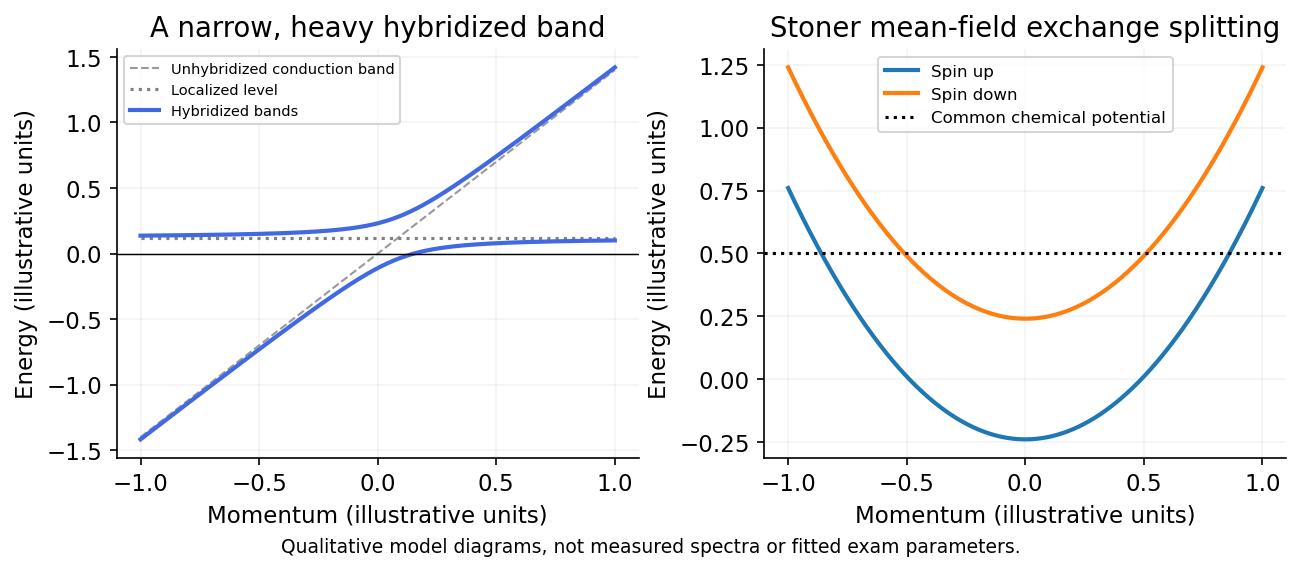
Hybridization flattens a conduction band near a localized level, while an itinerant exchange field splits spin bands
. Source. Details. 
The Hubbard model combines hopping with a local repulsion,Hopping favours a broad itinerant band; the interaction penalizes opposite-spin double occupancy. For uniform Stoner decoupling of the Hubbard interaction, let be the spin imbalance per site. The interaction is , so polarization lowers it by , at the expense of kinetic energy.
If is the noninteracting density of states per spin per site, small polarization costs . Thereforeis the mean-field ferromagnetic instability criterion. The exchange splitting is , and the paramagnetic response is enhanced as . A density of states including both spins changes the written factor in the criterion.
The model explains how itinerant bands can polarize without imposing pre-existing localized atomic spins. It is not a claim that every large- metal becomes ferromagnetic: near half filling the Hubbard model can instead form a Mott insulator with antiferromagnetic superexchange of scale . Band filling, bandwidth and fluctuations matter.[ref] The interaction-energy and kinetic-cost expansion above is the stated mean-field derivation of the enhancement.[ref]
Electron correlations in narrow energy bands by John Hubbard. Original local-repulsion model and the competition between atomic and itinerant limits
For an electron wavepacket in one isolated band under a uniform electric field,Because , acceleration through successive Brillouin zones makes the velocity periodic rather than increasing indefinitely. For ,for a positive field along the chosen axis. Integration givesThe excursion amplitude of a Bloch-oscillating wavepacket is about its mean and peak-to-peak extent . The turning of velocity corresponds semiclassically to Bragg reflection near a zone boundary.
Coherent Bloch oscillations require scattering/dephasing times long compared with and a field weak enough to avoid substantial interband tunnelling. Ordinary metals usually scatter too rapidly; semiconductor superlattices and cold atoms in periodic optical potentials provide cleaner realizations. A completely filled band has canceling velocities, so its net current does not oscillate simply because individual wavepackets can.[ref]
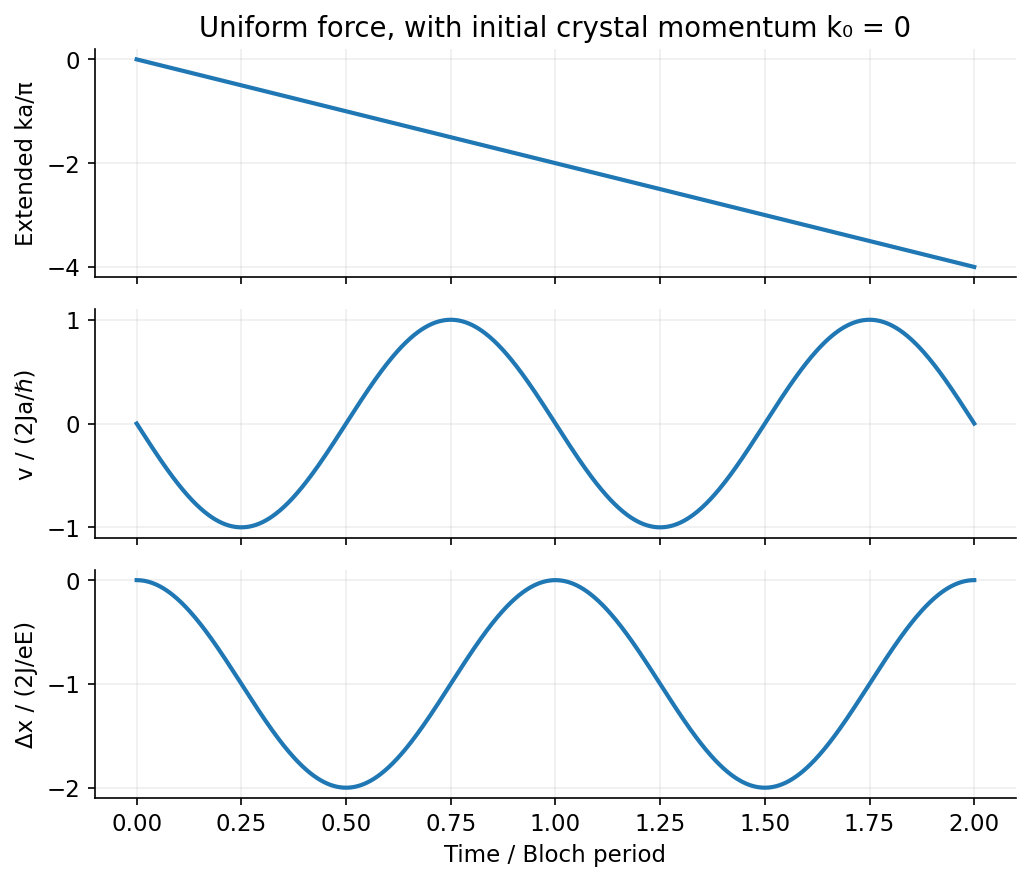
Constant force sweeps crystal momentum linearly, but a periodic band produces oscillating velocity and bounded displacement
. Source. Details. 
For a spin-degenerate band, each unit cell contributes two available states. An even electron count per cell can fill an integer number of bands; a band insulator additionally needs a global gap between the highest occupied and lowest unoccupied bands. Even filling alone is not sufficient when bands overlap.
For a free two-dimensional gas with spin degeneracy two,The reciprocal vectors of the periodic potential are and . Its first Brillouin zone is the square , of side and area ; the real-space cell has side .
At zero potential, the extended-zone Fermi surface is the circle of radius . Since , it crosses every square face but misses the corners. For Fermi-surface reconstruction in a weak square potential, weak positive potential opens gaps at the Bragg crossings: the second band has electron pockets at the two inequivalent edge centres , while unfilled regions of the first band form a hole pocket at the zone corner . Opposite edges are identified: four edge half-pockets are two electron pockets, and four corner pieces are one hole pocket.
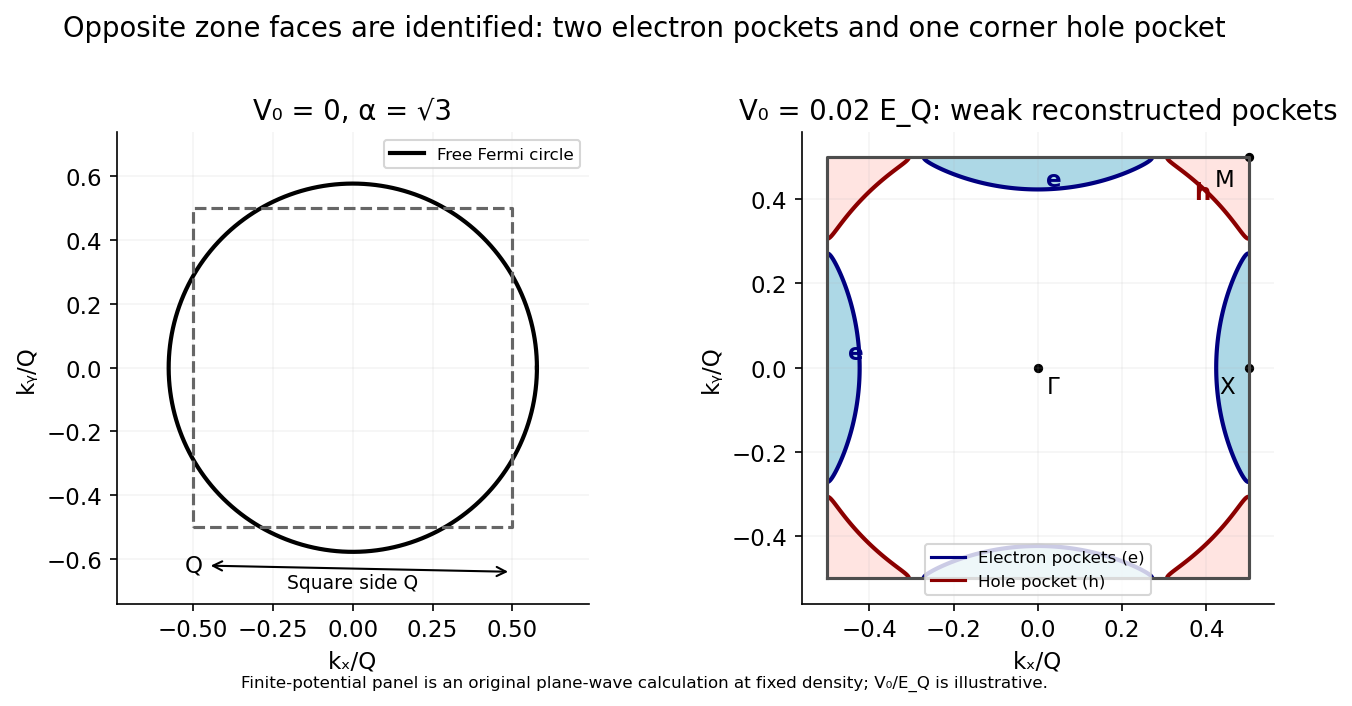
A square Brillouin zone reconstructs the free Fermi circle into edge-centred electron pockets and a corner-centred hole pocket
. Source. Details. 
For the circular-cap carrier count in a square Brillouin zone, put and . Each circular cap outside a square face has areaNo two such caps overlap in the specified interval. The total second-band electron area is . The first-band hole area is the square area minus the occupied central-circle area, . Including spin,Thus at ,The carrier densities are the electron- and hole-pocket counts, not the total electron density. The carrier compensation and even band filling in a square lattice follows because their difference obeys , so compensation occurs at . These area formulas are the limit, before finite-gap reconstruction changes the pocket shapes.[ref]
The filling per real-space cell is . In the given interval, the only even integer filling is , again requiring . At any other fixed filling a full gap cannot yield an ordinary spin-degenerate band insulator in this unchanged periodicity. In particular, the system retains excess electron carriers even after its holes disappear.
A rough gap threshold comes from comparing different symmetry directions, rather than only a direct zone-face gap. Define . The zone-face two-plane-wave gap for a cosine potential follows because each cosine couples plane waves by , giving the one-dimensional zone-edge levels . The four-plane-wave splitting at a square-zone corner is the sum of two such pairs. The potential is separable in , so to first orderThe indirect gap of a separable square cosine potential is consequentlyAt the compensated filling, this is , with . An insulator needs both the even filling and a positive indirect gap. At the touching threshold the gap is zero; a positive direct gap at every Bragg crossing is not by itself sufficient. The estimate neglects higher-plane-wave corrections and is not an exact critical amplitude.
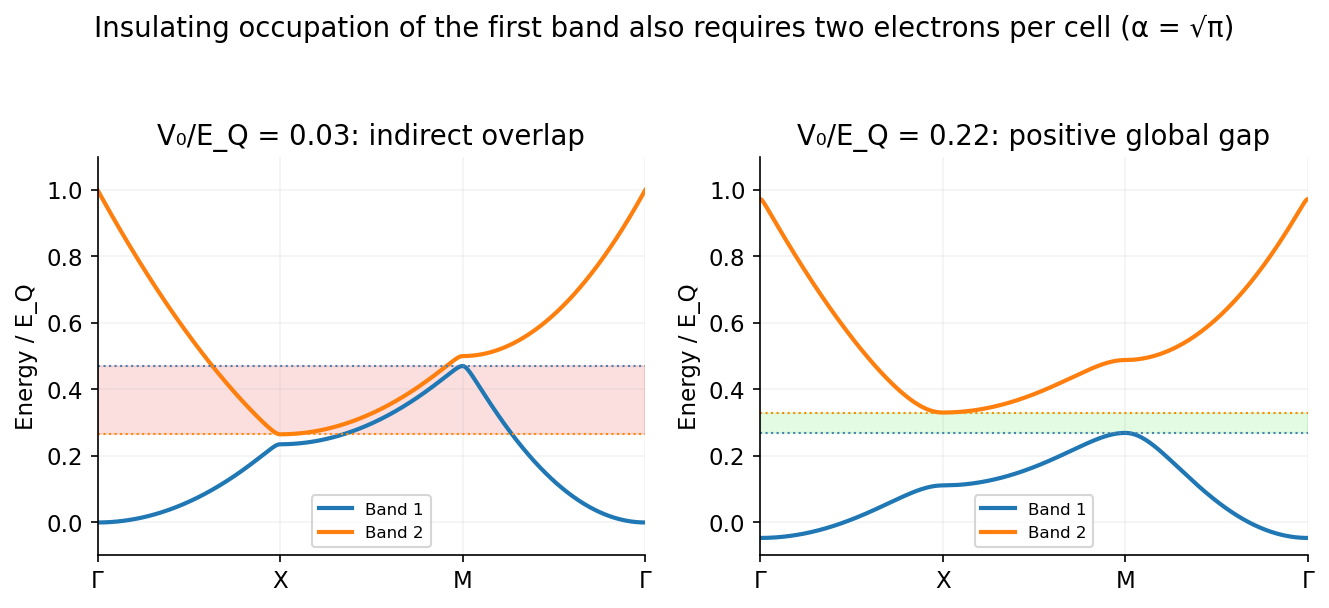
A local Bragg gap can coexist with a global band overlap; a stronger square potential separates the full first band from the second
. Source. Details. 
Assume three-dimensional parabolic band edges, with density-of-states masses and one valley per edge, each with spin degeneracy two. Their effective densities of states areFor the semiconductor mass-action law, integrating the square-root density of states against the Boltzmann tail gives and . Multiplication cancels the chemical potential, givingIf there are additional valley degeneracies, multiply by their product; anisotropic bands use the appropriate density-of-states masses. In the later equal-mass model, . No numerical mass or valley multiplicity has been invented.
When , the conduction-edge occupation is exactly , so the nondegenerate approximation for electrons fails at every positive temperature. Define the Normalized complete Fermi-Dirac integralFor the carrier densities with chemical potential pinned to a band edge, with the two specified equal masses, put . Direct Fermi-Dirac integration then givesThus exactly within the parabolic model. At low temperature, is thermally activated; at , from below. Both vanish at zero temperature and increase at fixed chemical potential. The other states that pin can supply the compensating charge; one must not additionally impose .
For the Pauli reduction of the pinned-edge mass-action product, the exact product relative to the classical law isIt approaches at low temperature and in the formal high-temperature limit. The low-temperature activation factor is unchanged but its prefactor is reduced; the classical mass-action formula overestimates the product. The high-temperature limit here refers to the given unbounded parabolic bands, not a claim that real semiconductor band structures remain unchanged at arbitrarily high temperature.[ref]
Quantum Gases by David Tong. Sections 3.1 and 3.6.1–3.6.4: density of states, Fermi occupation and Sommerfeld expansion
Finally, for a fixed positive , the zero-temperature Fermi sphere has radius , soThe low-temperature expansion at fixed gives the fixed-chemical-potential Sommerfeld density increase:The monotonic density at fixed chemical potential in a square-root density of states initially rises quadratically from . For , its leading behaviour crosses to . The fixed chemical potential is what allows the particle number to change.
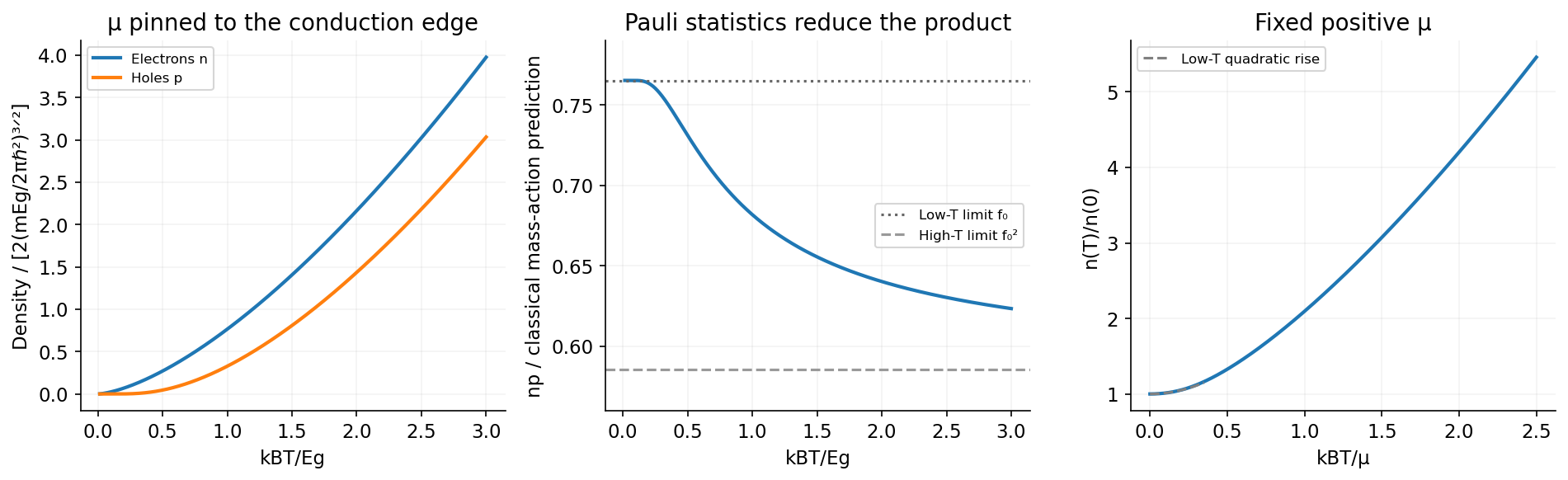
Pinning the chemical potential to or above a band edge changes carrier populations and the mass-action product
. Source. Details. 
Articles by others on the same topic
There are currently no matching articles.