For a lattice-periodic one-electron Hamiltonian, Bloch's theorem givesHere is any lattice translation and labels an energy band. Under that translation the wavefunction gains phase . The crystal momentum labels this translation eigenvalue and is defined modulo for a reciprocal lattice vector .
The mechanical momentum is different. In zero magnetic field its operator is , which acts asA general Bloch state is therefore not a mechanical-momentum eigenstate. Expanding its periodic factor gives plane-wave components with momenta , with probabilities determined by their Fourier coefficients. For a local Hamiltonian , its mean momentum satisfiesnot generally . The lattice exchanges actual momentum with the electron; crystal-momentum conservation in scattering is instead modulo reciprocal-lattice vectors, as in Umklapp scattering.
Use Thomas-Fermi screening, treating a homogeneous three-dimensional conductor in static linear response. For a positive test charge the screened electric potential and bare Coulomb potential areHere is the background permittivity before the mobile carriers screen; it is in the simplest free-electron model. Both curves have the same leading divergence near the origin, while the screened curve lies below the bare one and decays much faster.
A positive potential attracts Electrons. If is their total spin-summed density of states per volume and energy, and . Inserting this charge into Poisson equation gives the Thomas-Fermi screening lengthA larger density of states lets the conductor rearrange more charge for the same potential change and shortens the screening length. For a parabolic free electron model, , hence .
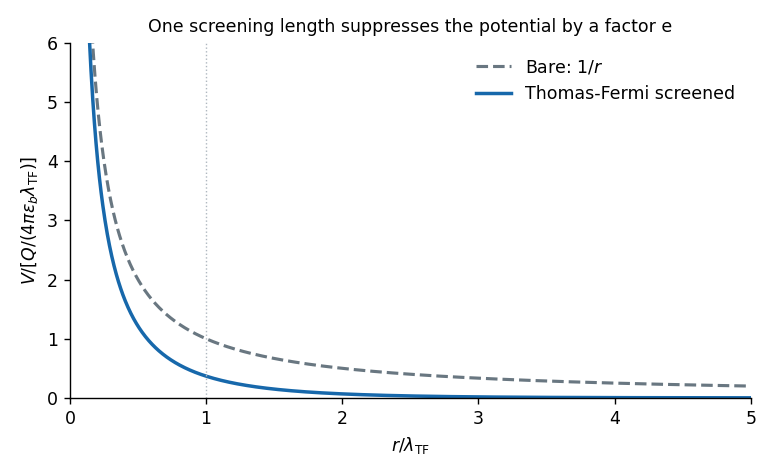

The exponential form is the intended local screening model. A microscopic zero-temperature metal also has Friedel oscillations, so the exponential alone is not an exact description at every length scale.
The Moiré pattern sets a superlattice periodFor the stipulated scalar one-dimensional model, right- and left-moving states have . The th Bragg crossing satisfies and hence . The Bragg gap ladder for a linear dispersion therefore has centresThis is the spacing of successive possible Bragg gaps. The corresponding atomic-lattice scale is , fifty times larger.
Shifting a linear branch by one full reciprocal period instead gives , twice the consecutive Bragg-threshold spacing; the first zone boundary is at . These scales should not be confused with the gap width, which depends on the weak potential's Fourier coefficients. The geometry alone does not guarantee equally wide or even observable gaps at every threshold, nor an exactly periodic full spectrum. The estimate neglects graphene's additional pseudospin selection rules and interlayer correlations, as required by the scalar-chain approximation.
Articles by others on the same topic
There are currently no matching articles.