For the XXZ spin chain, write and replace each spin by a classical vector of length . A bond is , whose minimum is . For an even periodic chain all bonds can attain that bound simultaneously. The classical ground states of an XXZ spin chain therefore give gives the two easy-axis Néel states and its reversal, with energy .
For the ground states are planar Néel configurations, , with arbitrary : their degeneracy is a circle and their energy is . This includes the easy-plane interval used later. Part (a), however, does not restrict negative to that interval. For , and the lowest states are instead the two uniform -polarized ferromagnetic configurations, with energy . At , a rotation by about on alternating sites maps the classical energy to an isotropic ferromagnet: for any unit vector is a ground state. This special degeneracy is a sphere. At the other boundary, , the ordinary Néel direction is arbitrary on a sphere. These statements concern classical minimizing configurations, not the degeneracy of the exact finite-chain quantum ground state.
Let , , and take . The physical Holstein–Primakoff occupation constraint limits the Hilbert space, which contains only . Acting in this number basis givesThe upper and lower endpoints are annihilated as required. ConsequentlyThe change in also gives . These matrix elements prove the spin algebra on the full physical spin- space. Extending the oscillator space to arbitrary occupation would not give a physical finite spin: the occupation constraint and operator ordering in the square root matter. bosons on distinct sites have and all other site commutators zero.
Rotate the spin on one sublattice through about its axis, using the unitary product of the corresponding spin-rotation operators. On a rotated site the old components obey , , . Every bond joins opposite sublattices, soThe longitudinal product changes sign. Hence the rotated bond is , giving the requested form. The canonical spin algebra is unchanged because the transformation is unitary. A staggered easy-axis reference configuration is now the uniform all-up state. At one first chooses a Néel direction, here , before performing the same rotation.
For occupations small compared with , use , and . The longitudinal bond contributes ; the transverse pair terms contribute . Thus the direct real-space expansion isTake , with over one full Brillouin zone and the lattice spacing set to one in . Symmetrizing and changes the phase in the pair sum to , givingnormal ordering the second Nambu spinor component then yieldsThe printed matrix has a factor-of-two error on its diagonal. With a full-zone sum its printed would produce , and even its vacuum expectation would differ from the direct expansion by . A half-zone convention cannot repair both coefficients: one must then group each pair and double its off-diagonal pair coefficient as well. The formula above follows from the specified Hamiltonian and has the expected gapless isotropic limit; subsequent physical results use this consistent expansion. Terms quartic in bosons first enter at order .
Write , , taking real even . The transformation givesThe second equality uses and , while the first uses . The creation-creation commutator vanishes by conjugation. Therefore the modes are canonical bosons. In the paired basis,Its determinant is one and its inverse reverses the signs of the off-diagonal entries. Hence . At self-inverse momenta this is the corresponding one-mode squeezing transformation, still canonical for finite .
For the easy-axis XXZ antiferromagnetic spin-wave spectrum, the consistent quadratic Hamiltonian in part (d) has and . The inverse transformation acts on the Nambu matrix by a congruence. Its diagonal and off-diagonal entries become and . The pair term vanishes whenFor the transformation is real and finite for every . Summing the two Nambu number operators over the full zone givesHere names the constant in the requested oscillator form; the actual quadratic ground-state energy is . This distinguishes the normal-ordering constant from the total zero-point contribution. bosonic Bogoliubov diagonalization is a canonical, not an ordinary unitary, diagonalization of the Nambu matrix.
At and , the same formula holds with . The exact zero modes have , so no finite squeezing angle diagonalizes them as positive-frequency oscillators. Treat collective rotations separately or retain a small anisotropy regulator before taking the limit. Finally, if one instead diagonalizes the literal erroneous printed matrix, it gives and . That result remains gapped at and is not the spin-wave spectrum of the Hamiltonian stated at the start.
For , the dispersion is periodic and has minima at in the rotated full-zone convention, withThe maximum is at . The easy-axis state has no continuously broken symmetry, so a gap is allowed. Near a minimum the energy behaves as . At it becomes , linear near its zeros, with small- slope in the chosen units. Restoring lattice spacing and gives spin-wave speed . Zone folding reorganizes the same modes into the magnetic Brillouin zone.
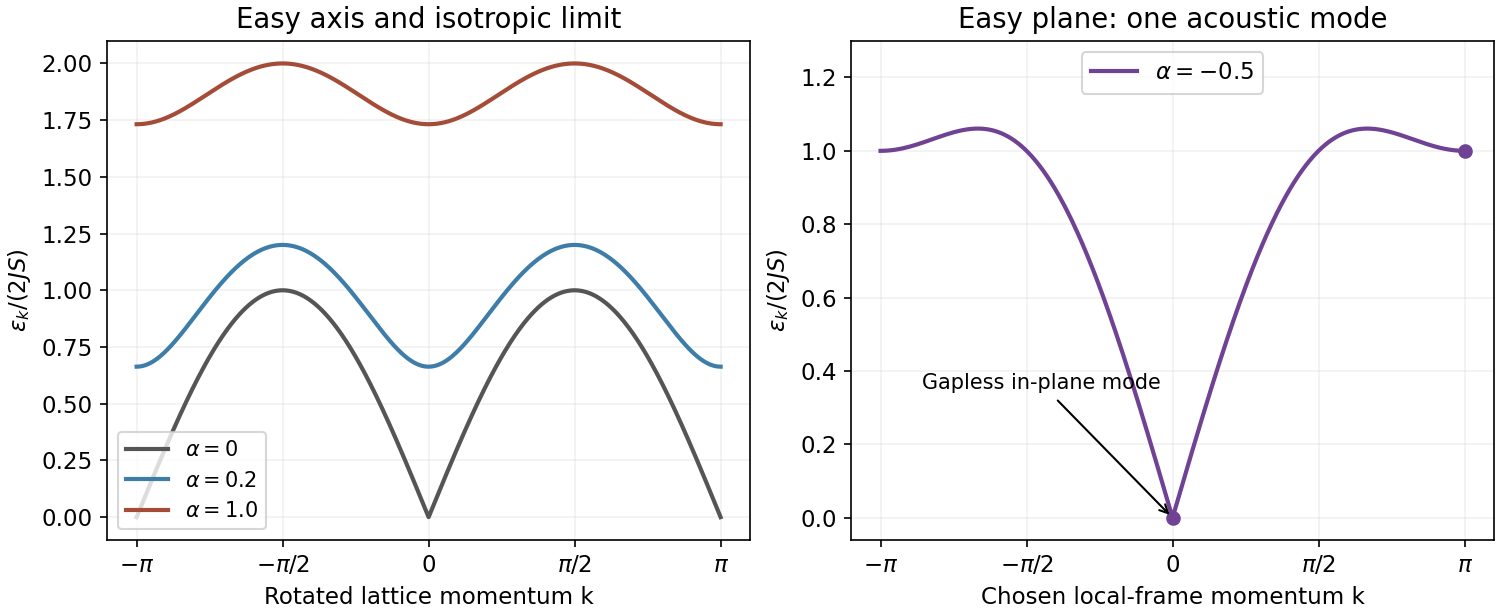

These are linear spin-wave predictions, not a statement that the exact one-dimensional quantum chain always has long-range Néel order. At the isotropic point the zero-point spin reduction contains , which diverges logarithmically as the infrared cutoff vanishes. This failure of the assumed ordered reference must not be mistaken for a calculation of the exact interacting spectrum.
In this part , so the ordered reference lies in the plane. Choosing one direction breaks the continuous rotation symmetry within that plane. A gapless, linearly dispersing phase mode is therefore expected in the spin-wave approximation, while tilting the Néel axis out of the plane costs anisotropy energy. It is incorrect to continue the easy-axis expansion about an unstable -ordered reference and interpret its imaginary frequencies as physical modes.
For the easy-plane XXZ antiferromagnetic spin-wave spectrum, take the Néel direction along old , then rotate alternating local spins so that all longitudinal components point up. One such local frame gives the full-zone quadratic coefficientsand thereforeNear , . The zone-edge mode has gap . A different sublattice phase convention shifts the zero by ; folding into the magnetic zone displays an acoustic and a gapped polarization. The figure uses this explicitly chosen frame. One-dimensional long-wavelength fluctuations again limit the ordered-reference interpretation.
Articles by others on the same topic
There are currently no matching articles.