Original source: Cambridge FOI 2023/399 released PDF, physical pages 797–799.
For the XXZ spin chain, write and replace each spin by a classical vector of length . A bond is , whose minimum is . For an even periodic chain all bonds can attain that bound simultaneously. The classical ground states of an XXZ spin chain therefore give gives the two easy-axis Néel states and its reversal, with energy .
For the ground states are planar Néel configurations, , with arbitrary : their degeneracy is a circle and their energy is . This includes the easy-plane interval used later. Part (a), however, does not restrict negative to that interval. For , and the lowest states are instead the two uniform -polarized ferromagnetic configurations, with energy . At , a rotation by about on alternating sites maps the classical energy to an isotropic ferromagnet: for any unit vector is a ground state. This special degeneracy is a sphere. At the other boundary, , the ordinary Néel direction is arbitrary on a sphere. These statements concern classical minimizing configurations, not the degeneracy of the exact finite-chain quantum ground state.
Let , , and take . The physical Holstein–Primakoff occupation constraint limits the Hilbert space, which contains only . Acting in this number basis givesThe upper and lower endpoints are annihilated as required. ConsequentlyThe change in also gives . These matrix elements prove the spin algebra on the full physical spin- space. Extending the oscillator space to arbitrary occupation would not give a physical finite spin: the occupation constraint and operator ordering in the square root matter. bosons on distinct sites have and all other site commutators zero.
Rotate the spin on one sublattice through about its axis, using the unitary product of the corresponding spin-rotation operators. On a rotated site the old components obey , , . Every bond joins opposite sublattices, soThe longitudinal product changes sign. Hence the rotated bond is , giving the requested form. The canonical spin algebra is unchanged because the transformation is unitary. A staggered easy-axis reference configuration is now the uniform all-up state. At one first chooses a Néel direction, here , before performing the same rotation.
For occupations small compared with , use , and . The longitudinal bond contributes ; the transverse pair terms contribute . Thus the direct real-space expansion isTake , with over one full Brillouin zone and the lattice spacing set to one in . Symmetrizing and changes the phase in the pair sum to , givingnormal ordering the second Nambu spinor component then yieldsThe printed matrix has a factor-of-two error on its diagonal. With a full-zone sum its printed would produce , and even its vacuum expectation would differ from the direct expansion by . A half-zone convention cannot repair both coefficients: one must then group each pair and double its off-diagonal pair coefficient as well. The formula above follows from the specified Hamiltonian and has the expected gapless isotropic limit; subsequent physical results use this consistent expansion. Terms quartic in bosons first enter at order .
Write , , taking real even . The transformation givesThe second equality uses and , while the first uses . The creation-creation commutator vanishes by conjugation. Therefore the modes are canonical bosons. In the paired basis,Its determinant is one and its inverse reverses the signs of the off-diagonal entries. Hence . At self-inverse momenta this is the corresponding one-mode squeezing transformation, still canonical for finite .
For the easy-axis XXZ antiferromagnetic spin-wave spectrum, the consistent quadratic Hamiltonian in part (d) has and . The inverse transformation acts on the Nambu matrix by a congruence. Its diagonal and off-diagonal entries become and . The pair term vanishes whenFor the transformation is real and finite for every . Summing the two Nambu number operators over the full zone givesHere names the constant in the requested oscillator form; the actual quadratic ground-state energy is . This distinguishes the normal-ordering constant from the total zero-point contribution. bosonic Bogoliubov diagonalization is a canonical, not an ordinary unitary, diagonalization of the Nambu matrix.
At and , the same formula holds with . The exact zero modes have , so no finite squeezing angle diagonalizes them as positive-frequency oscillators. Treat collective rotations separately or retain a small anisotropy regulator before taking the limit. Finally, if one instead diagonalizes the literal erroneous printed matrix, it gives and . That result remains gapped at and is not the spin-wave spectrum of the Hamiltonian stated at the start.
For , the dispersion is periodic and has minima at in the rotated full-zone convention, withThe maximum is at . The easy-axis state has no continuously broken symmetry, so a gap is allowed. Near a minimum the energy behaves as . At it becomes , linear near its zeros, with small- slope in the chosen units. Restoring lattice spacing and gives spin-wave speed . Zone folding reorganizes the same modes into the magnetic Brillouin zone.
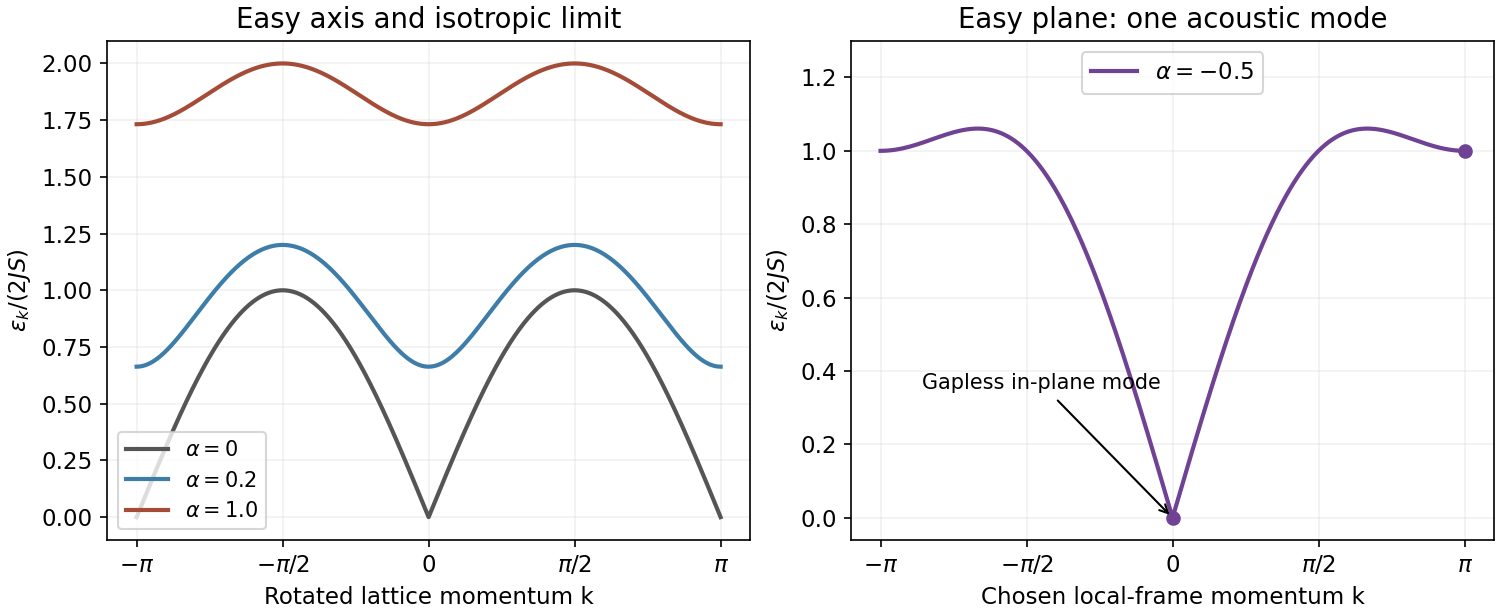

These are linear spin-wave predictions, not a statement that the exact one-dimensional quantum chain always has long-range Néel order. At the isotropic point the zero-point spin reduction contains , which diverges logarithmically as the infrared cutoff vanishes. This failure of the assumed ordered reference must not be mistaken for a calculation of the exact interacting spectrum.
In this part , so the ordered reference lies in the plane. Choosing one direction breaks the continuous rotation symmetry within that plane. A gapless, linearly dispersing phase mode is therefore expected in the spin-wave approximation, while tilting the Néel axis out of the plane costs anisotropy energy. It is incorrect to continue the easy-axis expansion about an unstable -ordered reference and interpret its imaginary frequencies as physical modes.
For the easy-plane XXZ antiferromagnetic spin-wave spectrum, take the Néel direction along old , then rotate alternating local spins so that all longitudinal components point up. One such local frame gives the full-zone quadratic coefficientsand thereforeNear , . The zone-edge mode has gap . A different sublattice phase convention shifts the zero by ; folding into the magnetic zone displays an acoustic and a gapped polarization. The figure uses this explicitly chosen frame. One-dimensional long-wavelength fluctuations again limit the ordered-reference interpretation.
Take a uniform nearest-neighbour harmonic chain with displacement , conjugate momentum , mass , spring stiffness , lattice spacing and periodic length . These specify a standard model for the requested notes, not additional numerical exam data. Its Lagrangian and Hamiltonian areVariation gives . For a mode , periodicity requires andThe lattice makes periodic modulo , so choose one Brillouin zone. At long wavelength , where is the sound speed. The continuum limit of a harmonic chain expands and replaces by . Defining mass density and one-dimensional elastic coefficient givesThe momentum density is , and the Hamiltonian density is . Translational invariance of makes total momentum conserved. The continuum approximation describes acoustic wavelengths large compared with ; it is not a justification for extending the lattice dispersion and zero-point sums to arbitrarily large wavevector.[ref]
Applications of Quantum Mechanics by David Tong. chapter 4, §4.1.1, printed pp.103–105: periodic monatomic chain and acoustic dispersion
canonical quantization promotes the coordinates and momenta to operators with and the other equal-time commutators zero. In the continuum, . The nonzero normal modes can be represented by independent phonon operators obeying . A useful lattice expansion iswhere is the centre-of-mass displacement. The corresponding momentum isIncluding the centre-of-mass term restores the full site commutator: the nonzero-mode sum alone gives . Substitution diagonalizes the Hamiltonian,A phonon is one quantum of a collective normal mode, carrying energy and lattice momentum modulo a reciprocal-lattice vector. Reality of relates its Fourier coordinates by ; it does not remove the independent oppositely travelling phonon modes. Using one complete Brillouin zone avoids double-counting real standing-wave coordinates.[ref]
The free centre of mass has no restoring force and must not be treated as an oscillator of zero frequency. Fixing it, weakly pinning it, or specifying a finite centre-of-mass volume defines the corresponding zero-mode factor. With a fixed centre of mass, the internal thermal partition function and occupations areThe internal energy is ; its high-temperature heat capacity approaches . For a large one-dimensional chain at temperatures below the lattice cutoff but above its finite-size mode spacing,This one-dimensional acoustic phonon heat capacity shows that quantization turns classical normal waves into bosonic excitations with a linear low-temperature heat capacity in one dimension. The Euclidean field action is Gaussian, with periodic imaginary-time boundary conditions; its Fourier modes reproduce these oscillators. Absolute displacement correlations require the zero-mode convention, and the lattice regulates short-distance fluctuations.
For one bosonic mode, define the unnormalized bosonic coherent state . The commutator gives and . The normalized state is ; it is not orthogonal to a different coherent state. The coherent-state resolution of identity follows from Gaussian moments,For many modes take products of these states and measures. The complex amplitudes have the natural scale of square root occupation; coherent states turn normal-ordered matrix elements into classical symbols without replacing the quantum trace by a single classical configuration.
For fermions, and a nilpotent annihilation operator cannot have an arbitrary nonzero ordinary complex eigenvalue. Introduce independent Grassmann variables , anticommuting among themselves and with the fermionic operators, and define . Then and . With an ordered Berezin integral measure satisfying for one pair,for an even operator ; this is the fermionic coherent-state trace. In one mode the trace integrand is , whose integral is . Without the sign reversal it would be the supertrace, not the thermal trace. These formal Grassmann-valued coherent states do not represent ordinary complex-valued fermion amplitudes.
To construct the many-body thermal path integral, write with and divide the imaginary-time interval into slices of width . Insert the appropriate coherent-state resolution of identity between factors. For a normal-ordered Hamiltonian, the adjacent-slice kernel iscoherent-state time slicing makes the overlap and Gaussian measure combine into the first-order time derivative. The grand-canonical coherent-state action in the regulated continuum limit isFor bosons the integration variables are complex, with the conjugate labels on the original integration contour; for fermions the barred and unbarred Grassmann variables are independent. The continuum notation retains the time-sliced ordering prescription. For example, has normal symbol , whereas has that symbol plus . Dropping that distinction changes a theory. The coherent-state thermal boundary conditions follow because the bosonic trace closes paths periodically and the fermionic sign in the trace closes them antiperiodically:The barred fields obey the same respective boundary conditions. Hence Matsubara frequencies are and . The derivative term encodes the canonical structure; omitting it would remove the quantum dynamics.[ref]
Physics 215C: Quantum Field Theory, Part 3 by John McGreevy. §§3.1–3.2, printed pp.51–61: coherent-state completeness, time slicing and fermionic trace boundary conditions
As a check, a free diagonal mode with gives for , whereas gives . Gaussian integration produces an inverse determinant for bosons and a determinant for independent complex fermions, with their respective temporal boundary conditions. Differentiating recovers Bose-Einstein and Fermi-Dirac occupations. Interactions become higher powers in the normal-ordered symbols, and sources generate time-ordered correlations. The coherent-state construction preserves statistics, ordering and boundary conditions together; a formal continuum expression without its measure and temporal prescription is incomplete.
Use the contact-interaction Bose-gas field integral for a homogeneous three-dimensional weakly interacting Bose gas with repulsive short-range interaction as the standard model. Let particle mass be , scattering length , physical coupling and gas parameter . These are symbolic model definitions, not supplied numerical parameters. The grand-canonical coherent-state integral has periodic fields and actionThe contact term is the normal symbol of . In three dimensions a contact interaction needs a regulator and coupling matched to the measured scattering length; the displayed is the low-energy physical coupling. This field integral is useful because an ordered saddle and its quantum/thermal fluctuations follow from the same action.
Stationarity with respect to gives the imaginary-time Gross–Pitaevskii equation. A uniform saddle exists at with and condensate density . Its arbitrary phase reflects global symmetry; a selected condensate fixes a phase in the thermodynamic symmetry-breaking description. Write after choosing that phase. Linear terms vanish, and the quadratic part isWith and the Fourier convention , the paired quadratic kernel isThe one-half in the Nambu spinor action removes pair double counting. Analytic continuation of the inverse kernel gives the Bogoliubov dispersionAt high momentum it approaches the free-particle kinetic energy plus its mean-field shift. The crossover scale is the healing length . Gaussian integration adds a fluctuation determinant to the saddle free energy. Expressed using the physical three-dimensional coupling, its zero-temperature integrand can be regularized as ; the subtraction follows from renormalization of a three-dimensional dilute-gas contact coupling, not discarding an infinite answer arbitrarily. The thermal contribution is . A calculation beyond mean field must keep that matching and its thermodynamic derivatives consistent.
The density-phase action of a Bose gas makes the physical content clear, . Up to a periodic density total derivative, the long-wavelength quadratic action containsnumber-phase conjugacy pairs the density fluctuation and phase in the quadratic density-phase action. Dropping the density-gradient term only in the long-wave limit and completing the density Gaussian square gives the Bose-gas phase-only actionThis has the same sound pole. A term is also present before restricting to the smooth zero-winding sector; although locally a total derivative, it cannot in general be ignored in topologically nontrivial sectors. The density and phase variables describe the same coupled Bogoliubov branch, not a second independent massive particle simply because the density has a static restoring cost.[ref]
Physics 215C: Quantum Field Theory, Part 3 by John McGreevy. §2.3, printed pp.29–38: superfluid phase stiffness, amplitude fluctuations and phase dynamics
A phase gradient carries superflow . Its energy cost defines the superfluid number density. At leading mean-field order the stiffness uses , but condensate density and superfluid number density are different observables: for a Galilean-invariant continuum gas at zero temperature the latter is the full density even when interactions deplete the condensate. Bogoliubov coefficients give and a small zero-temperature depletion of relative order in three dimensions. Large depletion or strong long-wavelength phase fluctuations would invalidate the small-fluctuation saddle approximation.
The Landau criterion for creating excitations is for this homogeneous dispersion. Thus repulsion produces a linear sound mode and a positive critical velocity from the Landau criterion, whereas an ideal quadratic gas has zero value of this criterion. Vortices, obstacles and nucleation can reduce an actual flow threshold below ; the criterion alone is not a complete theory of metastable flow. At finite temperature thermal quasiparticles reduce the superfluid number density. Dimensionality and finite size also matter: the uniform three-dimensional weak-depletion condensate expansion must not be transferred unchanged to a one- or two-dimensional thermodynamic system. The field integral provides systematic corrections only within its dilute, stable and sufficiently weak-fluctuation regime.
Keep the electromagnetic units of the supplied Lagrangian, including its factor , and regard as the signed coupling used there. Set . The canonical momentum is , so the Legendre transform givesSingle-valued periodic wavefunctions have normalized eigenstates with integer . Defining dimensionless flux gives , and the trace is thereforeThe flux-threaded quantum rotor spectrum is periodic under after relabelling , corresponding to flux period in these units. A local gauge change can remove the magnetic vector potential from the differential operator but then imposes a twisted boundary condition with phase ; it cannot remove the flux dependence from both the Hamiltonian and boundary condition simultaneously. In SI conventions the flux coupling has no , so one must not mix the two unit systems.
The trace integrates the diagonal thermal kernel over a single fundamental interval, . On the circle a closed path can wind an integer number of times. Lift it to the real covering coordinate so its endpoints are and , with .
Under Wick rotation , , so the real-time phase becomes minus the Euclidean action divided by , withThus sum the path integral over these lifted endpoint conditions and integrate from zero to . This gives the requested winding-sector representation of the trace. The flux term is a total derivative, so it leaves the local classical equation unchanged, but its weight is and distinguishes different winding sectors. This is the Aharonov-Bohm phase in a thermal path integral, rather than a force from a magnetic field on the ring itself.
The Euclidean saddle in winding sector is a constant-speed lifted path, . Write with Dirichlet fluctuation endpoints . The cross term in the kinetic action is proportional to , and the flux term of vanishes for the same reason. ThereforeDefine the fluctuation prefactor byIt is the free-line diagonal Euclidean propagator for the angular coordinate with inertia , or equivalently the Gaussian bridge amplitude about a given classical lifted path. It is independent of and flux. It is not the complete zero-flux ring partition function, which still includes every winding and the initial-angle integral. Translational independence supplies the factor , leavingThe momentum-winding duality of a quantum rotor uses a Gaussian expansion that is exact here because the kinetic action is quadratic and the flux coupling is a total derivative. It is not merely a leading semiclassical approximation.
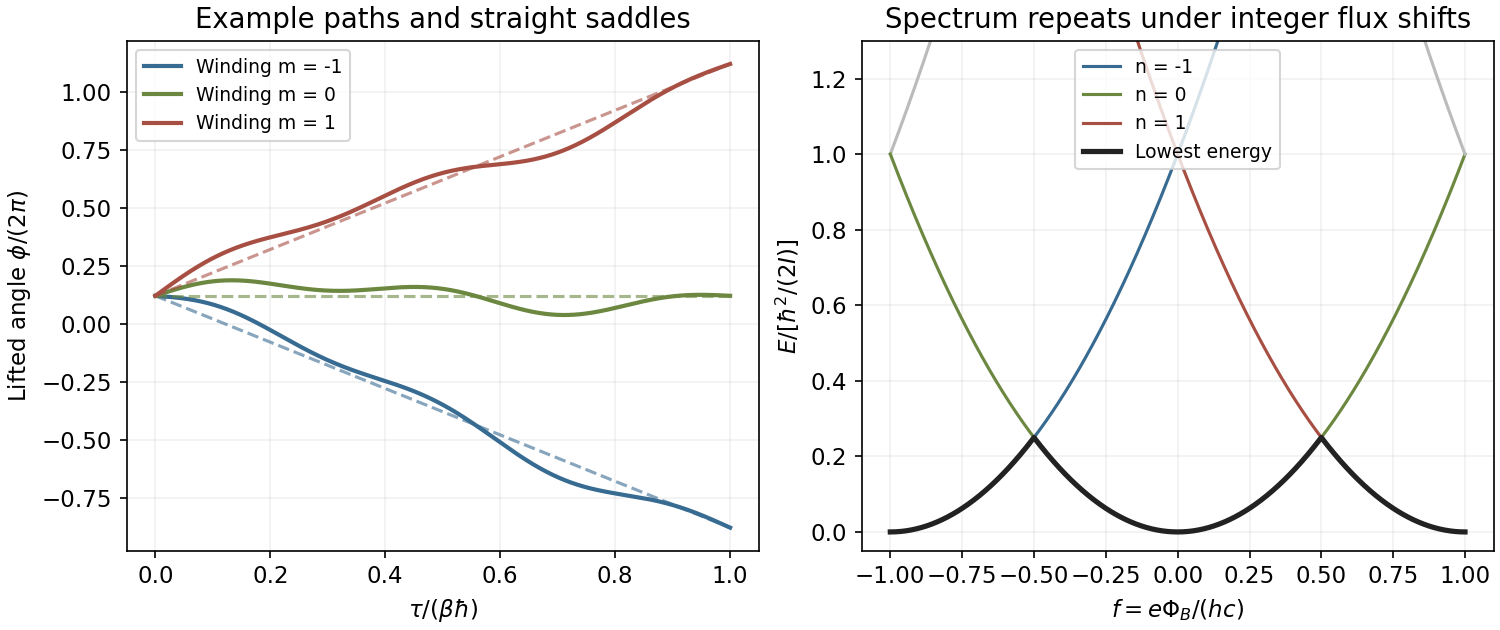
Lifted winding sectors on a flux-threaded ring and the periodic flux dependence of quantum energy levels
. Details. 
Continue the free-particle propagator to and replace its coordinate mass by the angular inertia . The Euclidean free-particle bridge amplitude at coincident endpoints isThis normalization includes the time-sliced Gaussian measure, not just a formal determinant with an unspecified multiplicative constant. Set . The correct Poisson summation formula is ; the source PDF omits the integral sign before its . For the Gaussian Fourier integral givesThe overall prefactor cancels exactly: , and . Hencein agreement with the angular-momentum trace. Pairing and makes the winding expression real, and the momentum expression shows positivity. Both are periodic in flux and invariant under . At high temperature the zero-winding term gives , with exponentially small flux dependence; at low temperature the nearest integer angular-momentum state dominates, with two equal lowest terms at half-integer flux. These independent limits also check the normalization and the flux phase.
Articles by others on the same topic
There are currently no matching articles.