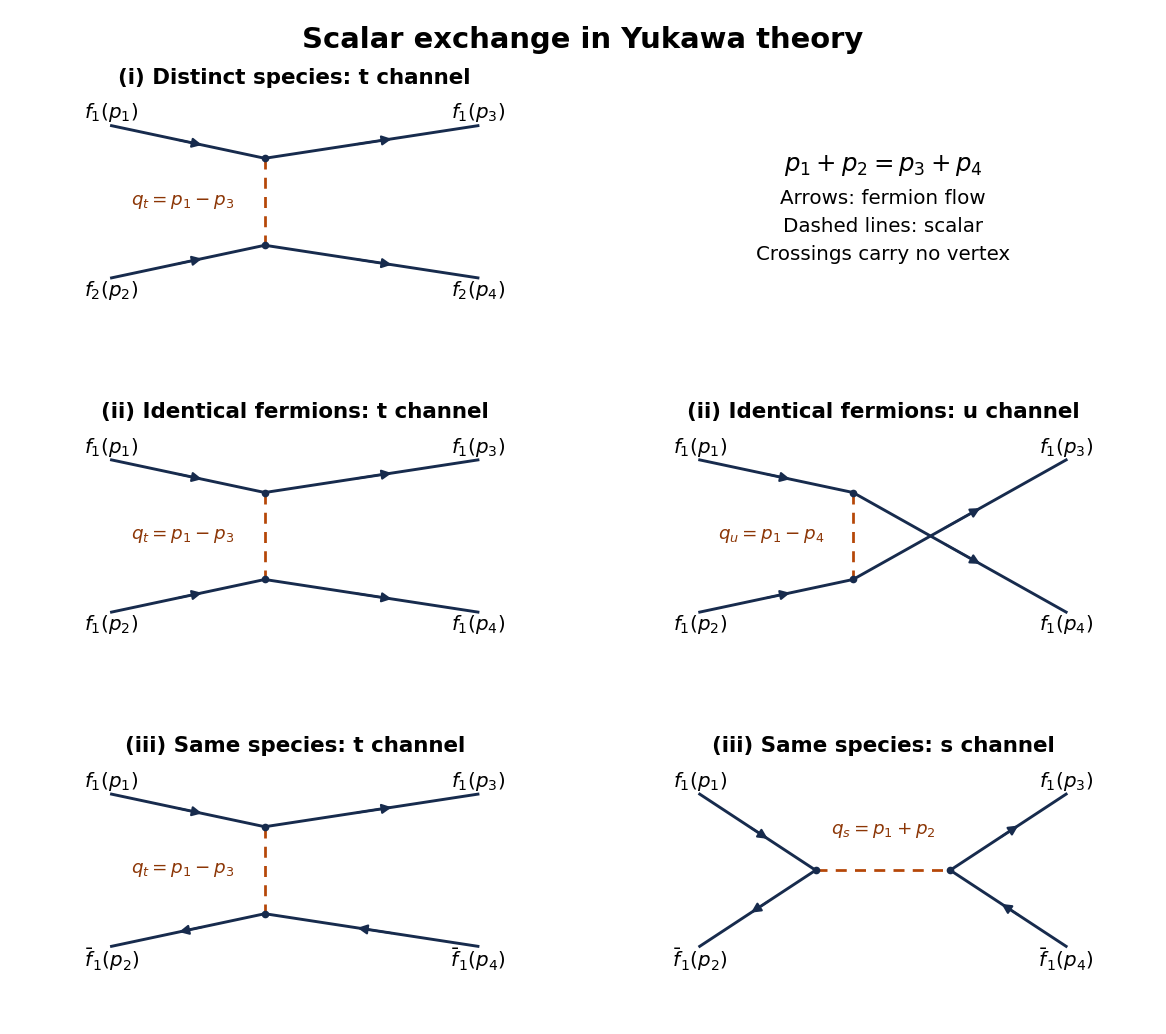
Momentum-labelled tree diagrams for the three Yukawa scattering processes. Solid arrows show fermion flow; dashed lines are scalar exchange. Each row contains every allowed tree channel for that process.
Details. 
Label the initial species-1 and species-2 fermions by and , and the final species-1 and species-2 fermions by and . There is exactly one tree-level Feynman diagram: the -channel scalar propagator joins the continuous species-1 line to the continuous species-2 line . Its exchanged four-momentum determines , in the notation of Mandelstam variables:The top row of the figure displays this Feynman diagram. A crossed attachment would change species at an interaction vertex and is forbidden. There is no initial antifermion for an annihilation channel.
With all four external fermions of species 1, both final attachments are possible. The middle row of the figure gives the two tree-level Feynman diagrams:
- The channel has lines and , joined by a scalar propagator with .
- The channel has lines and , joined by a scalar propagator with .
For a fixed ordering of external fermion states, the fermionic sign from exchanging the final identical fermions givesHere are Dirac spinors. In particular, the scattering amplitude changes sign when the complete final labels and are exchanged, as required for identical fermions.
Let label the incoming and outgoing fermion, and the incoming and outgoing antifermion. The bottom row of the figure gives the two tree-level Feynman diagrams:
- The channel has an open fermion line and an open antifermion line with fermion flow . The scalar propagator carries .
- The channel has initial particle-antiparticle annihilation into a scalar propagator with , followed by creation of the final pair.
Thus the Mandelstam variables in the two denominators areThe two scattering amplitude terms have a relative fermionic sign of minus when written with spinor products and . The overall phase depends on the chosen ordering of the external states. No channel joins an incoming fermion to an outgoing antifermion through a species-preserving Yukawa interaction.
Articles by others on the same topic
There are currently no matching articles.