The cover establishes Hilary Term 2020 despite the source bundle's 2019 filename. Use , the Minkowski metric , and for Feynman slash notation. In question 1, the repeated species index in the Yukawa interaction is summed over . The spatial mode expansions in question 2 are at a fixed time.
For four-momentum flowing along the fermion flow, the momentum space Feynman rules areThe scalar propagator and Dirac propagator invert their respective quadratic kernels. The interaction vertex follows by expanding , fixing its sign. Species is conserved along each open fermion line; there is no vertex changing species 1 into species 2.
An interaction vertex carries with inward four-momenta. Impose momentum conservation and integrate each independent loop momentum with . Include the closed fermion loop sign for every fermion loop, the relevant fermionic signs when rearranging external states, and the Feynman-diagram symmetry factor. External incoming and outgoing fermions carry and ; incoming and outgoing antifermions carry and . An external real scalar field leg has factor 1 in an amputated scattering amplitude. The Feynman i-epsilon prescription specifies the poles.
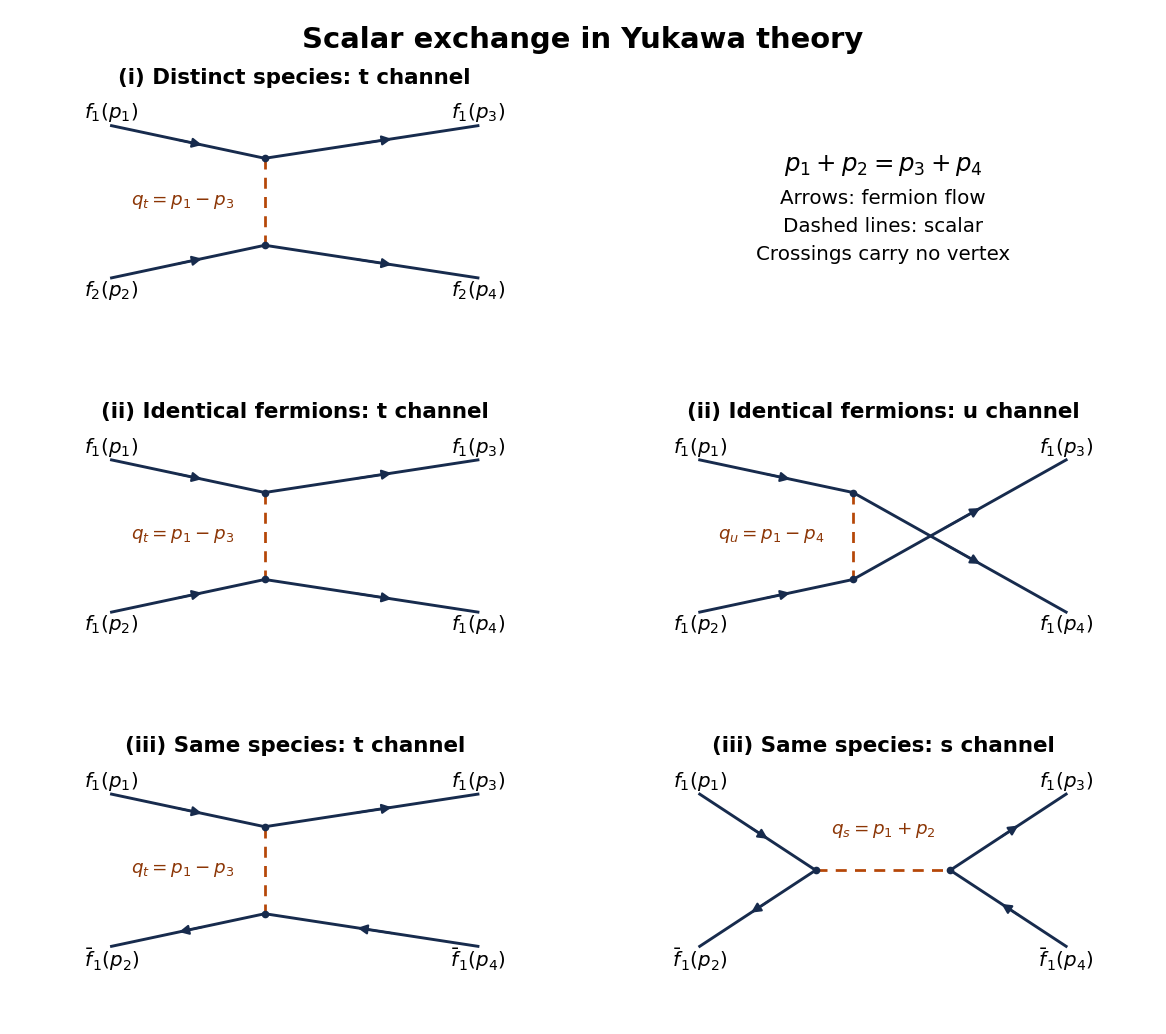
Momentum-labelled tree diagrams for the three Yukawa scattering processes. Solid arrows show fermion flow; dashed lines are scalar exchange. Each row contains every allowed tree channel for that process.
Details. 
Label the initial species-1 and species-2 fermions by and , and the final species-1 and species-2 fermions by and . There is exactly one tree-level Feynman diagram: the -channel scalar propagator joins the continuous species-1 line to the continuous species-2 line . Its exchanged four-momentum determines , in the notation of Mandelstam variables:The top row of the figure displays this Feynman diagram. A crossed attachment would change species at an interaction vertex and is forbidden. There is no initial antifermion for an annihilation channel.
With all four external fermions of species 1, both final attachments are possible. The middle row of the figure gives the two tree-level Feynman diagrams:
- The channel has lines and , joined by a scalar propagator with .
- The channel has lines and , joined by a scalar propagator with .
For a fixed ordering of external fermion states, the fermionic sign from exchanging the final identical fermions givesHere are Dirac spinors. In particular, the scattering amplitude changes sign when the complete final labels and are exchanged, as required for identical fermions.
Let label the incoming and outgoing fermion, and the incoming and outgoing antifermion. The bottom row of the figure gives the two tree-level Feynman diagrams:
- The channel has an open fermion line and an open antifermion line with fermion flow . The scalar propagator carries .
- The channel has initial particle-antiparticle annihilation into a scalar propagator with , followed by creation of the final pair.
Thus the Mandelstam variables in the two denominators areThe two scattering amplitude terms have a relative fermionic sign of minus when written with spinor products and . The overall phase depends on the chosen ordering of the external states. No channel joins an incoming fermion to an outgoing antifermion through a species-preserving Yukawa interaction.
Define by removing the factor from the connected transition matrix element. The single tree-level Feynman diagram in i givesThere is no identical-particle exchange term because the species differ. Each incoming fermion has two equally populated spin angular momentum states in an unpolarized beam. Their probabilities multiply to , giving a spin average over the four initial choices. The unobserved final spin angular momentum states are distinct outcomes, so their probabilities are added by a spin sum, with no final averaging:Taking the complex conjugate of gives . The fermion spin sum therefore converts each squared bilinear into a gamma-matrix trace:Using , , , and the mass shell conditions , each gamma-matrix trace isThe second equality follows from ; momentum conservation gives the identical result for . HenceThe printed prefactor is incorrect for the stated coupling. Each of the two Yukawa interaction vertices contributes one to the scattering amplitude, so its square is proportional to . As a concrete counterexample, take , , and forward elastic kinematics , . Then and the spin average is , whereas the printed expression gives .
For a connected amputated Feynman diagram, write for the number of independent loop momenta. Each loop momentum integration scales as , each internal scalar propagator as , and each internal Dirac propagator as when both four-momenta and mass are scaled. The Yukawa coupling has mass dimension zero. ThusCounting the two fermion ends and one scalar end at each interaction vertex, and using connectedness, givesConsequently , , andThe requested exponent requires amputation and removal of the overall momentum delta function. An ordinary unamputated connected Green function has an additional external scalar propagators, giving mass dimension after stripping that delta function, or if it is retained. For a concrete check, the free two-point scalar propagator scales as , not . The exponent is the engineering result for the amputated object. A fixed renormalization scale introduces logarithms; the displayed homogeneity is a naive power counting statement rather than an exact quantum scaling law at fixed subtraction scale.
More generally, with external scalar ends and external fermion ends, the same counting gives the superficial degree of divergenceThis is an upper bound on the overall ultraviolet divergence. Numerator cancellations and Lorentz invariance may lower it; an apparently convergent whole Feynman diagram can still have ultraviolet subdivergences. Local subtraction of those ultraviolet subdivergences is required first.
For pure scalar ends, can require counterterms. Lorentz invariance reduces the two-point terms to a mass counterterm and wave-function renormalization; derivatives of a single scalar field are total derivatives, and a one-derivative cubic scalar term cannot be a Lorentz scalar. With two external fermions, requires their kinetic term and mass counterterm, while requires Yukawa coupling renormalization. Four external fermions give , so no independent four-fermion counterterm is required.
A complete counterterm Lagrangian consistent with the species symmetry can therefore be writtenThe vacuum energy density term matters for an unnormalized vacuum functional and cancels from normalized Green functions. The tadpole counterterm can impose . There is no symmetry of the massive Yukawa interaction, so linear, cubic and quartic scalar terms cannot be excluded. For instance, in a constant background the divergent fermion loop contribution contains , exhibiting all these powers. This is counterterm closure of a massive Yukawa theory.
The two species have identical couplings, so their common unitary flavour rotations preserve the Lagrangian density and their counterterms can be chosen species independent. Equality of the scalar and fermion masses, however, is not protected: and are independent. Including the displayed finite set of operators yields a renormalizable quantum field theory. Restricting the bare Lagrangian density to the terms printed in the question is not closed under renormalization.
Write and . The nonzero canonical commutation relations arewith cross-species brackets zero. The commutator product rule givesLinearity of the commutator now yields, for the real coefficient ,Strictly, the printed contains an infinite constant in continuum Fock space. Work first with finitely many modes, or replace it by its normal ordering . Their difference is a constant, so every displayed commutator and every conjugation below is unchanged. The latter convention fixes the vacuum state phase without an infinite phase ambiguity.
For a Hermitian operator , the operator exponential is a unitary operator, with . Differentiation and giveWhen , this is the first-order ordinary differential equation with . Multiplication by makes its derivative zero, provingEquivalently, the commutator expansion for exponential conjugation has successive nested commutators , whose exponential series sums to this expression.
Use the combinations at each momentum. Part a gives , , while their creation operators obey , . Applying b givesThe creation operators transform by the Hermitian adjoint formulas with . At , both exponentials are , soSubstituting into the fixed-time mode expansion of a free field of the complex scalar field givesThus exchanges particles and antiparticles, as required for charge conjugation. To see the charge reversal explicitly, the conserved charge obeys . The generator in the question is distinct from this charge.
The two occupation terms in the Hamiltonian are exchanged, with the same relativistic energy , and thereforeIn fact because its mixing terms exchange equal-energy modes. With normal ordering, for . Then fixes the vacuum state and satisfies . The construction is a bosonic species-swap generator.
Take parity symmetry in quantum field theory to preserve free time evolution, so the conjugate initial data reflect along with the field. Substitute the mode expansion of a free field into the defining parity operator relation and change the integration variable . Since , coefficient comparison, or comparison of both the field and its conjugate initial data, gives the intrinsic-even conventionHere parity symmetry in quantum field theory reverses spatial momentum and preserves time. The creation operator formulas follow by taking Hermitian adjoints. The given field relation has fixed the intrinsic phase to .
For one real scalar field, let act on one-particle wave functions by . It is a Hermitian operator with , so is the orthogonal projector onto odd wave functions. Its second quantization is the odd-mode number operatorThe full momentum space is integrated in both expressions; the factors prevent double counting the pairs . A suitable parity operator isFor verification, . Thus the even combination is unchanged, and the odd combination changes sign under conjugation by , exactly reproducing . The same holds for creation operators. The odd-mode number operator has integer eigenvalues, so , and . Multiplying by an overall constant phase would not change its conjugation action. This is parity as odd-mode number parity.
Keep for the cubic coupling and for the external source. Expanding the interaction part of the scalar field path integral yieldsA functional derivative of the source exponential inserts . In particular, , so can be replaced by . The functional derivatives commute and can be taken outside the free path integral. Resumming the exponential series givesThis is a formal perturbation series; a real cubic scalar potential is unbounded and the expression does not assert a stable nonperturbative vacuum state.
To evaluate the free Gaussian path integral, use integration by parts to writeThe inverse kernel isCompleting the square with changes the exponent to . The translation-invariant functional measure makes the remaining Gaussian path integral precisely , henceFor , the exponent includes , which damps the regulated finite-dimensional integrals. The Feynman i-epsilon prescription displaces the positive-energy pole below the real axis and the negative-energy pole above it, selecting the time-ordered vacuum expectation value. Indeed the Feynman propagator is . Thus specifies both convergence and the vacuum state boundary conditions, with taken after integration.
For the interacting vacuum state defined perturbatively by the same Feynman i-epsilon prescription, the normalized time-ordered product isEach functional derivative inserts , accounting for . The denominator implements cancellation of vacuum bubbles, while disconnected pieces carrying external insertions still contribute. The lower limit in the printed product is a typographical error; the product here runs from 1 to .
At order in the cubic scalar field interaction term, the expansion of the generating functional supplies . The counts permutations of indistinguishable integrated interaction vertices, and counts permutations of the three field slots at each interaction vertex. Applying the Wick theorem pairs fields into Feynman propagators. Several pairings produce the same Feynman diagram; their number multiplies the expansion coefficient. For fixed labelled external points, the net combinatorial weight isHere is the order of the graph's automorphism group when the external labels are fixed, with permutations of identical parallel lines and reversal of a self-loop included as applicable. This is the Feynman-diagram symmetry factor convention in which a Feynman diagram is divided by . Each cubic interaction vertex then contributes , each line contributes , and each internal vertex is integrated over its position. External labelled points are not divided by .
Hold the external endpoints fixed and distinguish the three Feynman diagrams by their left-to-right order in the source. Write for the divisor and for the multiplying combinatorial weight. Each line below includes external Feynman propagators; amputation leaves the same .
Left: two-point bubble. There are two cubic interaction vertices and two parallel internal lines. Interchanging those lines preserves the labelled external endpoints, giving . Direct Wick contraction counting gives two assignments of the external endpoints to the vertices, choices of their field slots, and pairings of the remaining slots:With and external points , its contribution is
Middle: three-point triangle. The three labelled external endpoints fix their three adjacent cubic interaction vertices, so no nonidentity graph automorphism remains. Counting gives assignments of endpoints to vertices, choices of external field slots, and assignments of remaining slots to the two specified neighbours:Its contribution isThe apparent rotational symmetry of an unlabelled triangle does not survive fixing three distinct external endpoints.
Right: two-point graph with a chord. There are four cubic interaction vertices: the left and right attachment vertices and the two chord ends . Its internal edges are . Reflection interchanges , fixes , and preserves the two external labels. This is the only nontrivial graph automorphism, so .
For a separate Wick contraction count, choose the ordered external attachment vertices in ways and their field slots in ways. Assign their two remaining slots to in ways. At each of , choose the slot joining and then the slot joining in ways; the last slots join each other. ThusIts contribution isConsequently the three multiplying weights are , or divisors . The central chord is a single internal line joining two vertices, not a vertex at the centre of the circle.
Articles by others on the same topic
There are currently no matching articles.