Outcome determinism means that a complete hidden state , together with the chosen measurement settings, fixes each outcome. The observed probabilities can still arise from an ensemble of unknown . This differs from deterministic unitary evolution of a wavefunction, which does not by itself specify a unique measurement outcome. Quantum nonlocality means failure of a Bell-local account of the correlations, under assumptions including measurement independence; it is stronger than the existence of entanglement and does not imply controllable faster-than-light signaling.
Use the first ket for the Positron and the second for the electron. Before either final beam splitter, the first pair of splitters and annihilation produceThe photon state is orthogonal to the surviving charged-particle sector. Its probability is , while the remaining sector has squared norm . The states below retain that photon amplitude and are normalized over all trials, without conditioning on nonannihilation. For compactness write , and similarly for .
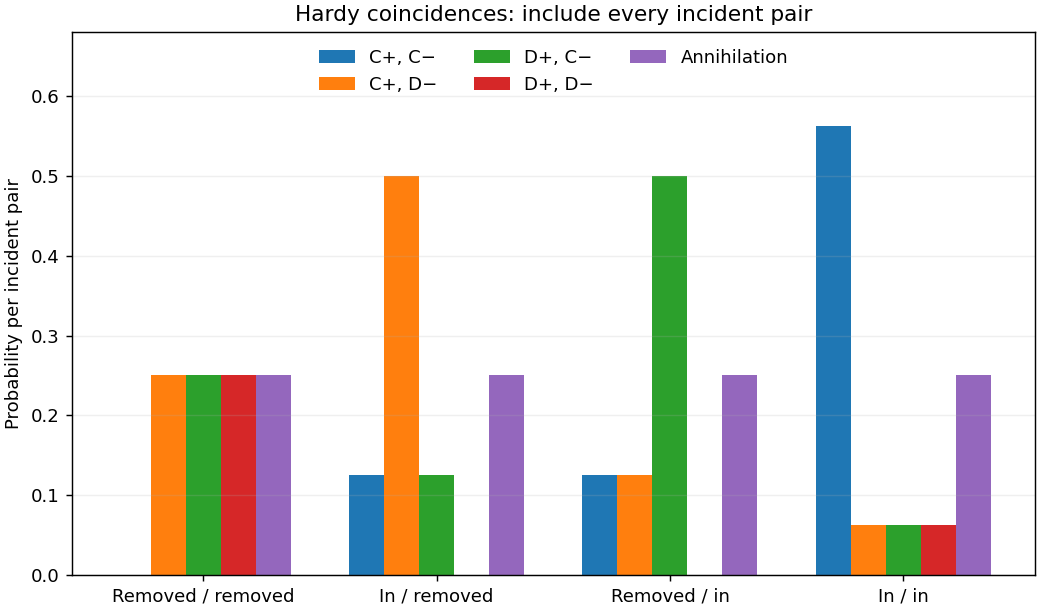
With both final splitters removed, the path labels map directly into detector labels:In particular , because joint occupation of the two intersecting arms has already annihilated. Each of the other three charged-particle coincidences has unconditional probability .
Apply the final splitter only to the first ket. The amplitudes from and cancel, givingThus detection at occurs only in the coincidence , with probability . The other two nonzero coincidence probabilities are and . The cancellation is quantum interference between indistinguishable surviving alternatives.
Interchanging the two wings givesNow detection at occurs only together with , with probability . The remaining nonzero coincidence probabilities are and .
Applying both final splitters givesThe charged-particle coincidence probabilities are in the displayed order, and the annihilation probability remains . In particularConditioning on surviving pairs would change this number to ; it would not change the amplitudes of the unconditioned all-trials state above.

In a deterministic local hidden-variable model, write or without an argument for the remote splitter setting. That omission is the parameter independence assumption: the local response for a fixed complete hidden state does not change when the other wing changes its apparatus. Measurement independence also requires the hidden-state ensemble to be independent of the freely selected settings, allowing the same assignments to be compared across configurations.
The zero probabilities derived above then constrain those assignments, apart from sets of hidden states of zero measure:
- Case requires .
- Case requires .
- Case requires .
For a trial with , the last two implications force , contradicting the first condition. Thus these deterministic local assignments predict zero probability for the double- event, whereas quantum theory predicts . This is Hardy's paradox, an inequality-free ideal contradiction. With imperfect apparatus the zero-event conditions become small nonzero rates and require a statistical inequality rather than declaring a contradiction from one imperfect detection.[ref]
Quantum mechanics, local realistic theories, and Lorentz-invariant realistic theories by Lucien Hardy. 1992 abstract: a two-particle proof of Bell's theorem without inequalities
The logical contradiction combines counterfactual hidden-variable assignments; it does not assign simultaneously observed path properties to a quantum state. Nor does it allow a message to be sent by changing a distant splitter: the observable local marginal obeys quantum no-signalling. For example, fixing the plus-side splitter to gives for either minus-side setting in the results above.
Articles by others on the same topic
There are currently no matching articles.