Original public paper: Physical PDF pages 835–838. All three questions and all alternatives in question 3 are answered. Entropies use logarithms to base two.
An eigenvalue of an observable in a known corresponding eigenstate is a simple example satisfying the Einstein–Podolsky–Rosen criterion of reality: its value is predictable with certainty. For example, a spin angular momentum component in a prepared spin-up eigenstate has a definite predicted value. For a distant system, Albert Einstein, Boris Podolsky and Nathan Rosen invoked locality: a measurement performed on a sufficiently separated, noninteracting partner should not disturb that system. In the relativistic version here, the measurement events have spacelike separation.
The Pauli matrices obey , soTheir nondegenerate eigenstates are incompatible: an eigenstate has equal probabilities for the two outcomes, and conversely. Thus no single quantum state has both components sharply determined. The Robertson uncertainty relation gives , but its right-hand side may be zero; that alone is not a proof that simultaneous zero uncertainties exist. The absence of a common eigenstate supplies the stronger conclusion for this spin-half pair.
For the specified Bell state, Bob obtains or with probability when he measures . Conditional on his result, Alice obtains the same sign with certainty if she measures . Under the EPR locality premise, this certainty supplies an element of reality for her ; it is a conditional prediction after Bob learns his own random result, not a premeasurement prediction of its sign.
The normalized eigenstates are and . Expanding their tensor products givesConsequently the same Bell state has equal, perfectly correlated outcomes. Bob's two outcomes again each have probability , and the same locality-and-certainty argument applies separately to Alice's .
The disputed step is to combine predictions conditional on two incompatible choices into two simultaneous, measurement-independent pre-existing values. Quantum theory provides the two conditional ensembles, not a joint sharp assignment of and . This is quantum steering. Bob cannot measure both incompatible observables sharply on the same member of the pair. Nor does conditional steering allow signalling: ignoring his result leaves Alice's reduced density matrix equal to for either measurement choice, by the no-communication theorem.
To test the stronger claim of a local hidden-variable theory, Alice needs several correlation settings, not just perfect agreement along the two common axes. For the CHSH inequality, choose observables with outcomes :In the given Bell state, and the crossed correlations vanish. Henceexceeding the local bound . The bound assumes Bell local causality and measurement independence, with the appropriate treatment of sampling and settings.
Experimental Bell tests support violations rather than that local assignment. The Aspect switching experiment changed analyzer settings during separated photon flights, while leaving sampling and switching limitations. By the time of this examination, the Delft electron-spin Bell test had used electron spins at stations apart, efficient spin readout and rapid random basis choices. The combination addressed both detection and locality loopholes, providing evidence against the tested local model class.[ref]
Experimental loophole-free violation of a Bell inequality by Bas Hensen and others. 2015 abstract: separated electron spins, efficient readout and fast random settings
This does not prove that every conceivable notion of reality is false, or that noncommutation alone rules out every hidden-variable theory. A nonlocal theory can evade the local premise. What Alice can challenge is Bob's claim that locality, measurement-independent simultaneous values and all observed correlations can be retained together. An ordinary measurement disturbance at Bob's lab is not by itself a local explanation of Alice's conditional ensemble.
Use the thin singular value decomposition , with , unitary and nonnegative. Expanding its entries givesThe columns of and of are orthonormal, establishing the Schmidt decomposition. Bob's basis uses the complex-conjugated columns of . Omitting that conjugation would not reproduce the coefficient matrix. The squared Schmidt coefficients are the eigenvalues of ; equivalently and . The two reduced density matrices are and , which have the same nonzero eigenvalues.
The printed coefficient slightly rounds a normalized state: each squared norm is . Normalize before calculating an entropy. For the two states, the resulting Gram matrices are approximatelyFor a trace-one two-dimensional Hermitian matrix with diagonal entry and off-diagonal entry , its eigenvalues areSort them decreasingly and take square roots:The Von Neumann entropy is . is more entangled: its Schmidt weights are closer to equal and its reduced-state entropy is larger. Neither state is a product state or maximally entangled on its two-dimensional support.
By Nielsen's pure-state conversion theorem, deterministic LOCC conversion requires the input vector of squared Schmidt coefficients to be majorized by the output vector. Here and both sums are one, so . Therefore is possible deterministically; is not. Entanglement can be discarded by local operations but cannot increase deterministically for these pure inputs. Probabilistic concentration is a separate question and is allowed below.[ref]
Conditions for a class of entanglement transformations by Michael A. Nielsen. 1999 primary theorem: deterministic pure-state conversion and majorization
There is a dimensional qualification in the proposed measurement. Write . The two supplied measurement operators obeyThus their effects form a POVM on the occupied support, where is the identity. Alice's full space is three-dimensional, so these two operators alone do not sum to . A full-space completion is . It has zero probability on either input, so it changes none of the requested outcomes. Strictly, the POVM consists of the effects ; the specified additionally fix a quantum instrument and therefore the conditional states.
In the appropriate Schmidt basis for either input, write . The two outcomes have probabilitiesand normalized conditional statesThese formulas give both outcomes for each state by substituting its row of the table. For example,The two inputs have different Schmidt bases; the primed measurement basis is adapted separately to the state, as the question specifies, not one common unexamined laboratory basis.
For the outcome to be a maximally entangled state, its two amplitudes must be equal. HenceThe requested numerical results areThus has the larger success probability, consistent with its greater initial entanglement. The branch cannot be balanced in the allowed angle range for either nonmaximal input: it would require .
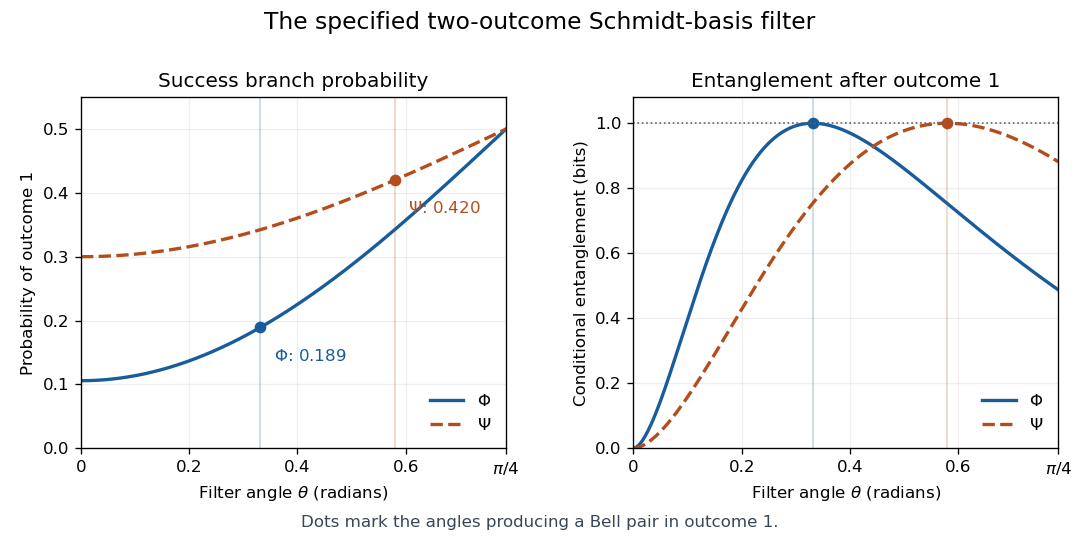
Success probability and conditional entanglement for the specified Schmidt-basis filter
. Original calculation with normalized printed coefficients. Each marked angle makes outcome 1 maximally entangled. Curves refer to the specified two-outcome instrument, not the optimal unrestricted concentration protocol. Details.The success probabilities belong to this particular binary Schmidt filter. They are not the optimum over every possible quantum instrument. The diagonal success operator instead gives the standard single-copy entanglement concentration probability . Postselection can increase entanglement in the retained branch, while the outcome-averaged entanglement cannot increase under LOCC.
A weak measurement couples an observable only weakly to a meter, so the pointer distributions associated with its different eigenvalues overlap strongly. One trial supplies little information and a small disturbance; an ensemble is needed to estimate a small mean shift. It is not an exact determination of a previously hidden eigenvalue with no disturbance.
For pointer position and conjugate momentum , a short von Neumann measurement interaction has unitary . An eigenvalue translates the pointer by . The weak regime requires those translations to be small relative to the pointer width. Without postselection the first-order mean displacement is for an initially uncorrelated, suitably centered meter.
If the system is prepared in and postselected in , the unnormalized meter state isFor a real centered Gaussian pointer with no position–momentum correlation, the conditional position shift is ; the imaginary part affects the conjugate momentum distribution. The weak value can be complex or have a real part outside the observable's eigenvalue interval, because it is a conditional transition-amplitude ratio, not an eigenvalue.
An example apparatus uses photon polarization as the two-level system, a weak polarization-dependent transverse displacement as the interaction, and an output polarizer for postselection. Repeated position detections estimate the selected beam's displacement. Nearly orthogonal selection can make the conditional shift large, but also reduces the accepted sample and eventually invalidates the first-order expansion. The original weak-value proposal emphasized preselection, a weak coupling and postselection, rather than an anomalous result from an ordinary sharp spin measurement.[ref]
Weak values by Yakir Aharonov, David Z. Albert and Lev Vaidman. 1988 primary paper: preselected and postselected spin ensemble and conditional weak value
Weak coupling limits quantum measurement backaction per trial; it does not abolish the information–disturbance tradeoff. Repeating weak observations can accumulate substantial backaction, and discarding rejected trials cannot automatically improve the information available per prepared system. Conditional pointer amplification and a statistically improved parameter estimate are distinct claims.
Quantum teleportation transfers an unknown qubit state using a previously shared Bell pair, local operations and two classical bits. It requires no description of the unknown complex amplitudes and produces no extra copy.
Let the input be , and let Alice and Bob share . Alice applies a controlled-NOT gate from to , then a Hadamard gate to . Expanding the circuit gives the Bell-basis teleportation identity in computational-output form:Her projective measurement yields each bit pair with probability . She sends the two classical bits, and Bob applies to recover . The order is the inverse of the displayed conditional operator; interchanging these Pauli corrections changes only an irrelevant global phase when both bits are one.
Before receiving the bits, Bob hasThus teleportation respects the no-communication theorem and cannot transmit the usable unknown state faster than the classical message. Alice's input has been measured, and the shared entanglement resource has been consumed, in agreement with the no-cloning theorem. The protocol transfers the state, not the material particle initially carrying it.
A physical implementation must distribute and preserve an entangled pair, implement a Bell-basis measurement and transmit its result to a controllable output system. Imperfect entanglement, lost outcomes and noisy corrections reduce quantum fidelity; a heralded probabilistic experiment must report its success probability separately from conditional fidelity. Ideal deterministic teleportation assumes every Bell outcome can be identified and corrected.
Quantum error correction encodes a logical qubit into a larger Hilbert space, diagnoses a specified error family with an error syndrome, and reverses it without learning the protected logical amplitudes. It must preserve arbitrary superpositions, not just distinguish two classical codewords.
The bit-flip repetition code encodesMeasure the commuting stabilizer generators and using ancillary qubits. Their outcomes reveal the parity relations, with the three-qubit bit-flip syndrome tableBoth codewords have the same parity checks, so the syndrome does not reveal or . For example, the error produces ; applying restores the encoded superposition. A coherent combination of correctable errors is also recoverable after the syndrome is recorded in an ancilla, by linearity.
This three-qubit code corrects one bit flip, not every one-qubit error. A physical changes the relative logical phase without a nontrivial bit-flip syndrome. General single-qubit noise is a linear combination of ; protecting arbitrary single-qubit errors therefore needs a code such as the Shor code, the Steane code or the five-qubit code, with the corresponding enlarged syndrome structure.
The general exact-recovery criterion is the Knill--Laflamme condition. For code projector and error operators , there must be constants such thatIt expresses that the syndrome information can depend on the error but not on the logical state. Encoding entangles several physical qubits; it does not create independent copies of an unknown input, so it respects the no-cloning theorem. Fault-tolerant implementations must also prevent noisy syndrome extraction and recovery gates from spreading an initially correctable error into an uncorrectable one.
Original public paper: Physical PDF pages 761–764. All questions and all optional notes are answered. A pure premeasurement state, a nonselective projection, and a state conditional on one observed outcome are distinguished throughout.
Linearity of the detector's unitary time evolution maps the two input branches separately, giving the quantum premeasurement stateIn the ordered tensor product basis , its pure density matrix isA nonselective projective measurement in the indicated detector basis applies , removing the two off-diagonal terms:This is the usual nonselective meaning of von Neumann process 1. It is not equal to the pure projector . If “the detector has clicked” means conditioning on an actual up outcome, the normalized postselected state is instead , with probability . The correlated superposition describes the coherent premeasurement before that selection.
Put and . The detector rotation is real and orthogonal, so its inverse is the same transformation. Substituting it givesThus the requested orthonormal system states areThe pure density operator has not changed: this is only a different Schmidt decomposition of a maximally entangled state. But choosing a nonselective projective measurement in this new detector basis gives a different operation and generally a different state:For an explicit matrix in the original ordered basis, write and . ThenAt the entries and are , whereas they vanish in . Nevertheless, the system and detector individually each have reduced density matrix for either mixture.
This is the preferred-basis problem: the correlated state alone does not specify which detector observable becomes a stable classical record. Arbitrarily declaring collapse in a Schmidt basis changes the physical prediction. The actual detector interaction and environment must supply the basis selection, rather than a mere choice of notation.
Write , with . The orthogonal projection operators obey and . Hence , and the remaining tensor factors commute with detector operators. ThereforeThe environment interaction preserves these detector populations, making their basis a candidate pointer basis. It can change their relative coherence without flipping the stored labels.
Since , the solution of the Time-dependent Schrödinger equation isThe two detector eigenvalues generate opposite rotations of the environment. Acting on the initial state givesThese are the indicated and . Their conditional environment overlap is . The partial trace therefore multiplies the coherence between and by . This is an exactly solvable single-qubit environment dephasing model, with fully reversible global evolution.
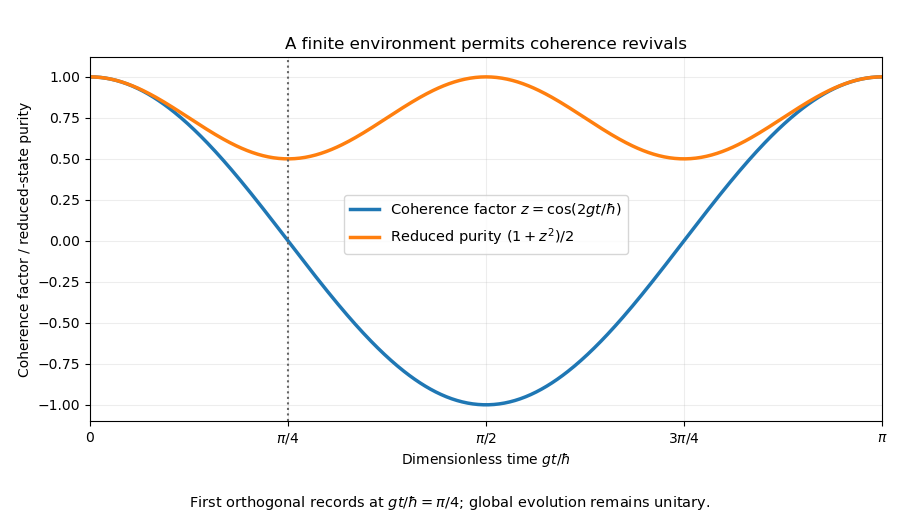
Single-qubit environmental records suppress and later restore reduced coherence
. Original ideal unitary model. Zero off-diagonal coherence at one time does not imply irreversible collapse of the full state. Details.At , defineThey are normalized and orthogonal. The full state is the pure superposition . A nonselective von Neumann process 1 selecting the original detector records givesWithout imposing any projection on the full state, tracing out the orthogonal environment states already gives from part (a). These two global descriptions share that reduced state but differ in their global coherence. Quantum decoherence does not make a pure global state literally equal to the corresponding statistical mixture.
Inverting the detector rotation at this time givesFor a representation with one system factor and one environment factor per displayed detector state, each parenthesized system–environment vector would have to be a product state. But the first has coefficient matrix in the indicated orthonormal bases; the second has matrix . Their matrix ranks are two whenever . Equivalently, their two nonzero Schmidt coefficients are , which no independent basis changes can remove. Thus the proposed factorization is impossible when .
The exception matters: at , the detector basis is the original basis up to phases or interchange, and a factorization does exist. In particular, the literal condition is insufficient if it includes . The intended obstruction concerns genuinely mixed detector bases.
The environment has selected robust detector records: its interaction commutes with the original projectors, and orthogonal environmental records suppress their interference in the reduced density matrix. A rotated detector branch instead leaves the system and environment entangled. This is environment-induced pointer-basis selection, the issue analyzed by W. H. Zurek in his apparatus-environment model.[ref]
Pointer basis of quantum apparatus: Into what mixture does the wave packet collapse? by W. H. Zurek. 1981 abstract: the apparatus-environment interaction selects recorded observables through a commutation condition
This addresses the basis ambiguity but does not by itself select one realized outcome from the global superposition. Moreover, a two-state environment has recurrences: returns to unit modulus, so the toy model does not establish irreversible macroscopic collapse. A large environment can make records effectively persistent over experimental times, but that requires further dynamical assumptions. The distinction is part of the measurement problem, not an algebraic error cured by a partial trace.
The spin singlet state has zero local means and outcomes , so both variances are one. Its Pearson correlation coefficient is therefore . Summing over the four joint outcomes givesThe equal-sign products contribute and the opposite-sign products contribute . In a finite sample the corresponding relative frequencies estimate these probabilities; the formula is not an assertion that a finite random sample has exactly zero empirical means.
A spin measurement along unit vector has outcome projector , with . The spin singlet state obeys and . Applying the Born rule,Thus and . Substitution into part (a) givesEqual axes give perfect anticorrelation, while orthogonal axes give zero correlation. Each local marginal remains uniform.
The four required dot products areConsequently the specified CHSH inequality combination isThe magnitude reaches the quantum Tsirelson bound and exceeds the local bound two. The negative sign follows this singlet and the stated order of terms; other conventions can reverse it.
Let Eve obtain . Applying part (b) to her axes gives . Conditional on these rank-one local measurements, the forwarded particles are a product state with individual spin directions and . HenceConditional independence gives the product of these means. Averaging over Eve's outcomes,The sum is , soEve has turned the entangled source into an ensemble of product states by an intercept-resend attack. Ignoring her records does not restore the original singlet coherence.
Write and . Since and , the CHSH inequality combination becomesThereforeParallel or antiparallel Eve axes attain the lower endpoint; orthogonal axes attain zero. This bound is specific to the two-sided projective attack and these planar settings. It is stronger than the generic local bound and should not be attributed to every possible eavesdropping strategy.
If Eve varies her axes independently of the users' still-secret random settings, the measured correlations average over her choices. The same linear combination obeys and remains in the interval by convexity. Strategies correlated with disclosed measurement settings would violate that independence premise; the protocol must protect it.
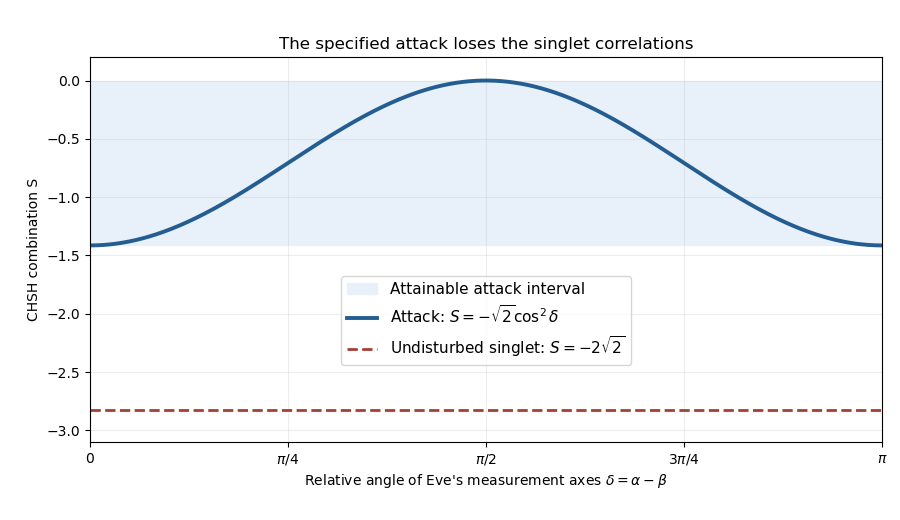
The planar two-sided intercept-resend attack cannot reproduce the singlet CHSH value
. Original analytic curve as Eve changes the relative angle of her measurement axes. The dashed line is the undisturbed singlet result, outside the attack's attainable interval. Details.This is an entanglement-based quantum key distribution scheme of the type proposed by Artur K. Ekert.[ref]
Quantum cryptography based on Bell's theorem by Artur K. Ekert. 1991 primary proposal: Bell correlations used to test a key-distribution channel
The measurements generate correlated random data; Alice does not choose a message by choosing their random outcomes.After the measurements, Alice and Bob announce their basis choices over an authenticated public channel. They retain the pairs with equal axes, here and , and Bob flips his outcome signs to match Alice's bits. They sacrifice a random subset for error estimation and use the appropriate other setting combinations to estimate . In the ideal source the same-axis bits match after the flip and ; the specified intercept-resend attack cannot reproduce that value.
A practical protocol includes information reconciliation, an accounting of information leaked publicly, and privacy amplification. It must abort when its statistical security conditions fail. Authentication is essential: a completely unauthenticated public channel permits a man-in-the-middle attack. A Bell-violation observation alone, without sampling, device and adversary assumptions and a finite-key analysis, is not a proof that Eve knows no key bits.
With a sufficiently uniform secret shared key of the required length, Alice can send publicly using a one-time pad; Bob recovers . The pad must be secret, as long as the protected message, and never reused. A complete security proof makes the probability or distinguishing advantage of failure small under stated assumptions. The ideal exam correlations diagnose the stated attack; they do not provide an unconditional guarantee against every attack or implementation fault.
A bipartite pure state is entangled when it is not a product state. Its Schmidt decomposition is , where and . More than one nonzero coefficient means entanglement. The two reduced density matrices have the same nonzero spectrum, and their Von Neumann entropy is the pure-state entanglement entropy. A maximally entangled pair of qubits has one bit of this entropy.
For mixed states, classical correlations are not sufficient: a separable quantum state is a convex mixture , and entanglement means that no such decomposition exists. A reduced entropy alone no longer measures mixed-state entanglement. An entanglement witness or a suitable separability criterion can detect it.
Local unitary transformations preserve the Schmidt spectrum. More general local operations and classical communication can discard entanglement but cannot freely create it from a separable input. Nielsen's pure-state conversion theorem gives the exact deterministic criterion: is possible precisely when . In decreasing order, every partial sum for the input is no larger than the corresponding output sum, with equal totals. The direction matters: a uniform spectrum can be converted to a concentrated one; a product state cannot deterministically become a Bell pair.
A probabilistic local filter can concentrate a partially entangled pair. For with , Alice's successful operator produces equal amplitudes. The outcome is a Bell pair with probability ; a complementary operator supplies a complete measurement. Failure is heralded, so there is no deterministic creation of a more entangled pair. This illustrates entanglement concentration.
Many-copy entanglement distillation and entanglement dilution connect noisy or nonuniform resources with standard Bell pairs. Entanglement enables quantum teleportation and other protocols, but classical communication is still required; the no-communication theorem excludes message transmission merely by choosing a distant local measurement.
A qubit has state with . An -qubit register occupies a -dimensional Hilbert space and may contain entanglement. This large state space does not mean that a measurement reads out all its complex amplitudes: computational-basis outcomes occur with the Born rule probabilities.
A quantum circuit prepares a register, applies quantum gates, and measures selected outputs, possibly using classical feed-forward. Closed gates are unitary operators and therefore reversible; initialization, measurement and discarding can be treated using a larger system and environment. Single-qubit rotations together with an entangling two-qubit gate give a universal quantum gate set. The CNOT gate acts as .
For example, a Hadamard gate on the first qubit of followed by a CNOT creates . A Hadamard produces amplitudes with relative signs, so later gates can make unwanted alternatives interfere destructively and useful alternatives reinforce. Quantum algorithms organize this interference to improve a specified computational task; superposition alone does not supply an arbitrary speedup or permit reading every branch.
A finite discrete universal set such as Clifford gates together with a non-Clifford phase gate approximates general unitaries to chosen precision. Runtime includes the number of gates, repetitions and classical processing. Measurement outcomes may require multiple runs to estimate a probability or amplify success.
Quantum decoherence and imperfect gates limit an implementation. Quantum error correction encodes logical information into several physical qubits and measures error syndromes without directly learning the encoded amplitudes. Under appropriate noise and control assumptions, fault tolerance permits reliable longer computations; simply maintaining an isolated ideal state is not a realistic account of a large processor.
In de Broglie-Bohm theory, the system has both a wavefunction and an actual configuration of particle positions. The wavefunction obeys the Time-dependent Schrödinger equation; the configuration follows the guidance equation. For spinless particles without electromagnetic vector potentials, write using a dimensionful action . ThenThe actual configuration selects a trajectory, while the guiding wave generally retains all branches. A measurement correlates system and apparatus configurations; the actual apparatus position lies in one recorded branch. Effective collapse follows when wave packets have separated sufficiently in configuration space, although the full wave continues its Schrödinger evolution.
Substituting the polar form into that equation yields the probability continuity equation and a modified Hamilton-Jacobi equation,The amplitude-dependent term is the quantum potential. Taking gradients gives a second-order force description, but initial velocities remain constrained by the guidance law. Nodes require care because the displayed quotient is singular there.
If the initial configuration distribution is , the same continuity equation preserves that distribution: quantum equilibrium equivariance. It then reproduces ordinary nonrelativistic quantum measurement statistics within the model's applicability. Equivariance preserves a distribution; it is not by itself a proof that every initial distribution equals .
For entangled particles the guiding wave lives on their joint configuration space, so one particle's velocity can depend on the distant actual configuration. This explicit nonlocality avoids the locality premise of a Bell inequality. In quantum equilibrium it does not permit controllable faster-than-light signalling. Spin extensions use a spinor wavefunction and its probability current; they need not assign a classical little spinning vector with simultaneous definite values for every spin component.
David Bohm developed this account in his two 1952 papers. The first sets out the dynamics and the second treats measurement and the relation to ordinary predictions.[ref]
A Suggested Interpretation of the Quantum Theory in Terms of Hidden Variables I by David Bohm. 1952, first paper in the two-part interpretation
[ref]A Suggested Interpretation of the Quantum Theory in Terms of Hidden Variables II by David Bohm. 1952, second paper on the measurement account
The theory supplies additional dynamical variables and a particular nonlocal account of outcomes, rather than deriving a unique interpretation from the standard wavefunction alone.Original public paper: Physical PDF pages 684–686. All questions and optional notes are covered. The equal-length period-register assumption is distinguished from the general normalized order-finding state.
Nielsen's pure-state conversion theorem concerns exact deterministic transformations of bipartite pure states by local operations and classical communication. Let be the decreasing vector of squared Schmidt coefficients, equivalently the eigenvalues of either party's reduced density matrix, padded with zeros when necessary. ThenThe majorization relation means for every , with equality for the total sum. The direction allows a maximally entangled state to become a product state, not the reverse. Local-unitary invariance of reduced-state spectra alone would require equality of all the weights; measurements and communicated outcomes permit this larger class of conversions. A comparison of entanglement entropies alone is not a sufficient test in higher dimension.[ref]
Conditions for a class of entanglement transformations by Michael A. Nielsen. Necessary and sufficient majorization criterion for deterministic bipartite pure-state conversion
For the supplied states, the weight vectors and cumulative sums areAt , , violating the required inequality. The desired conversion is impossible with certainty using LOCC alone. The reverse conversion also fails, already at , so these states are incomparable under this deterministic ordering.
Taking a tensor product with the catalyst multiplies every original weight by each catalyst weight. Regrouping the two local systems on Alice's side and the two on Bob's side leaves a Schmidt decomposition across the Alice–Bob partition. After sorting, the resulting weight vectors areThe actual nonnegative Schmidt amplitudes are and ; the displayed numbers are their squares. The cumulative sums areEvery component obeys , so . HenceThe final catalyst is exactly its initial state and is uncorrelated with the desired output. It can therefore be returned and reused. This is entanglement catalysis; it is stronger than merely retaining the same catalyst marginal while leaving correlations with the output.[ref]
Entanglement-assisted local manipulation of pure quantum states by Daniel Jonathan and Martin B. Plenio. Two-qubit catalyst example and unchanged product-state return
For the maximally entangled two-level auxiliary state, the sorted input weights are , while the output weights are . Their first four sums are and . This maximally entangled auxiliary state cannot catalyze the conversion while being returned unchanged.
Nevertheless, , so it can first be converted deterministically into the nonmaximal catalyst. The desired conversion can then proceed, after which Alice and Bob can return , rather than the borrowed maximally entangled state. Turning that returned pair alone back into a maximally entangled pair would increase its entanglement entropy and is forbidden by LOCC. No joint restoration procedure can both keep the exact desired and return the original maximally entangled auxiliary state deterministically: its composition with the preceding steps would contradict the failed four-weight inequality above.
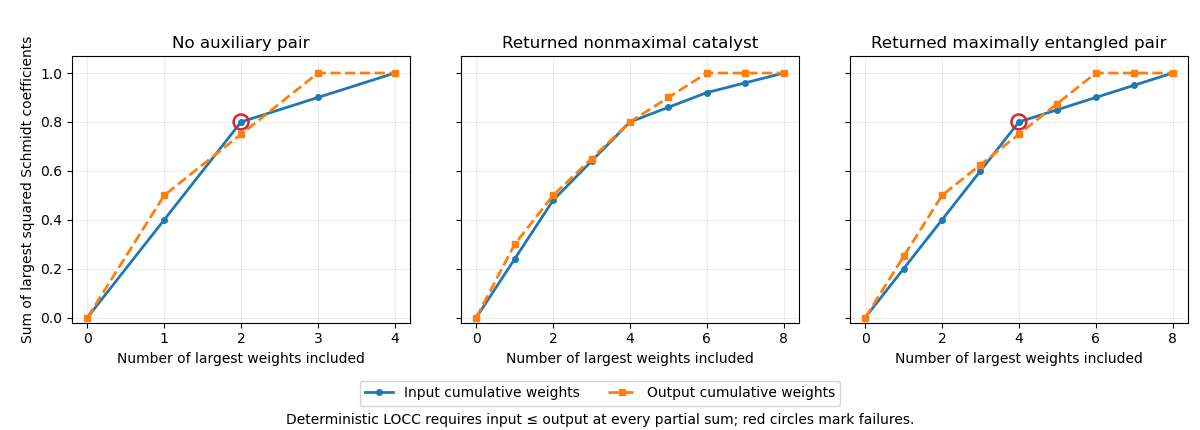
The catalyst repairs every failed majorization inequality, while a maximally entangled pair does not
. Details. The input size of an integer factorization problem is its number of bits . Trial division up to is exponential in ; advanced classical algorithms do substantially better, but no general polynomial-time classical factoring algorithm is known. The heuristic general-purpose general number field sieve has subexponential rather than polynomial scaling, roughly . This describes known algorithmic performance, not a proof that efficient classical factoring is impossible or that every large integer is difficult.
Choose with . A nontrivial greatest common divisor already supplies a factor; otherwise find the multiplicative order of modulo . If is even and , thenMinimality of the order also excludes , so factor extraction from an even modular order gives nontrivial factors through . Unhelpful choices of or odd orders require another trial. For , has successive residues and order four, givingComputing the powers is easy by repeated squaring; discovering a large order is the step accelerated by Shor's algorithm.[ref]
Polynomial-Time Algorithms for Prime Factorization and Discrete Logarithms on a Quantum Computer by Peter W. Shor. Quantum reduction to order finding and classical factor extraction
Put and suppose . For each residue class , letThese are normalized uniform superpositions of the arguments with the same modular-exponentiation value. Their amplitudes repeat at separation within the finite register window. Exact cyclic periodicity requires . The correctly normalized entangled register state isThe equal prefactor in the displayed algorithm is exact when , for then every . It is not generally exact for an arbitrary unknown order. A physical implementation uses quantum modular exponentiation as a reversible map; its specified action on second-register input zero is extended to a unitary operator on the whole register space.
For the illustrative , and , the four first-register states areApplying the positive-sign quantum Fourier transform to the general state givesThe bracket is a finite geometric Fourier amplitude. If , it vanishes unless for , when it equals . HenceThe second-register states are orthogonal, so their different phases do not change the marginal first-register probabilities. Measurement givesIn the example the possible outcomes are . A nonzero observed ratio estimates , not a prime factor directly. Reducing it gives denominator ; repeating avoids uninformative outcomes or recovers missing order factors. For example, or gives denominator four, whereas alone gives only two.
When , the Fourier probabilities have narrow peaks near instead of support only on an exact reciprocal grid. The general marginal distribution isChoosing supplies the usual precision for continued-fraction recovery in quantum order finding: a nearest grid sample differs from the target rational by at most . Candidate denominators and extracted divisors are checked classically, and repetitions provide useful samples. The small example works exactly because its order divides the register size; it is not a general precision guarantee for factoring every four-bit integer.
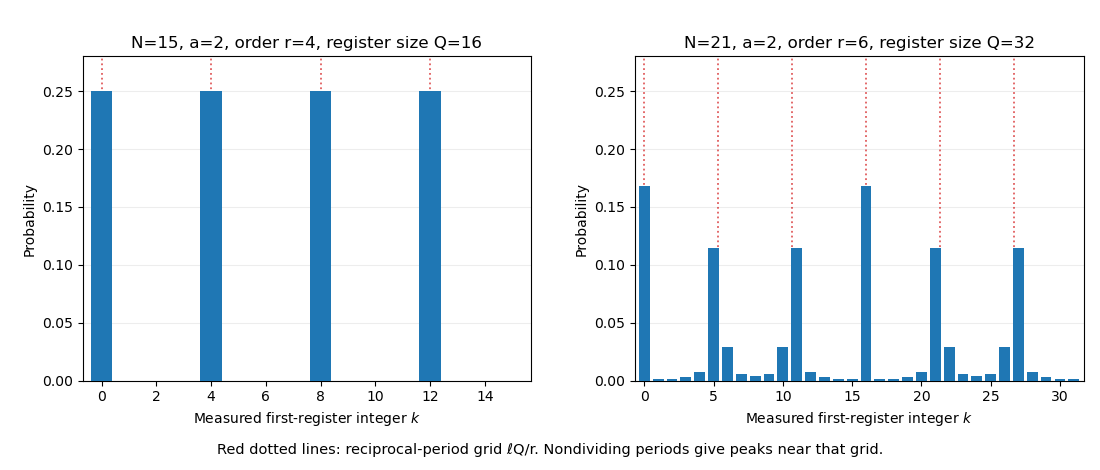
Exact reciprocal-period sampling for order four and broadened peaks when the order does not divide the register
. Details. A sufficiently large reliable quantum computer would undermine RSA by efficient factorization. The related discrete-logarithm algorithm also threatens Diffie-Hellman key exchange and elliptic-curve public-key schemes. This does not imply that every communication scheme or symmetric cipher is broken by the same algorithm; post-quantum cryptography studies alternatives based on other problems. The mathematical speedup assumes a scalable quantum computation with enough precision and error control, not merely a small demonstration of factoring fifteen.
Consistent histories assigns probabilities to suitably compatible sequences of quantum alternatives without making an external measuring apparatus fundamental. At successive times choose complete orthogonal sets of projection operators. In the Heisenberg picture, a history has class operator . For an initial density operator , its decoherence functional isA common sufficient consistency condition is for . Then is nonnegative and coarse-grained alternatives have additive probabilities: the interference cross-terms vanish. The weaker requirement on real cross-terms can suffice for individual probability sum rules. Predictions must stay within one compatible framework; mutually incompatible history families cannot simply be combined into one classical account.
The many-worlds interpretation instead treats unitary quantum evolution as universally valid and interprets the correlated outcome branches as components of one global state. A measurement interaction givesWhen the environment records become nearly orthogonal, quantum decoherence suppresses observable interference between stable apparatus records. Each relative state contains an observer correlated with a definite record; no additional physical collapse is postulated. Branch structure is an emergent approximation, rather than a unique literal splitting at every arbitrary choice of basis.
Both approaches use the ordinary unitary formalism and decoherence, but their interpretations of histories and branches differ. Decoherence alone does not prove that one unique branch is selected, nor does the unitary equation by itself settle every assumption needed to justify Born rule probabilities. Neither interpretation predicts ordinary interference experiments incorrectly merely by interpreting the same state differently.
In quantum teleportation, Alice transfers an arbitrary unknown qubit using one shared Bell pair and two bits of classical communication. Define , with . Regrouping the initial three-qubit state into this Bell basis givesAlice's Bell-basis measurement selects each label with probability . She sends to Bob, who applies the inverse , restoring . The correction depends on the measurement label, not on the unknown amplitudes. Before the message, Bob's average state is , independent of the input; quantum no-signalling therefore prevents superluminal communication. The shared pair is consumed and Alice does not retain an independent copy, in agreement with the no-cloning theorem.
The Bouwmeester quantum teleportation experiment used photon polarization, a down-conversion entangled pair, a beam-splitter Bell-state analyzer and coincidence-conditioned output polarization measurements. Temporal indistinguishability of the two analyzer photons was essential. Its successful selected Bell outcome demonstrated the state transfer, rather than a deterministic implementation of all four outcomes.[ref]
Experimental quantum teleportation by Dik Bouwmeester and others. 1997, experimental realization and Figures 1–5
The general experimental tasks are to distribute entanglement, prepare and synchronize the input, perform a sufficiently discriminating joint measurement, communicate the label and apply or account for the correction. A demonstration must test nonorthogonal input states, not merely transfer a known classical basis label. Finite efficiency, accidental coincidences, distinguishability and phase drift reduce success probability or teleportation fidelity. Postselected verification, a heralded usable output and unconditional deterministic teleportation are distinct experimental claims.
Schrödinger's cat exposes the quantum measurement problem by correlating a microscopic alternative with macroscopically distinct records. Under unitary evolution a schematic state becomesThe difficulty is explaining why a definite macroscopic outcome is observed if the isolated total state is always governed by the linear Schrödinger equation. It is not a claim that one classically contradictory record has literally been observed. Environmental interactions rapidly entangle the records with different environment states, making their reduced density matrix approximately diagonal. That explains the practical loss of interference but does not, by itself, turn a global pure superposition into a selected single branch.
Wigner's friend places an observer's physical memory inside the quantum description. A friend measuring can become correlated asConditioned on one friend record, the corresponding relative state contains a definite outcome. An external observer applying unitary theory to the perfectly isolated entire laboratory instead assigns the entangled vector . In principle, a coherent joint measurement could distinguish it from the collapsed mixturewhereas projecting the pure state onto succeeds with probability one. Preserving that laboratory coherence, including all records and environment correlations, is an extreme idealization for macroscopic observers.
The paradox concerns how state assignment, definite records and universal unitary dynamics fit together. It does not show that an observer can send messages faster than light or that consciousness must be given a special dynamical role. The many-worlds interpretation retains the global unitary state with branch-relative records; interpretations with a physical collapse must specify when and how unitary evolution changes. Stating the chosen assumptions prevents the friend's conditional state and the external observer's unconditioned state from being treated as the same mathematical object.
Original public paper: Physical PDF pages 586–588. All four interferometer configurations, the search derivation and all three optional notes are covered.
Outcome determinism means that a complete hidden state , together with the chosen measurement settings, fixes each outcome. The observed probabilities can still arise from an ensemble of unknown . This differs from deterministic unitary evolution of a wavefunction, which does not by itself specify a unique measurement outcome. Quantum nonlocality means failure of a Bell-local account of the correlations, under assumptions including measurement independence; it is stronger than the existence of entanglement and does not imply controllable faster-than-light signaling.
Use the first ket for the Positron and the second for the electron. Before either final beam splitter, the first pair of splitters and annihilation produceThe photon state is orthogonal to the surviving charged-particle sector. Its probability is , while the remaining sector has squared norm . The states below retain that photon amplitude and are normalized over all trials, without conditioning on nonannihilation. For compactness write , and similarly for .
With both final splitters removed, the path labels map directly into detector labels:In particular , because joint occupation of the two intersecting arms has already annihilated. Each of the other three charged-particle coincidences has unconditional probability .
Apply the final splitter only to the first ket. The amplitudes from and cancel, givingThus detection at occurs only in the coincidence , with probability . The other two nonzero coincidence probabilities are and . The cancellation is quantum interference between indistinguishable surviving alternatives.
Interchanging the two wings givesNow detection at occurs only together with , with probability . The remaining nonzero coincidence probabilities are and .
Applying both final splitters givesThe charged-particle coincidence probabilities are in the displayed order, and the annihilation probability remains . In particularConditioning on surviving pairs would change this number to ; it would not change the amplitudes of the unconditioned all-trials state above.
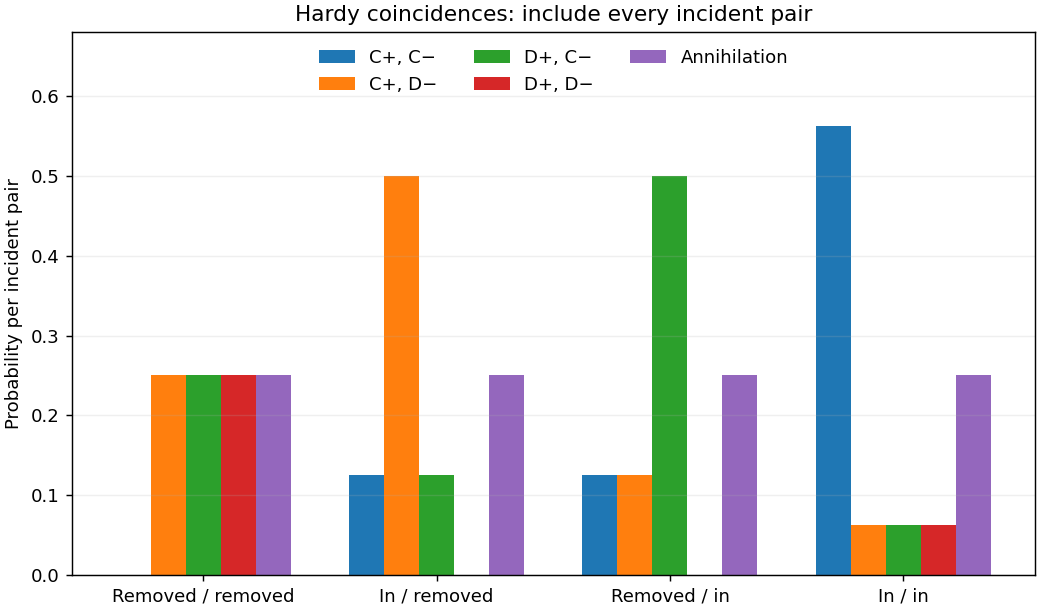
In a deterministic local hidden-variable model, write or without an argument for the remote splitter setting. That omission is the parameter independence assumption: the local response for a fixed complete hidden state does not change when the other wing changes its apparatus. Measurement independence also requires the hidden-state ensemble to be independent of the freely selected settings, allowing the same assignments to be compared across configurations.
The zero probabilities derived above then constrain those assignments, apart from sets of hidden states of zero measure:
- Case requires .
- Case requires .
- Case requires .
For a trial with , the last two implications force , contradicting the first condition. Thus these deterministic local assignments predict zero probability for the double- event, whereas quantum theory predicts . This is Hardy's paradox, an inequality-free ideal contradiction. With imperfect apparatus the zero-event conditions become small nonzero rates and require a statistical inequality rather than declaring a contradiction from one imperfect detection.[ref]
Quantum mechanics, local realistic theories, and Lorentz-invariant realistic theories by Lucien Hardy. 1992 abstract: a two-particle proof of Bell's theorem without inequalities
The logical contradiction combines counterfactual hidden-variable assignments; it does not assign simultaneously observed path properties to a quantum state. Nor does it allow a message to be sent by changing a distant splitter: the observable local marginal obeys quantum no-signalling. For example, fixing the plus-side splitter to gives for either minus-side setting in the results above.
Set , and , with . The ordered vectors are normalized but nonorthogonal, since . Their coordinate Gram matrix is thereforeAn operator matrix in this basis is obtained from the coefficients in the images of its basis vectors, not by treating those vectors as orthogonal measurement outcomes. Directly applying the two reflection operators givesTheir columns are consequentlyThese are physical unitary operators even though the coordinate matrices are not unitary in the ordinary Euclidean coordinate norm: they preserve , so .
The Grover iteration in a nonorthogonal basis isIt has determinant one and trace , hence eigenvalues . For example, the invertible matrix of eigenvectorssatisfiesThis diagonalization is exact for ; no large- approximation is needed.
To extract an actual probability using the Born rule, introduce the orthonormal unmarked superposition . In the ordered basis , the same iteration is the rotationAfter iterations,Equivalently the original coordinates are . The overlap with is the first coordinate plus times the second, recovering the same amplitude. Squaring just the first coordinate would be incorrect in a nonorthogonal basis.
For large , , and dropping the initial angle gives the requested approximation . The first near-unit success occurs at the integer closest to :One can choose , with either neighbor equivalent in a tie. Further iterations overshoot and reduce success rather than monotonically improving it. The special problem needs no search and the two-vector coordinate construction becomes singular.
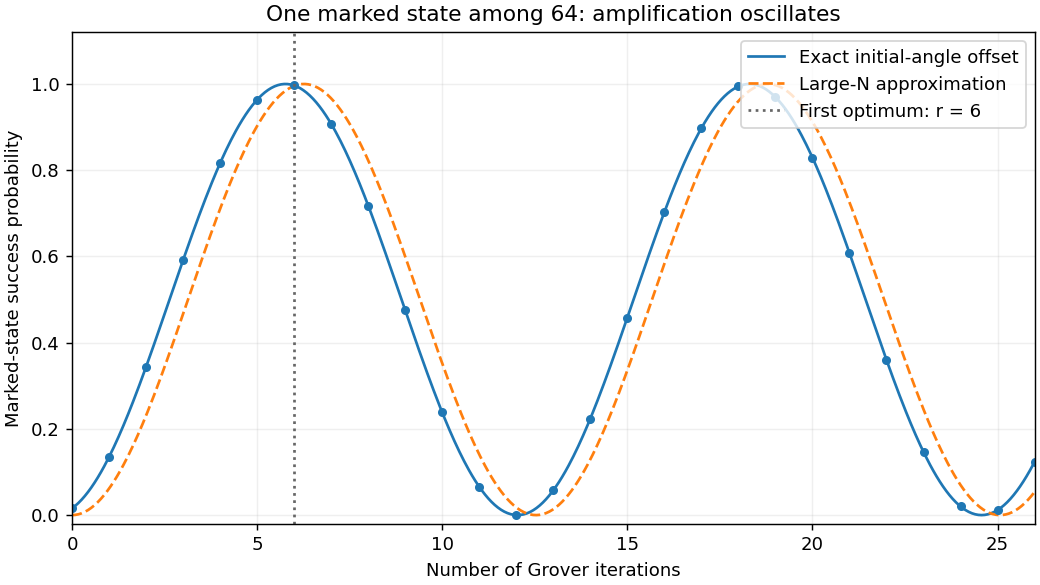


For an unstructured search, a reversible Boolean quantum oracle implements a phase change on the marked entry, while the diffusion reflection about a uniform state is known. Repeating the pair of reflections amplifies the marked amplitude and measurement yields a candidate that can be checked by another oracle query. The bounded-error query count is for one marked item, compared with classical queries. It is a quadratic oracle-query speedup: state preparation, the cost of implementing the oracle and access to a classical database still matter. The method does not reveal an unknown marked value without the promised query access.[ref]
A fast quantum mechanical algorithm for database search by Lov Grover. 1996 abstract and search construction
Quantum complementarity concerns experimental arrangements or observables that cannot be combined into one sharp classical description. For a qubit, the Pauli operators and have incompatible eigenbases: a definite value gives equal probabilities for the two outcomes. One can measure either observable sharply on a given preparation, but a joint measurement cannot reproduce both sharp projective measurements on every state. Complementarity is not merely ignorance of two simultaneously definite quantum properties.
In a balanced two-path interferometer, which-path information reduces the interference available when the paths recombine. If the path becomes entangled with detector states,the path reduced density matrix has off-diagonal magnitude . Its interference visibility is . For equally likely pure marker states, optimal path distinguishability is , giving in this ideal model. Identical marker states preserve full interference; orthogonal ones permit perfect path discrimination and erase the unconditional fringes.
A concrete optical realization puts different polarizations on the two arms of a Mach-Zehnder interferometer. A detector that ignores polarization sees reduced interference because polarization records the path. Projecting the outgoing light onto a common polarization erases that information in the selected subensemble and can recover conditional fringes; summing all outcomes again removes them. This is a physical change in which alternatives remain distinguishable, not a retrospective alteration of earlier detections.
Quantum decoherence arises when different system alternatives correlate with distinguishable environmental states. For an initially uncorrelated state, a measurement-like unitary time evolution can produceTaking the environmental partial trace givesThe environmental overlap suppresses locally observable quantum coherence. Scattered photons, surrounding gas and uncontrolled apparatus variables can carry away such records. The interaction often singles out robust states forming a pointer basis. Decoherence can be much faster than thermal energy relaxation because recording a macroscopic distinction need not transfer much energy.
The overall state can remain pure and evolve unitarily even when the system alone looks like a classical mixture. Discarding environmental information is therefore not, by itself, a proof of fundamental wavefunction collapse or a solution to the definite-outcome measurement problem. A small controlled environment can return coherence, as in the single-qubit environment dephasing model; practical irreversibility arises when recovering the many dispersed records becomes inaccessible. In an interferometer, varying gas pressure or an independently controllable path marker tests the dependence of fringe contrast on this environmental coupling. Quantum computation must suppress or correct such unwanted system–environment entanglement to preserve the intended interference.
Quantum cryptography includes quantum key distribution, which uses quantum transmissions and authenticated public discussion to establish a secret random key. In BB84, the sender independently chooses a random bit and either the computational or Hadamard basis, sending one of . A receiver independently chooses one of those two bases. They announce bases after receipt, retain matching-basis positions and reveal a random sample of those bits to estimate noise or eavesdropping. Ideal uniform independent basis choices retain about half of the detected signals before testing and further processing.[ref]
Quantum cryptography: Public key distribution and coin tossing by Charles H. Bennett and Gilles Brassard. 1984 key-distribution protocol; original proceedings pp. 175–179
The no-cloning theorem prevents an adversary from copying arbitrary unknown nonorthogonal signal states perfectly. In a simple intercept–resend attack, the adversary chooses a random protocol basis. On half of the sifted positions it is the wrong basis, and the resent state then yields an erroneous receiver bit with probability one half. Thus the BB84 intercept-resend error rate isif every signal is intercepted, or when an independently selected fraction is attacked this way. This is an illustrative attack calculation, not a security proof against all possible quantum attacks.
After parameter estimation, classical error reconciliation aligns the remaining keys; privacy amplification compresses them to remove the adversary's bounded information, including information leaked during public reconciliation. The classical channel requires message authentication, otherwise an attacker could impersonate each party to the other. Real sources, losses, multiphoton pulses and detector behavior must fit the security model. A low observed error rate alone is insufficient to certify arbitrary hardware. Finally the protocol distributes a key; encrypting a later message is a separate step.
Use the computational basis in the stated order and let the rightmost operation act first. The controlled phase gate is . From the rotation definition,The control-zero block remains the identity, and the control-one block becomes . ThusThis proves the relation for arbitrary superpositions, rather than only for computational-basis probabilities.
For the second relation write . Its central block is , with , . Because , and , direct multiplication givesMeanwhile . Multiplying these diagonal matrices and the overall factor givesThe supplied is indeed a square root of the SWAP gate: exchanges and while fixing the other basis states. It acts as one on the triplet subspace and as on the singlet subspace.
For an isotropic exchange interaction with Hamiltonian , define . Triplet and singlet energies differ by , soAn exchange pulse with therefore implements . Two such pulses, interspersed with the specified local rotations, implement the controlled phase gate; the initial and final target rotations then turn it into a CNOT gate. Their common overall phase has no effect on an isolated gate's outcome probabilities; a subsequently controlled version must keep track of conditional phases.
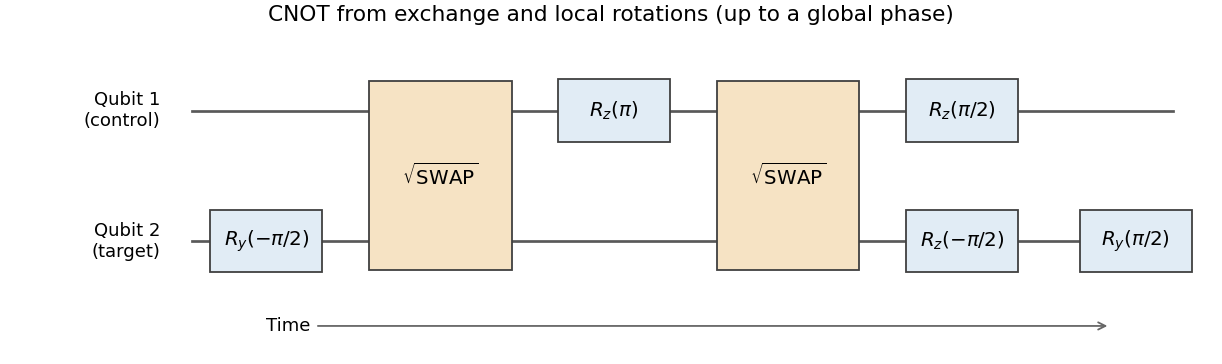
CNOT synthesis from two square-root-of-SWAP exchange pulses and local rotations, with time running left to right
. Details. 
The construction converts a physically available two-spin interaction into a standard entangling gate, which together with arbitrary one-qubit rotations supplies universal quantum computation. Practical operation needs calibrated exchange pulse area and timing, individually controllable rotations, and reproducible phase references. Charge noise can change ; magnetic-field gradients add unwanted single-spin evolution, and anisotropic exchange modifies the assumed Hamiltonian. Pulses must suppress leakage into unwanted orbital states while finishing before excessive decoherence. Readout, preparation, cross-talk and the extra operations in this decomposition all affect the achieved quantum gate fidelity. The algebraic identity alone does not establish a fault-tolerant quantum computation implementation.
Include Alice's detector and environment before taking a partial trace. Ideal measurement produces the global stateOrthogonality of the two record states removes their cross terms from the reduced state of the particles:This nonselective quantum measurement has changed the initially entangled singlet into a separable, classically anticorrelated reduced state. Its entropy is one bit, although the full particles-plus-records state is still pure under the assumed unitary dynamics. The reduced density matrix is an improper mixture; tracing the environment does not by itself assert a literal collapse of that global state.
The Born rule gives Alice outcomes zero and one with equal probability. Conditional on a recorded result, the selective quantum measurement assigns or to the particles. The unitary measurement coupling and orthogonal records explain decoherence in this basis; they do not supply an additional rule selecting a unique outcome. That is part of the measurement problem. In a collapse postulate the individual outcome is stochastic; other interpretations account for outcome experience differently while retaining these operational probabilities.
When Bob makes the same kind of measurement, the global state becomesTracing both laboratories gives the same reduced matrix, . Bob has added a correlated record, not restored the lost reduced coherence. If Alice's outcome is known, Bob's opposite outcome is certain in this ideal common basis. Without that record, his marginal is , so his outcome remains equiprobable. Alice cannot choose her random result or use this correlation for faster-than-light signalling, consistently with quantum no-signalling.
These common-basis measurements alone do not distinguish quantum predictions from a local source sending opposite preassigned bits. To test that explanation, prepare fresh singlets and let the observers independently choose among incompatible measurement axes before recording each result. For singlet spin measurements along unit vectors , quantum mechanics predicts . The CHSH inequality bounds for Bell-local models with measurement-independent settings. Choosinggives . A suitable Bell test constrains that class of explanations. Independently chosen settings, control of detection bias and separation of the measurement events matter when interpreting an actual experiment.
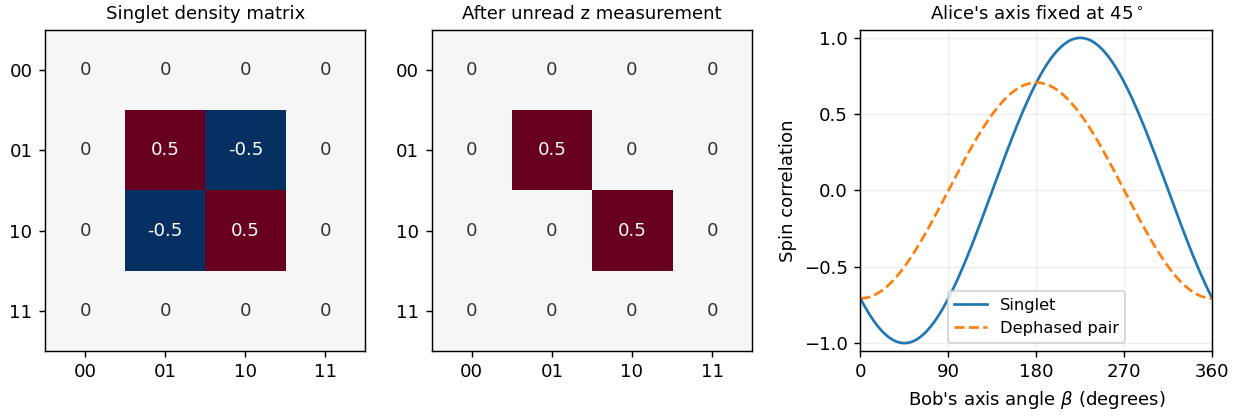
Singlet coherence is lost from the reduced density matrix after a local unread measurement; common-axis anticorrelation survives
. Details. 
If Alice first performs the fixed-axis irreversible measurement described above, the resulting mixed state has and cannot supply that singlet violation. The incompatible settings must belong to the Bell measurement itself. Moreover, Bell violations do not choose among all interpretations of quantum mechanics: interpretations sharing the Born predictions remain observationally equivalent for this experiment. Objective-collapse modifications could instead require additional interference tests with specified departures from unitary dynamics.
A positive operator-valued measure consists of positive semidefinite effects with . Its outcome probabilities are , which are nonnegative and sum to one. Unlike a projective measurement, its effects need not be mutually orthogonal projections, and there can be more outcomes than the system's Hilbert-space dimension.
For example, choose three equatorial Bloch vectors separated by and set . Each effect has eigenvalues zero and , and the vectors sum to zero, so the three effects sum to . This trine qubit POVM gives for input Bloch vector . It cannot be a three-outcome orthogonal projective measurement on that qubit.
A physical implementation can couple the system to an ancilla and projectively measure the enlarged system. More generally, operators implement an outcome with ; the normalized conditional state is . Thus a POVM does not determine the post-measurement state: different measurement instruments can have the same outcome probabilities and different disturbance. Generalized measurements are useful for state discrimination and realistic detection, including explicitly modeled inconclusive outcomes.
Quantum cryptography includes quantum key distribution, which establishes a shared secret key rather than transmitting an arbitrary plaintext directly. In BB84, Alice randomly prepares one of the two computational-basis or two complementary-basis qubit states; Bob randomly measures in either basis. They announce bases over an authenticated classical channel and retain the positions where their choices agree, about half in the ideal unbiased case. They test a subset for errors, reconcile the remaining strings, and apply privacy amplification to remove a bounded eavesdropper's information. A protocol can abort when the observed data do not support a secret key.[ref]
Quantum cryptography: Public key distribution and coin tossing by Charles H. Bennett and Gilles Brassard. 1984 protocol; authors' later upload of the original proceedings contribution
Nonorthogonal states cannot be perfectly copied by a state-independent device, by the no-cloning theorem. An intercept-resend attacker who measures each signal in a random BB84 basis chooses the wrong basis half the time. On those sifted positions Bob has a one-half error probability, giving the ideal BB84 intercept-resend error rate . This simple calculation demonstrates detectable disturbance for that attack; it is not a complete security proof for arbitrary attacks.
Authentication is essential: otherwise an adversary can impersonate both participants. Error correction reveals information that must be included in the privacy budget, and losses, finite sample sizes, multiphoton emission and detector behavior belong in the security model. Entanglement-based variants can use Bell correlations, but observing some entanglement or a Bell violation alone does not replace a quantitatively specified key-distillation protocol. The final key can subsequently be used in a suitable classical encryption scheme.
For quantum teleportation, Alice holds an unknown input and one member of a shared pair; Bob holds qubit 3. Alice applies a CNOT gate from 1 to 2 and a Hadamard gate on 1, then measures both in the computational basis. Expansion gives the Bell-basis teleportation identityEvery outcome pair has probability , independently of the input. Alice sends these two classical bits, and Bob appliesThe order of the two corrections matters only by a global sign for the doubly nonzero outcome. The transformation also transfers entanglement with an untouched reference, because the identity is linear in the input amplitudes.
Before receiving the bits, Bob must average over all four Pauli-related states, obtaining for any input. Thus teleportation requires classical communication and does not send information faster than light. The original input is consumed by Alice's measurement, so no second copy remains and the no-cloning theorem is respected. Ideal qubit teleportation consumes one shared Bell pair and two classical bits, as well as local gates and measurements. Imperfect entanglement, gate error, detection error or lost classical records reduce practical fidelity; teleportation transfers the quantum state, not the underlying material particle.
Articles by others on the same topic
There are currently no matching articles.