Original public paper: Physical PDF pages 586–588. All four interferometer configurations, the search derivation and all three optional notes are covered.
Outcome determinism means that a complete hidden state , together with the chosen measurement settings, fixes each outcome. The observed probabilities can still arise from an ensemble of unknown . This differs from deterministic unitary evolution of a wavefunction, which does not by itself specify a unique measurement outcome. Quantum nonlocality means failure of a Bell-local account of the correlations, under assumptions including measurement independence; it is stronger than the existence of entanglement and does not imply controllable faster-than-light signaling.
Use the first ket for the Positron and the second for the electron. Before either final beam splitter, the first pair of splitters and annihilation produceThe photon state is orthogonal to the surviving charged-particle sector. Its probability is , while the remaining sector has squared norm . The states below retain that photon amplitude and are normalized over all trials, without conditioning on nonannihilation. For compactness write , and similarly for .
With both final splitters removed, the path labels map directly into detector labels:In particular , because joint occupation of the two intersecting arms has already annihilated. Each of the other three charged-particle coincidences has unconditional probability .
Apply the final splitter only to the first ket. The amplitudes from and cancel, givingThus detection at occurs only in the coincidence , with probability . The other two nonzero coincidence probabilities are and . The cancellation is quantum interference between indistinguishable surviving alternatives.
Interchanging the two wings givesNow detection at occurs only together with , with probability . The remaining nonzero coincidence probabilities are and .
Applying both final splitters givesThe charged-particle coincidence probabilities are in the displayed order, and the annihilation probability remains . In particularConditioning on surviving pairs would change this number to ; it would not change the amplitudes of the unconditioned all-trials state above.
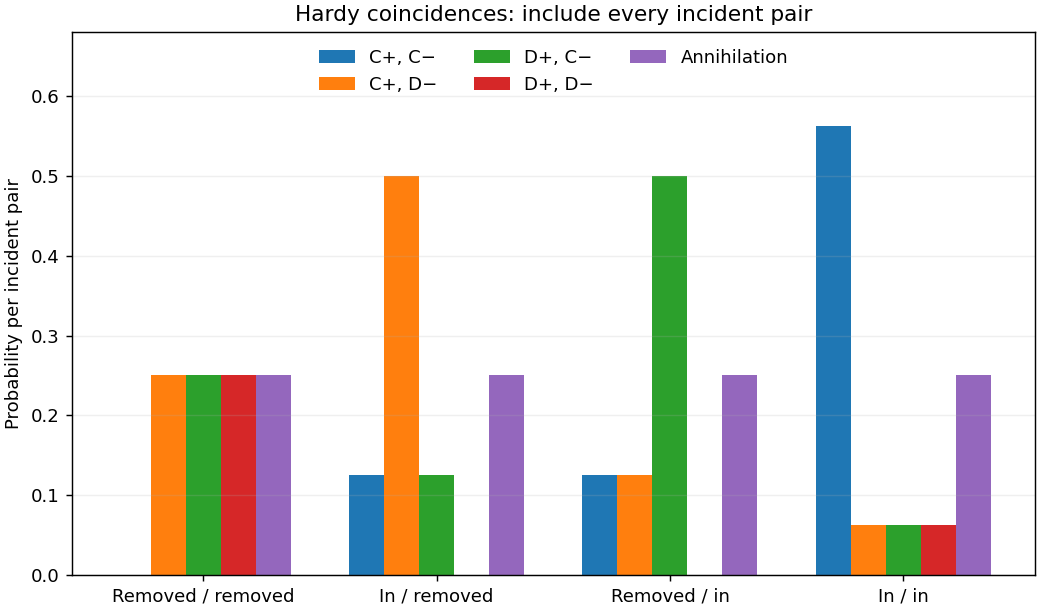
In a deterministic local hidden-variable model, write or without an argument for the remote splitter setting. That omission is the parameter independence assumption: the local response for a fixed complete hidden state does not change when the other wing changes its apparatus. Measurement independence also requires the hidden-state ensemble to be independent of the freely selected settings, allowing the same assignments to be compared across configurations.
The zero probabilities derived above then constrain those assignments, apart from sets of hidden states of zero measure:
- Case requires .
- Case requires .
- Case requires .
For a trial with , the last two implications force , contradicting the first condition. Thus these deterministic local assignments predict zero probability for the double- event, whereas quantum theory predicts . This is Hardy's paradox, an inequality-free ideal contradiction. With imperfect apparatus the zero-event conditions become small nonzero rates and require a statistical inequality rather than declaring a contradiction from one imperfect detection.[ref]
Quantum mechanics, local realistic theories, and Lorentz-invariant realistic theories by Lucien Hardy. 1992 abstract: a two-particle proof of Bell's theorem without inequalities
The logical contradiction combines counterfactual hidden-variable assignments; it does not assign simultaneously observed path properties to a quantum state. Nor does it allow a message to be sent by changing a distant splitter: the observable local marginal obeys quantum no-signalling. For example, fixing the plus-side splitter to gives for either minus-side setting in the results above.
Set , and , with . The ordered vectors are normalized but nonorthogonal, since . Their coordinate Gram matrix is thereforeAn operator matrix in this basis is obtained from the coefficients in the images of its basis vectors, not by treating those vectors as orthogonal measurement outcomes. Directly applying the two reflection operators givesTheir columns are consequentlyThese are physical unitary operators even though the coordinate matrices are not unitary in the ordinary Euclidean coordinate norm: they preserve , so .
The Grover iteration in a nonorthogonal basis isIt has determinant one and trace , hence eigenvalues . For example, the invertible matrix of eigenvectorssatisfiesThis diagonalization is exact for ; no large- approximation is needed.
To extract an actual probability using the Born rule, introduce the orthonormal unmarked superposition . In the ordered basis , the same iteration is the rotationAfter iterations,Equivalently the original coordinates are . The overlap with is the first coordinate plus times the second, recovering the same amplitude. Squaring just the first coordinate would be incorrect in a nonorthogonal basis.
For large , , and dropping the initial angle gives the requested approximation . The first near-unit success occurs at the integer closest to :One can choose , with either neighbor equivalent in a tie. Further iterations overshoot and reduce success rather than monotonically improving it. The special problem needs no search and the two-vector coordinate construction becomes singular.
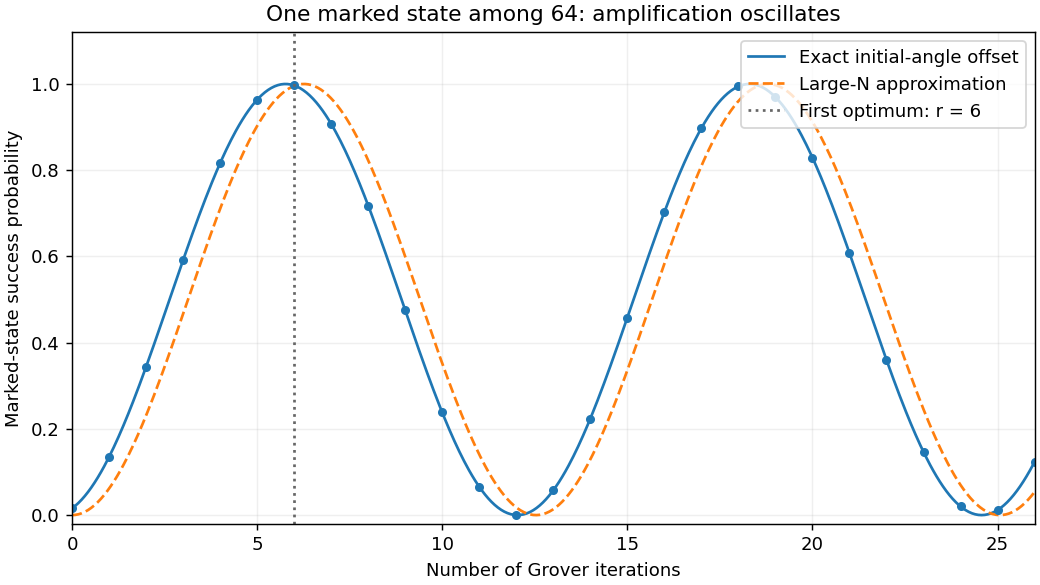


For an unstructured search, a reversible Boolean quantum oracle implements a phase change on the marked entry, while the diffusion reflection about a uniform state is known. Repeating the pair of reflections amplifies the marked amplitude and measurement yields a candidate that can be checked by another oracle query. The bounded-error query count is for one marked item, compared with classical queries. It is a quadratic oracle-query speedup: state preparation, the cost of implementing the oracle and access to a classical database still matter. The method does not reveal an unknown marked value without the promised query access.[ref]
A fast quantum mechanical algorithm for database search by Lov Grover. 1996 abstract and search construction
Quantum complementarity concerns experimental arrangements or observables that cannot be combined into one sharp classical description. For a qubit, the Pauli operators and have incompatible eigenbases: a definite value gives equal probabilities for the two outcomes. One can measure either observable sharply on a given preparation, but a joint measurement cannot reproduce both sharp projective measurements on every state. Complementarity is not merely ignorance of two simultaneously definite quantum properties.
In a balanced two-path interferometer, which-path information reduces the interference available when the paths recombine. If the path becomes entangled with detector states,the path reduced density matrix has off-diagonal magnitude . Its interference visibility is . For equally likely pure marker states, optimal path distinguishability is , giving in this ideal model. Identical marker states preserve full interference; orthogonal ones permit perfect path discrimination and erase the unconditional fringes.
A concrete optical realization puts different polarizations on the two arms of a Mach-Zehnder interferometer. A detector that ignores polarization sees reduced interference because polarization records the path. Projecting the outgoing light onto a common polarization erases that information in the selected subensemble and can recover conditional fringes; summing all outcomes again removes them. This is a physical change in which alternatives remain distinguishable, not a retrospective alteration of earlier detections.
Quantum decoherence arises when different system alternatives correlate with distinguishable environmental states. For an initially uncorrelated state, a measurement-like unitary time evolution can produceTaking the environmental partial trace givesThe environmental overlap suppresses locally observable quantum coherence. Scattered photons, surrounding gas and uncontrolled apparatus variables can carry away such records. The interaction often singles out robust states forming a pointer basis. Decoherence can be much faster than thermal energy relaxation because recording a macroscopic distinction need not transfer much energy.
The overall state can remain pure and evolve unitarily even when the system alone looks like a classical mixture. Discarding environmental information is therefore not, by itself, a proof of fundamental wavefunction collapse or a solution to the definite-outcome measurement problem. A small controlled environment can return coherence, as in the single-qubit environment dephasing model; practical irreversibility arises when recovering the many dispersed records becomes inaccessible. In an interferometer, varying gas pressure or an independently controllable path marker tests the dependence of fringe contrast on this environmental coupling. Quantum computation must suppress or correct such unwanted system–environment entanglement to preserve the intended interference.
Quantum cryptography includes quantum key distribution, which uses quantum transmissions and authenticated public discussion to establish a secret random key. In BB84, the sender independently chooses a random bit and either the computational or Hadamard basis, sending one of . A receiver independently chooses one of those two bases. They announce bases after receipt, retain matching-basis positions and reveal a random sample of those bits to estimate noise or eavesdropping. Ideal uniform independent basis choices retain about half of the detected signals before testing and further processing.[ref]
Quantum cryptography: Public key distribution and coin tossing by Charles H. Bennett and Gilles Brassard. 1984 key-distribution protocol; original proceedings pp. 175–179
The no-cloning theorem prevents an adversary from copying arbitrary unknown nonorthogonal signal states perfectly. In a simple intercept–resend attack, the adversary chooses a random protocol basis. On half of the sifted positions it is the wrong basis, and the resent state then yields an erroneous receiver bit with probability one half. Thus the BB84 intercept-resend error rate isif every signal is intercepted, or when an independently selected fraction is attacked this way. This is an illustrative attack calculation, not a security proof against all possible quantum attacks.
After parameter estimation, classical error reconciliation aligns the remaining keys; privacy amplification compresses them to remove the adversary's bounded information, including information leaked during public reconciliation. The classical channel requires message authentication, otherwise an attacker could impersonate each party to the other. Real sources, losses, multiphoton pulses and detector behavior must fit the security model. A low observed error rate alone is insufficient to certify arbitrary hardware. Finally the protocol distributes a key; encrypting a later message is a separate step.
Articles by others on the same topic
There are currently no matching articles.