The spin singlet state has zero local means and outcomes , so both variances are one. Its Pearson correlation coefficient is therefore . Summing over the four joint outcomes givesThe equal-sign products contribute and the opposite-sign products contribute . In a finite sample the corresponding relative frequencies estimate these probabilities; the formula is not an assertion that a finite random sample has exactly zero empirical means.
A spin measurement along unit vector has outcome projector , with . The spin singlet state obeys and . Applying the Born rule,Thus and . Substitution into part (a) givesEqual axes give perfect anticorrelation, while orthogonal axes give zero correlation. Each local marginal remains uniform.
The four required dot products areConsequently the specified CHSH inequality combination isThe magnitude reaches the quantum Tsirelson bound and exceeds the local bound two. The negative sign follows this singlet and the stated order of terms; other conventions can reverse it.
Let Eve obtain . Applying part (b) to her axes gives . Conditional on these rank-one local measurements, the forwarded particles are a product state with individual spin directions and . HenceConditional independence gives the product of these means. Averaging over Eve's outcomes,The sum is , soEve has turned the entangled source into an ensemble of product states by an intercept-resend attack. Ignoring her records does not restore the original singlet coherence.
Write and . Since and , the CHSH inequality combination becomesThereforeParallel or antiparallel Eve axes attain the lower endpoint; orthogonal axes attain zero. This bound is specific to the two-sided projective attack and these planar settings. It is stronger than the generic local bound and should not be attributed to every possible eavesdropping strategy.
If Eve varies her axes independently of the users' still-secret random settings, the measured correlations average over her choices. The same linear combination obeys and remains in the interval by convexity. Strategies correlated with disclosed measurement settings would violate that independence premise; the protocol must protect it.
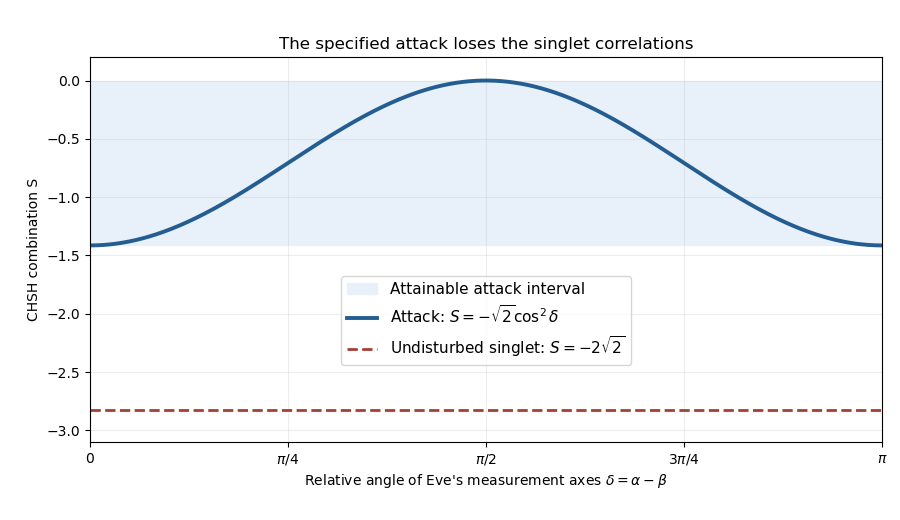
The planar two-sided intercept-resend attack cannot reproduce the singlet CHSH value
. Original analytic curve as Eve changes the relative angle of her measurement axes. The dashed line is the undisturbed singlet result, outside the attack's attainable interval. Details.
This is an entanglement-based quantum key distribution scheme of the type proposed by Artur K. Ekert.[ref]
Quantum cryptography based on Bell's theorem by Artur K. Ekert. 1991 primary proposal: Bell correlations used to test a key-distribution channel
The measurements generate correlated random data; Alice does not choose a message by choosing their random outcomes.After the measurements, Alice and Bob announce their basis choices over an authenticated public channel. They retain the pairs with equal axes, here and , and Bob flips his outcome signs to match Alice's bits. They sacrifice a random subset for error estimation and use the appropriate other setting combinations to estimate . In the ideal source the same-axis bits match after the flip and ; the specified intercept-resend attack cannot reproduce that value.
A practical protocol includes information reconciliation, an accounting of information leaked publicly, and privacy amplification. It must abort when its statistical security conditions fail. Authentication is essential: a completely unauthenticated public channel permits a man-in-the-middle attack. A Bell-violation observation alone, without sampling, device and adversary assumptions and a finite-key analysis, is not a proof that Eve knows no key bits.
With a sufficiently uniform secret shared key of the required length, Alice can send publicly using a one-time pad; Bob recovers . The pad must be secret, as long as the protected message, and never reused. A complete security proof makes the probability or distinguishing advantage of failure small under stated assumptions. The ideal exam correlations diagnose the stated attack; they do not provide an unconditional guarantee against every attack or implementation fault.
Articles by others on the same topic
There are currently no matching articles.